
Sep 15, 2026
Autism and sensory overload: Two new research projects are investigating the causes
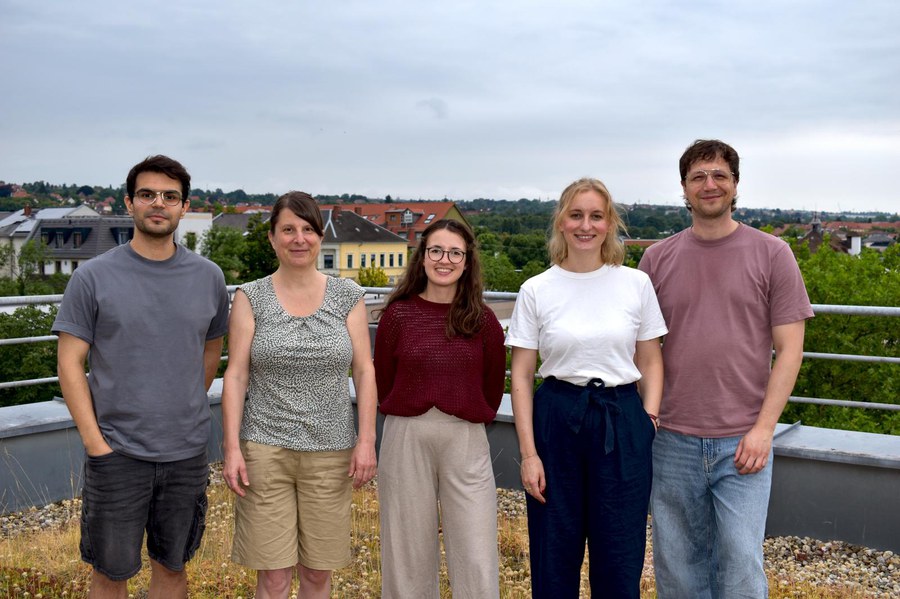
Prof. Katharina von Kriegstein’s (second from the left) research group is investigating the neuroscientific basis of sensory overload in autism in two new projects.
How does the brain process visual stimuli in people with autism? And what mechanisms underlie the rapid sensory overload associated with autism? Led by Prof. Dr Katharina von Kriegstein, researchers from the Chair of Cognitive and Clinical Neuroscience at TU Dresden are investigating these and other questions in two new projects. The aim is to understand the neuroscientific basis of sensory overload to improve everyday life for people with autism in the future.
Autism affects around one in 100 people worldwide. People with autism are often subject to sensory overload in their daily lives, which can lead to difficulties and/or avoidance behaviours. This applies, for example, to school or the workplace, but also to shopping and doctor’s visits. Overall, studies have shown that the autistic population faces greater difficulties in their educational careers, a higher rate of unemployment and a slightly shorter life expectancy than populations without autism.
A better understanding of the underlying perceptual processes could, in the long term, help to reduce these stresses and adapt environments more effectively to the needs of people with autism. “Our aim is to identify the mechanisms underlying sensory overload in autism. This can serve as a basis for managing sensory overload more effectively and designing environments in such a way as to minimise it. I expect that, through our basic research, this will enable us to make a contribution towards improving the everyday lives of people with autism,” explains Prof. Katharina von Kriegstein.
This research will be carried out as part of two interconnected projects. The project ‘Investigating the composition of the direct LGN-V5/MT pathway and its implications for Autism Spectrum Disorder’ is being conducted in collaboration with the Max Planck Institute for Human Cognitive and Brain Sciences in Leipzig. The research will examine the composition and function of a direct pathway within the visual pathway that connects the lateral geniculate nucleus (LGN) with area V5/MT in the brain. The researchers aim to determine whether changes in this connection in people with autism are linked to sensory overload. The connections in the brain will be examined using what is known as connectome MRI. The scanner features a particularly strong magnetic field gradient, thereby enabling a highly detailed visualisation of nerve fibre connections in the brain. There are only four devices of this kind in the world.
The second project, ‘Neurobiological mechanisms of sensory overload in autism: new insights into the visual pathway and their implications for diagnosis and therapy’, also focuses on the neural connections of the visual pathway. A 3-Tesla magnetic resonance imaging (3T MRI) scanner is being used for the studies at TU Dresden. This allows researchers to record brain activity and structures during the examinations.
As well as gaining a better understanding of the neurobiological fundamentals, the researchers have another goal: using the data collected, they aim to develop a measurement tool that will allow for better assessment of sensory overload in people with autism. In future, this could help to investigate perceptual differences more systematically and improve research into possible support services.
The projects are funded by the German Research Foundation (DFG) and the Hans and Ria Messer Foundation.
Adult participants with and without autism will be recruited for both projects. Data collection will begin in autumn 2026.
Contact:
Beatrix von Woedtke
Chair of Cognitive and Clinical Neuroscience
TU Dresden
E-Mail: