
Internships for school students
This program is designed for high school students who are working toward a General University Entrance Qualification (Abitur).
Are you interested in abstract structures, symmetries, and brain teasers?

Selbstorganisation interagierender Partikel
Are you fascinated by the connections between nature and technology, and do you want to know how to describe them using mathematical models and simulate them on a computer?
“What does math have to do with music and art?”
Do you want to know what holds the world together at its core?
Do you want to study in the STEM fields?
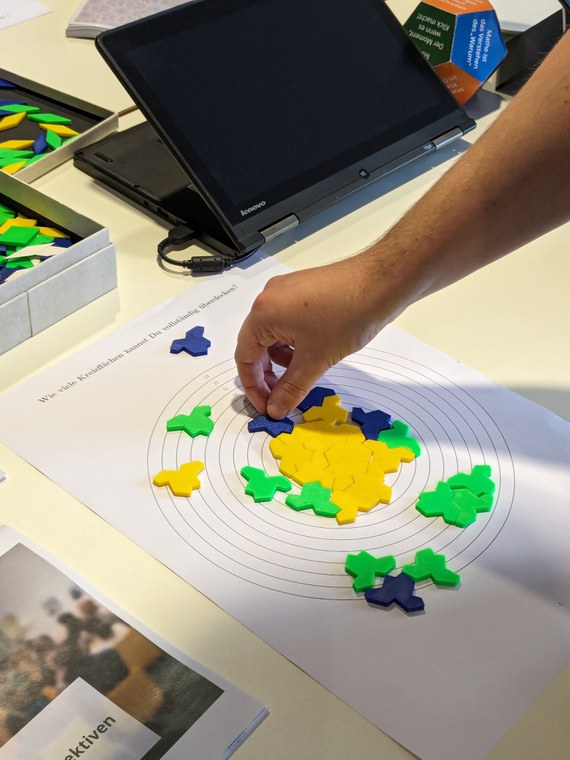
Then you’re sure to enjoy a student internship at the Faculty of Mathematics at TU Dresden. Our professors and staff offer various internships for high school students starting in 9th grade, such as work-based internships for career exploration.
Table of contents
- General Information
- Registration and Application
- Internship Projects
- P1 – “Mathematics, Music, and Vibrating Strings” Project
- P2 – “Vectors and Matrices” Project
- P3 – “Modular Arithmetic and Cryptography” Project
- P5 - Project “Headfirst into the Minimum—Optimizing with Python”
- P6 - Project “Mathematics of Pattern Formation”
- P7 - Project “Experimental Mathematics with AI Tools”
- P9 – Project “Selected Topics in a Specialized Field”
- Contacts at the Faculty of Mathematics
General Information
In our internships
- you’ll explore exciting mathematics through a small student project and gain insight into current mathematical research,
- you can learn about studying math and get a taste of what lectures are like,
- you’ll meet students and faculty members from the Faculty of Mathematics.
Topics. The thematic focus of our internships is diverse—ranging from “pure” mathematics to mathematics at the intersection of nature, technology, art, and music. You can find a list of current internships here.
Duration. The internships are designed to last 2 weeks.
Group. We prefer to conduct the internships in groups of 2–4 students. We put the groups together ourselves, but you can also register as a group with your classmates.
Registration and Application
Please send your application via email to (Attn: Dr. Antje Noack, Prof. Stefan Neukamm)
Requirements
- Curiosity and a high level of motivation
- Interest in the project’s topic
- Ability to work independently and as part of a team
- Good to very good academic performance (i.e., a GPA better than 2.0), particularly in mathematics
Application Materials
Your application should include the following information in particular:
- Internship period
- Please list your preferred internship project and two alternative projects. You may refer to the abbreviations in the list.
- Statement of Purpose: Why do you want to do an internship with us, and why are you interested in the project?
- Resume in table format
- Current transcript
Application Process
Internship positions for the 2026–2027 school year will be awarded starting in October 2027. They will be awarded in stages; that is, all applications received by October will be collected and awarded on November 1. Placements will then be made again on December 1 and January 1. For internships that begin as early as November, we’ll contact you in advance. We’ll try to take your preferred projects into account when making placements. However, we may suggest a completely different project if your preferred ones are already full or aren’t currently available.
Internship Projects
Our list of internship projects is currently being updated, which means some projects will be removed and new ones will be added. This process is expected to be completed by mid-October, when our semester begins.
Applications for the 26/27 school year can already be submitted. Fornow, please list all your preferred projects from the following list and send us a follow-up email in October if anything changes.
P1 – “Mathematics, Music, and Vibrating Strings” Project
Director: Prof. Stefan Neukamm – Chair of Applied Analysis
Description: What do tones, sounds, and noises look like, and what do functions sound like? What is the connection between musical intervals, trigonometric functions, and the physics of a vibrating string? How can we mathematically model a vibrating string and simulate it on a computer? In this lab, we’ll work in groups to explore these and other questions using methods from analysis and simple simulations that we’ll program ourselves in Python. You can find a final presentation on a project from previous years here.
Applicant Profile: Interest in mathematics and the natural sciences. Helpful: You play a musical instrument.
Keywords: Analysis, mathematical modeling, programming in Python, musical intervals, overtone series, tuning systems
Max. group size: 4
P2 – “Vectors and Matrices” Project
Instructor: Dr. Antje Noack – Institute of Algebra
Description: Forces are illustrated by vectors. A chessboard can be represented by a simple matrix. Vectors and matrices appear as practical tools in many other applications. We’ll explore this topic in depth. You will work independently to familiarize yourself with the topic and learn about the properties of these objects through various engaging tasks. Using the Matlab software package (or Python), you will write small programs, such as those for moving polygons in the plane.
Applicant Profile: Interest in mathematics and the natural sciences.
Keywords: linear algebra, programming
Max. group size: 4
P3 – “Modular Arithmetic and Cryptography” Project
Instructor: Dr. Julia Goedecke – Institute of Geometry
Description: Cryptography—the encryption of sensitive data or messages—is indispensable in many areas of today’s world: for example, for secure internet communications (including WhatsApp), the protection of government or industrial secrets or sensitive customer data, and online shopping. After a brief introduction to the historical origins (e.g., Caesar cipher), this project focuses on modular arithmetic and the RSA algorithm. This is an asymmetric encryption method, also known as a public-key system. Anyone who can tell time has already done modular arithmetic, and you’ll learn the mathematical fundamentals behind it. You’ll work your way through the topic independently and explore various aspects through engaging problems, as well as learn a few simple proofs. You may also do a little programming using the MatLab software package.
Applicant Profile: Interest in mathematics and/or computer science
Keywords: Cryptography and number theory
Available dates: February 8, 2027 – March 31, 2027 and July 19, 2027 – September 30, 2027
Max. group size: 4
P5 - Project “Headfirst into the Minimum—Optimizing with Python”
Leaders: Prof. Alexandra Schwartz, Carolin Leili – Chair of Mathematical Optimization
Description: You’ve probably seen a cartoon where someone tumbles down a slope, rolling over and over again (“ouch, ouch…”). This very idea—at least as a vivid illustration—lies behind a mathematical method for finding the minima of functions. The exciting part: All you need is the math you already learned in school!In our internship, you’ll learn the basics of programming in Python and, step by step, develop your own program that solves these minimization problems—from simple examples all the way to a method that can even handle functions with multiple variables.
Applicant Profile: Interest in mathematics and programming; strong spatial reasoning skills are helpful
Keywords: Optimization, programming with Python, concept of a function, points in the plane
Max. group size: 2
P6 - Project “Mathematics of Pattern Formation”
Instructor: Prof. Markus Schmidtchen – Chair of Applied Mathematics
Description: Upon closer inspection, self-organization can be found almost everywhere in nature. A very vivid example of self-organization is flocks of birds, which form even though there is no “leader” directing this behavior. Similar behavior can also be observed in schools of fish or herds of animals. So what does mathematics have to do with this? In the pattern formation practicum, we will work together to investigate and model, using mathematical formalisms, how self-organization and pattern formation can arise in large groups. We will then simulate this behavior on a computer.
Applicant Profile: Interest in mathematics and the natural sciences
Keywords: Mathematical modeling, self-organization, large-group dynamics
Max. group size: 4
P7 - Project “Experimental Mathematics with AI Tools”
Supervisor: Prof. Manuel Bodirsky – Chair of Algebra and Discrete Structures
Description: This project aims to collect open problems from many different areas of the mathematical literature and attempt to solve them using the most powerful AI tools available. The solutions will then be verified using other software programs.
Applicant Profile: Interest in mathematics.
Max. group size: 4
P9 – Project “Selected Topics in a Specialized Field”
Supervised by: Faculty of Mathematics
Description: Haveyou already engaged intensively with a specific area of mathematics—perhaps through a research paper, competitions such as the Math Olympiad, or simply out of personal interest? In this project, we offer you the opportunity to explore an advanced topic in mathematics on your own terms. We’ll work with you to select a specific topic—based on your prior knowledge, interests, and goals, which you should describe in as much detail as possible in your application.
Applicant Profile: You have an above-average enthusiasm for mathematics and have already explored mathematical problems beyond the scope of your high school curriculum.
Keywords: Advanced Mathematics
Max. group size: 1
Contacts at the Faculty of Mathematics
Dr. Antje Noack, Tel.: 463 32149
Prof. Dr. Stefan Neukamm, Tel.: 463 33998
Contact:
You can find a complete overview of TU Dresden’s internship opportunities for high school students here.