
Jul 07, 2026
Anjan Kumar N M Receives Alexander von Humboldt Fellowship to Investigate Excitonic Instabilities in Dirac and Weyl Semimetals
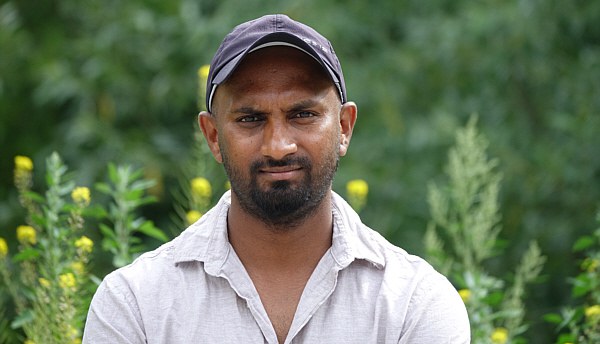
Anjan
On June 1, 2026, a new research project was launched at our institute with funding from the prestigious Alexander von Humboldt Foundation. Through its highly selective fellowship program, the Alexander von Humboldt Foundation recognizes exceptionally qualified researchers and supports scientific excellence worldwide. The award of this fellowship to Dr. Anjan Kumar N M is a testament to his outstanding scientific achievements and his growing international reputation. By becoming part of the influential global Humboldt Network, he will benefit from extensive interdisciplinary exchange and international collaboration, providing an excellent foundation for carrying out his independently designed research project over the next 24 months. Through this fellowship, he will pursue an ambitious research program aimed at uncovering the signatures of population inversion and excitonic instabilities in Dirac and Weyl semimetals using state-of-the-art time-resolved spectroscopic techniques in collaboration with Prof. Stefan Kaiser's group.
An excitonic insulator is an interaction-driven quantum state formed by the condensation of bound electron–hole pairs (excitons). Such a state can emerge when the exciton binding energy exceeds either the band gap of a narrow-gap semiconductor or the bandwidth of a semimetal. Depending on the underlying electronic structure, the transition may be described either as a Bose–Einstein condensation (BEC) of preformed excitons or as a Bardeen–Cooper–Schrieffer (BCS)-type instability associated with exciton formation. Although the concept of the excitonic insulator in solids was proposed more than six decades ago, recent advances in experimental techniques have renewed interest in its realization and detection. Anjan will use advanced, ultrafast time-resolved measurements to induce excitonic populations in metastable states and track their coherent response following photoexcitation. He seeks direct access to the collective amplitude and phase modes of the excitonic condensate that will provide a unique insight into the dynamics of the excitonic insulating state.
Dr. Anjan Kumar N M received his PhD from the Indian Institute of Science Education and Research (IISER) Kolkata, India, where his research focused on ultrafast and terahertz spectroscopy of two-dimensional magnetic materials and transition metal oxides.
We congratulate Dr. Anjan Kumar N M on this outstanding award and wish him every success and exciting insights into the project.