
16.10.2026
Dynamics of CDW puddles in 2H-NbSe2
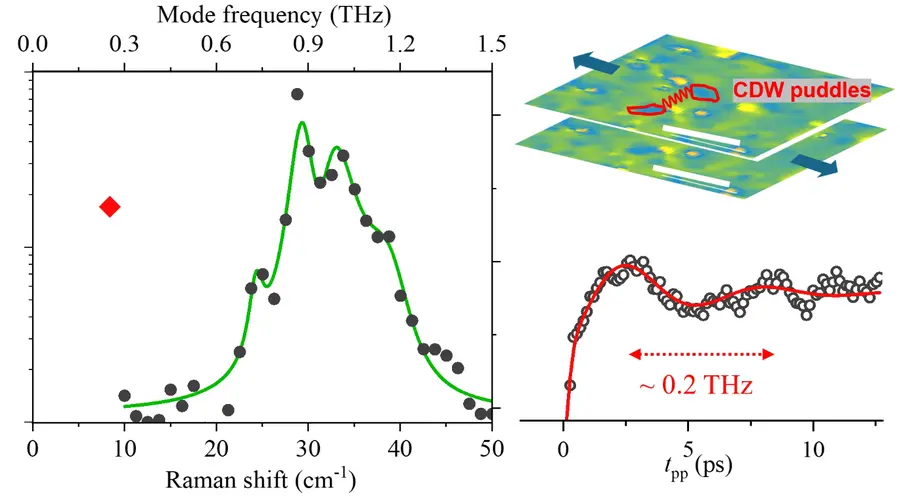
Left shows the Raman spectrum with the Fano line shape (green) from the coupled shear vibration and local charge-density wave. The red point indicates the frequency of the collective dynamics from charge-density-wave puddles, shown on the right side.
Dynamics of CDW puddles in 2H-NbSe2. When puddles move together: a new collective rhythm of charge order in a layered superconductor
New publication in the journal Nano Letters on the dynamics of charge-density-wave puddles in the layered superconductor 2H-NbSe2.
In many quantum materials, electronic order forms in islands only a few nanometres wide, called "puddles". Their arrangement in space is well mapped, but their dynamics in time, either moving individually or collectively, have remained unknown. Both properties are important to understand the macroscopic behaviour of the system. Now, a collaboration led by IFMP (TU Dresden) and the Superpuddles Lab at IFW Dresden has caught puddles of charge order oscillating together in the layered superconductor 2H-NbSe2.
In the layered superconductor 2H-NbSe2, below about 28 K, the electrons form a charge-density wave, a periodic ripple of charge that appears in puddles about 10 nanometres wide; below 7 K the material also becomes superconducting. Using Raman scattering, the team found that the sliding vibration of neighbouring layers is strongly coupled to the charge-density wave, resulting in a characteristic Fano interference.
Ultrafast laser experiments probe the collective dynamics of these puddles. Surprisingly, below 17 K the individual puddles lock into a coherent motion revealed by slow oscillations at about 0.2 terahertz together with a sharp slowing down of the electrons. The team interprets this as a collective, glass-like motion of many puddles at once. The results show how local puddle dynamics shape the global response of the material, and may explain why charge order is much stronger in single atomic layers.
Puddles, in general, are objects that start attracting curiosity in the context of complex systems. A growing interest among the scientific community is to understand how the rich behaviour of quantum materials grows from single atoms up to the micrometre scale. Puddles sit in between: their shapes, their arrangement and their slow motion steer the physics of the whole material, at every scale.
“Our study not only sheds insight into the unconventional nature and origin of the CDW in 2H-NbSe2 itself but also demonstrates that puddles, in general, are not just defect- or disorder-pinned phase-separated domains but can form a low-energy collective phase that governs the electronic ground state,” says Shreya Kumbhakar, first author of the study. "Indeed, puddles are not noise in quantum materials. They are where new physics happens," adds Nicola Poccia from the Superpuddles Lab at IFW Dresden. "If we learn to see how they move and how to steer them, we can design superconducting devices from the puddle up, from twisted junctions to components for quantum superconducting technologies". “We have shown here that the puddles do not only sit still, but they have their own rhythm, and we have developed the tools to understand this rhythm," Golam Haider from IFW summarizes the study. “In the future, controlling this rhythm allows us to define functionalities of future optoelectronic and quantum devices. We can achieve this by tailoring light pulses to selectively drive and tune the collective dynamics of the puddles”, concludes Stefan Kaiser from TU Dresden.
Original publication: S. Kumbhakar, M. Esposito, A. Kumar N M et al., Dynamics of Charge-Density-Wave Puddles in 2H-NbSe2. Nano Letters (2026), open access (CC BY 4.0).
https://doi.org/10.1021/acs.nanolett.6c03967
Funding: European Research Council (ERC-CoG 3DCuT, 101124606; ERC T-Higgs, 101044657), Deutsche Forschungsgemeinschaft (incl. Cluster of Excellence ctd.qmat, EXC 2147, and SFB 1143), PNRR MUR NQSTI (PE0000023).