
Zertifikat Microelectronic Engineering
Inhaltsverzeichnis
Mit dem Zertifikatsprogramm „Microelectronic Engineering“ der Fakultät Elektrotechnik und Informationstechnik bietet die TUD ab dem Sommersemester 2026 eine einzigartige Möglichkeit, wissenschaftlich fundiert und zugleich praxisnah, Kompetenzen in einem der wichtigsten Industriezweige zu erwerben.
Das Programm vermittelt sowohl grundlegende als auch vertiefte Kenntnisse in Halbleitertechnologien, Chip-Entwurf und System-Performance. Es richtet sich an Fachkräfte aus der Halbleiterindustrie, die ihre Kompetenzen gezielt ausbauen und sich für aktuelle sowie zukünftige Anforderungen der Halbleiterbranche qualifizieren möchten, sowie an Studierende.
Dank des modularen Aufbaus profitieren die Teilnehmenden von maximaler Flexibilität: Das gesamte Zertifikat kann ebenso absolviert werden wie einzelne Module zur gezielten fachlichen Spezialisierung.
Wichtige Informationen in aller Kürze:
| Abschluss |
|
| Bewerbungsfrist |
für das jeweilige Wintersemester 1. Juni bis 15. September |
| Dauer | 3 Semester (Regelstudienzeit), max. 7 Semester |
| Umfang |
Mindestens 30 ECTS (DAS), mindestens 15 ECTS (CAS) |
| Gebühr |
6.000,00 EUR (DAS), 3.000,00 EUR (CAS) |
| Formate | Vorlesungen, Übungen, Praktika, Exkursionen, Selbststudium |
| Unterrichtssprache | Deutsch, einige Module auf Englisch |
Beratung
Haben sie Fragen zum Zertifikatsangebot, z.B. zur Bewerbung und Immatrikulation oder den Gebühren? Dann wenden Sie sich bitte an Beate Herm (Kontaktdaten siehe unten). Die Informationsveranstaltung am 25.Juni 2026 muss leider abgesagt werden.
Zielgruppen
- Fachkräfte (Professionals) mit einer anerkannten Hochschulzugangsberechtigung und einschlägiger Berufserfahrung im Halbleiterbereich, die ihre Kenntnisse auffrischen oder vertiefen wollen.
- Absolvent:innen (Professionals) mit einem Hochschulabschluss in einem MINT-Studiengang (Mathematik, Informatik, Naturwissenschaften, Technik) oder einem Abschluss einer staatlichen oder staatlich anerkannten Berufsakademie in einem MINT- Studiengang, die ihr Wissen im Halbleiterbereich ausbauen und vertiefen möchten
- Studierende in MINT-Studiengängen der TUD, die ihr Wissen im Bereich Mikroelektronik gezielt ausbauen möchten.
Aufbau und Inhalte
Das Zertifikatsangebot setzt sich aus verschiedenen Bausteinen zusammen und ist modular aufgebaut:
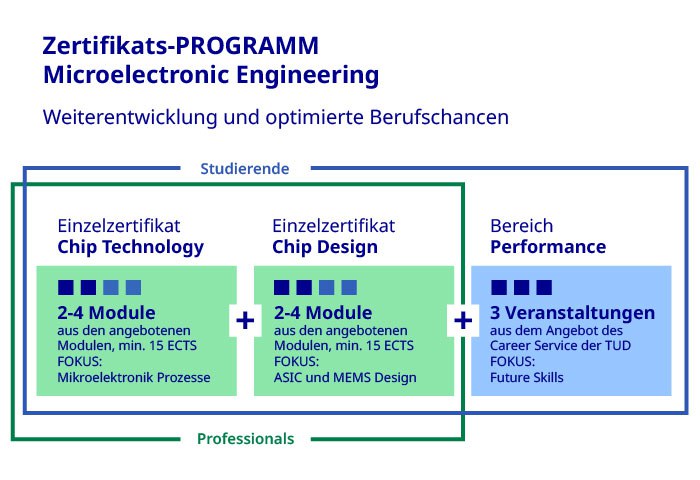
In diesem Baustein werden Grundlagen der Mikroelektronik, allgemeines Grundwissen sowie, abhängig von der Wahl der Teilnehmerin bzw. des Teilnehmers, Wissen und Kompetenzen in den Schwerpunkten Prozesstechnik & Prozessintegration, grundlegende Design- und Chip-Architekturkonzepte sowie Operations & Equipment Engineering vermittelt.
Die Teilnehmer:innen müssen ein Grundlagenmodul und zwei bis vier Vertiefungsmodule im Umfang von insgesamt mindestens 15 ECTS und maximal 20 ECTS absolvieren.
Grundlagenmodule:
- Technologien der Mikroelektronik
- Aufbau- und Verbindungstechnik der Elektronik (Kapazitätsbegrenzung: 20 Plätze)
Vertiefungsmodule:
- Mikrosysteme für Mikroelektronik
- Plasma Technology
- Hybridintegration (Kapazitätsbegrenzung: 20 Plätze)
- Halbleitertechnologie / Prozessintegration
Teilnehmer:innen, die das Zertifikatsangebot begleitend zu ihrem regulären Studiengang absolvieren, müssen für das Zertifikat zusätzlich eine Veranstaltung aus dem 3. Baustein Performance belegen.
Hinweis:
Die Vergabe von Plätzen in Modulen mit begrenzter Kapazität erfolgt per Losverfahren.
In diesem Baustein werden Grundlagen des Chip Designs sowie, abhängig von der Wahl der Teilnehmerin bzw. des Teilnehmers, Wissen und Kompetenzen in den Schwerpunkten Chip Design (VLSI-, ASIC-Design, Analog- und Digital-Design, Speicher) und Chip Technologie (MEMS- Technologie & Design) sowie die Grundlagen der Entwurfsmethodik und -automatisierung vermittelt.
Es müssen ein Grundlagenmodul und zwei bis vier Vertiefungsmodule im Umfang von insgesamt mindestens 15 ECTS und maximal 20 ECTS absolviert werden.
Grundlagenmodule:
- Elektronische Bauelemente
- Schaltungstechnik
Vertiefungsmodule:
- Numerische Bauelemente-Simulation
- Modellierung für den Schaltungsentwurf
- Digitale Schaltungstechnik
- Memory Technology
- Integrierte Analogschaltungen
- Radio Frequency Integrated Circuits
(Kapazitätsbegrenzung: 20 Plätze) - Innovative Concepts for Active Nanoelectronic Devices
(Kapazitätsbegrenzung: 20 Plätze) - Rechnergestützter Schaltkreisentwurf
(Kapazitätsbegrenzung: 20 Plätze) - Thermischer Entwurf
- VLSI Processor Design
(Kapazitätsbegrenzung: 20 Plätze) - Entwurfsautomatisierung
(Kapazitätsbegrenzung: 20 Plätze) - Integrated Circuits for Broadband Optical Communications
(Kapazitätsbegrenzung: 20 Plätze) - Elektromechanische und mikroelektromechanische Systeme
(Kapazitätsbegrenzung: 20 Plätze)
Teilnehmer:innen, die das Zertifikatsangebot begleitend zu ihrem regulären Studiengang absolvieren, müssen für das Zertifikat zusätzlich eine Veranstaltung aus dem 3. Baustein Performance belegen.
Hinweis:
Die Vergabe von Plätzen in Modulen mit begrenzter Kapazität erfolgt per Losverfahren.
Im Baustein Performance werden Soft Skills vermittelt, die die Teilnehmer:innen auf den Berufseinstieg vorbereiten und in Abstimmung mit dem Career Service semesterweis angeboten werden. Es werden z.B. wesentliche Aspekte bzgl. relevanter Präsentationstechniken, des Schreibens wissenschaftlich-technischer Texte, KI-unterstützten Schreibens sowie Techniken des erfolgreichen Projektmanagements vermittelt.
Zum Semesterprogramm des Career Service
Teilnehmende, die das Zertifikatsangebot begleitend zu ihrem regulären Studiengang absolvieren, müssen für das Zertifikatsprogramm insgesamt drei Veranstaltungen (jeweils eine im Rahmen der Bausteine 1 und 2 sowie eine weitere) aus dem Programm des Career Service auswählen. Alle anderen Teilnehmer:innen können optional an Veranstaltungen im Baustein Performance teilnehmen.
Ziele, Organisation, Inhalt, Aufbau und Ablauf sind in der Ordnung des Zertifikatsangebots „Microelectronic Engineering“ festgelegt.
Aktualisierte Übersicht über die Module
Modulübersicht: hier finden Sie auch die Links zu den Stundenplänen.
Prüfungen
Den Prüfungsablaufplan für die Prüfungen im Sommersemest 2026 finden Sie auf der Website der Fakultät Elektro- und Informationstechnik hier. Wenn Sie fragen zur Einschreibung in die Moduel oder zur Anmeldung zu den Prüfungen haben wenden Sie sich bitte an das Prüfungsamt der Fakultät Elektro- und Informationstechnik.
Bewerbung
Hier geht’s zum Bewerbungsportal.
Zugangsvoraussetzungen:
- Allgemeine oder fachgebundene Hochschulreife und nachgewiesene Berufserfahrung im Halbleiterbereich (für Schulabschlüsse aus dem Ausland einschließlich Anerkennungsbescheid durch eine Anerkennungsstelle in Deutschland https://www.schule.sachsen.de/anerkennung-von-abschluessen-4791.html) oder
- ein erster in Deutschland anerkannter berufsqualifizierender Hochschulabschluss in einem MINT-Studiengang oder ein Abschluss einer staatlichen oder staatlich anerkannten Berufsakademie in einem MINT- Studiengang oder
- Immatrikulation in einen MINT-Studiengang an der Technischen Universität Dresden
- Studienbewerberinnen und Studienbewerber, die ihre Studienqualifikation nicht an einer deutschsprachigen Einrichtung erworben haben, benötigen deutsche Sprachkenntnisse, die zum Studium an einer Hochschule befähigen. Der Nachweis kann erbracht werden durch die Deutsche Sprachprüfung für den Hochschulzugang (DSH) mit mindestens dem Gesamtergebnis DSH 2 oder einen äquivalenten Sprachnachweis. (Immatrikulationsordnung der TUD)
Hinweis zur Bewerbung: Die Auswahl der Bausteine und Module erfolgt nach der Immatrikulation.
Teilnahmegebühren
- Für die Teilnahme am Zertifikatsangebot (Baustein 1 und 2): 6.000 EUR sowie 338,00 EUR Semesterbeitrag pro Semester
- Für die Teilnahme an Baustein 1 oder 2: 3.000 EUR sowie 338,00 EUR Semesterbeitrag pro Semester
- Für die Teilnahme an einzelnen Modulen: Höhe ist abhängig von Anzahl und Umfang der Module
Ausnahme: Von Teilnehmer:innen, die an der TUD parallel zu dem Zertifikatsangebot in regulären Studiengängen immatrikuliert sind und nicht bereits über einen ersten in Deutschland anerkannten Hochschulabschluss in einem MINT-Studiengang oder einen Abschluss einer staatlichen oder staatlich anerkannten Berufsakademie in einem MINT- Studiengang verfügen, werden keine Gebühren erhoben. Gleiches gilt für Teilnehmer:innen, die an der TUD parallel zu dem Zertifikatsangebot in einen Masterstudiengang immatrikuliert sind.
Abschluss
Das Zertifikatsangebot eröffnet Ihnen international anerkannte Abschlussmöglichkeiten:
- Diploma of Advanced Studies (DAS):
Abschluss nach erfolgreichem Absolvieren von mindestens 30 ECTS aus allen Bausteinen (für Studierende inkl. Performance) oder - Certificate of Advanced Studies (CAS):
Berufserfahrene und Absolvent:innen können gezielt einen Baustein (Chip Technology oder Chip Design) absolvieren und erhalten ein CAS TUD im jeweiligen Bereich.
Beratung
Für weitere Informationen zum Angebot sowie zur Anmeldung zu einzelnen Modulen wenden Sie sich bitte an das TUD-Zentrum für Weiterbildung.
 © Sven Ellger
Frau Beatrice Schlegel
Wissenschaftliche Weiterbildung
Eine verschlüsselte E-Mail über das SecureMail-Portal versenden (nur für TUD-externe Personen).
Zentrum für Weiterbildung
Zentrum für Weiterbildung
Besuchsadresse:
Fritz-Foerster-Bau, Raum 107 Mommsenstr. 6
01069 Dresden
Postadresse:
Technische Universität Dresden Zentrum für Weiterbildung
01062 Dresden
Sprechzeiten:
- Mittwoch:
- 14:00 - 15:30
- Freitag:
- 10:00 - 11:00
Die Sprechzeit am 07.10. entfällt. Digitale Sprechzeit: am 06.10. von 15:30 bis 16:30 Uhr, für neue Weiterbildungsteilnehmende am 08.10. von 15:30 bis 16:30 Uhr (Anmeldung per Mail an weiterbildung.studiengang@tu-dresden.de)
 © Sven Ellger
Leiterin
NameBeate Herm
Eine verschlüsselte E-Mail über das SecureMail-Portal versenden (nur für TUD-externe Personen).
Zentrum für Weiterbildung
Zentrum für Weiterbildung
Besuchsadresse:
Fritz-Foerster-Bau, Raum 142 Mommsenstr. 6
01069 Dresden
Postadresse:
Technische Universität Dresden Zentrum für Weiterbildung
01062 Dresden