
Mar 19, 2026
Applied research under the acacia trees
Dagmar Möbius
Dr. Kendisha Soekardjo Hintz has been working at the Institute of Tropical and International Forestry in Tharandt since 2018, where she also completed her doctorate. Since 2023, she has been conducting research as part of the emPOWER project. We asked her why she sometimes feels like she’ll never outgrow her student status — and what she has learned about our spiritual relationship with trees.
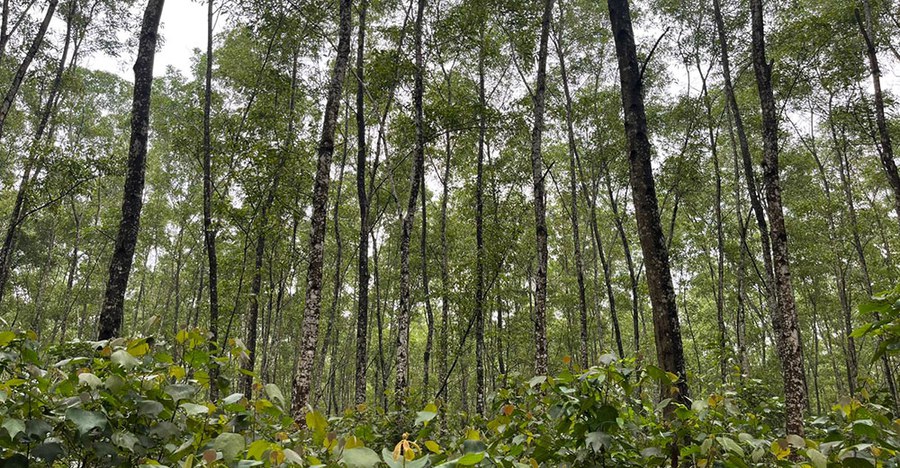
Acacia Forest in Vietnam
Kendisha Soekardjo Hintz studied environmental management and sustainability. Her academic background is in the social and economic sciences, which explains why, despite not being a forester, she is the ideal coordinator for the emPOWER project. The research project, which will run until June 2027, is not primarily about forestry. Instead, it focuses more on strengthening agroforestry organizations to promote landscape restoration through leadership in the timber value chain in the tropics. In other words: It is concerned with the social dimensions of the people who work and manage the forest.
Applied research with fieldwork
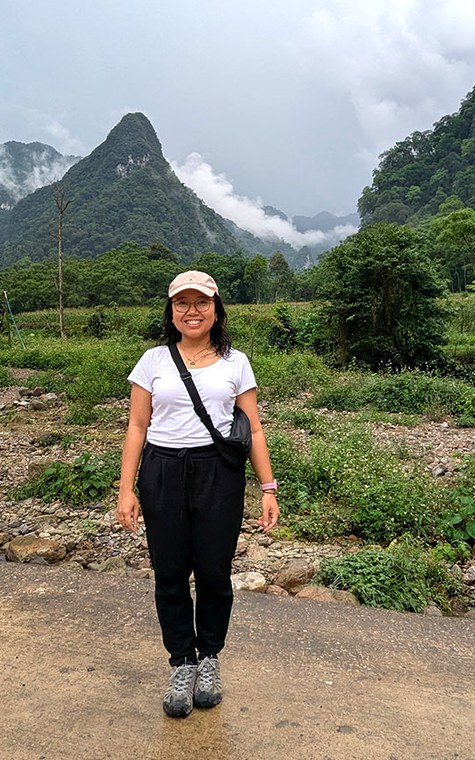
Dr. Kendisha Soekardjo Hintz in a Vietnamese national park.
Structured into five scientific work phases, the project involves studying agricultural enterprises and conducting case studies. “We aim to strengthen forest cooperatives and associations and examine whether (and what kinds of) direct and indirect benefits this brings for forest farmers,” explains Kendisha Soekardjo Hintz. “This is applied research with fieldwork.” She had already delved into this topic during her doctoral studies, which took her, among other places, to Tanzania and Ethiopia. The current project collaborates with partners in Vietnam and Tanzania.
At present in many of these countries, smallholder farmers primarily cultivate agricultural products on their farms. “Planting trees such as acacias or eucalyptus has become profitable and is seen as a kind of insurance,” says Dr. Hintz. “Farmers hope to harvest after six to ten years and use the revenue to build up their savings — for school fees, dowries, or in case of illness.”
Ecological issues and biodiversity
The research project also involves doctoral researchers from Vietnam and Tanzania. They study the value chains in the timber and wood-chip industry. In Tanzania, the focus is on pine trees, while in Vietnam it is primarily acacia, from which sawn timber and wood chips are produced. The project also examines power relations between stakeholders, financing mechanisms, and their financial capacities, with the ultimate aim of deriving strategies for improvement. Another key objective is to identify ways of balancing trade-offs between biodiversity and the resilience of agricultural systems, farmers’ livelihoods, the financial viability of organizations, and the timber value chain and its wider network. This is intended to support better decision-making in both policy and practice. An example of a recent publication presenting interim results from their work in Tanzania can be found here.
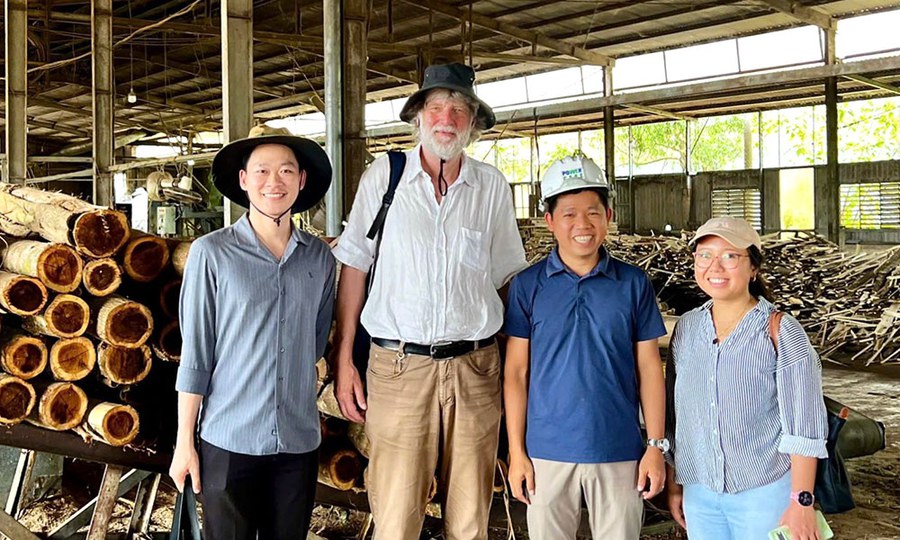
At the sawmill in Vietnam with Prof. Jürgen Pretzsch (second from left)
Administrative challenges and spiritual practices
Despite staff comings and goings in the partner countries, the research team is still on schedule, says Kendisha Soekardjo Hintz. Sudden changes in regulations can also have an impact on timelines and budgets. Administrative tasks and occasional intercultural misunderstandings are ever present. She most certainly had to learn patience as part of her work. “Nothing about the spiritual relationship with trees is set in stone,” she notes as an example.
Last year, she traveled to Vietnam with Professor Jürgen Pretzsch, where she met local stakeholders, visited acacia plantations and sawmills, and attended an alumni meeting. She’ll head back there at some point soon to conduct further interviews. “Sometimes I feel like I’ll always be a student at heart,” she says, as she often learns from local communities during data collection excursions. The next step will be to analyze institutional frameworks and to compare whether (and how) formal and informal regulations clash with reality.
Contact:
Dr. Kendisha Soekardjo Hintz
EmPOWER Project Coorindator and Public Relations