
Mar 19, 2026
Studying tropical forestry where it all began
Dagmar Möbius
The English-language master's program in Tropical Forestry has been offered in Tharandt for 30 years. A symposium has been held to celebrate this joyful occasion, and Lukas Giessen, Chair of Tropical and International Forestry since 2020, is setting out to provide some new inspiration.
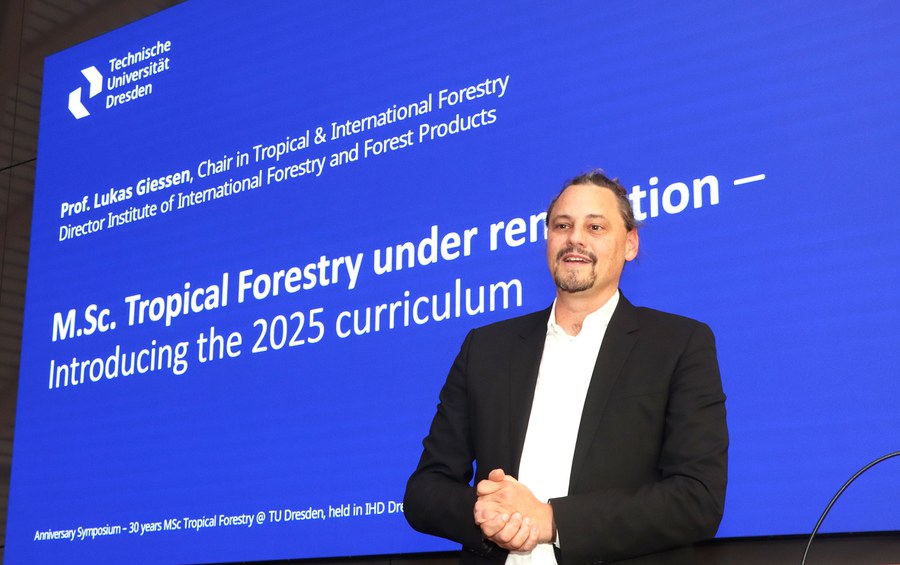
Prof. Lukas Gießen wants his students to feel that they are on equal footing with him.
"Even in German, we use the English name Tropical and International Forestry, because we only work internationally, so to speak," says Lukas Gießen. Since October 2020, the Wiesbaden native has been the Chair of Tropical and International Forestry at the Institute of International Forestry and Forest Products at TUD. All of his interlocutors quickly realize that he in fact belongs to a younger generation. He doesn’t consider himself an omnipotent professor as it is not something that is grounded in reality. "I don't have to correct every comma myself, that's what my colleagues do." This is not an arrogant statement, but consistent and a sign of modern leadership, which he also makes sure to pass on to his students. He wants young people to have a chance to make their own mark and become visible alongside their professors.
Oldest forestry campus in the world
For more than 60 years, the institute has been offering degree programs in forestry to students from all over the world. In the former GDR, since 1963 in German, from 1995 in English. But Tharandt has been a place of teaching for much longer. In 1811, Heinrich Cotta began systematic forestry education at his private forestry school, making it the oldest in the world. This was taken over by the state five years later as the Royal Saxon Academy of Forestry. In 1929, it became affiliated to the then Technische Hochschule Dresden. Today, the Department of Forest Sciences is part of the Faculty of Environmental Sciences at TUD Dresden University of Technology.
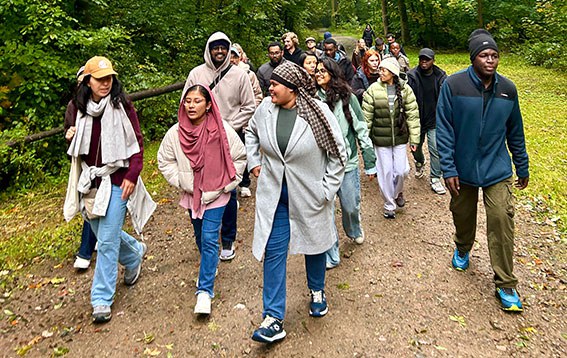
Current master's students in tropical forestry in the Tharandt Forest
From the tried and tested to the new
Lukas Gießen speaks with great respect and humility about the historical development of his institute. The work there is divided into the areas of research, teaching and international university networks. As a university lecturer, he has his own focal areas and has therefore developed an updated curriculum with new courses that have been taught since October 2025. While the focus was on socio-economic issues in the past, Lukas Gießen focuses his teaching on political and anthropocentric governance issues in dealing with forests worldwide. He sees himself more in the field of management training for future decision-makers. The DAAD provides funding through scholarships and programs.
Students from all over the world want to study where it all started
The demand for study places is very high. Each year, 30 to 40 students, almost all of them in their mid-twenties with a Bachelor's degree, some with a Master's degree, others with practical experience, are selected from around 700 applications that we receive from all over the world. For Professor Lukas Gießen, this makes a lot of sense: "Young people want to study where it all started." "Sustainable forestry" from Saxony, established by its founder Hans Carl von Carlowitz and perfected in Tharandt by Heinrich Cotta and his colleagues. When selecting the best Master's students, he looks at their individual life stories and career plans. "I'm not much of a typical lecturer," he laughs. "I want to get people out of their comfort zone. The best thing for me is when I look into motivated faces that want to make something of themselves." He always welcomes questions. He actively supports ambitious young forestry scientists: through offering mentoring modules, encouraging them to participate in excursions or taking them to various conferences.
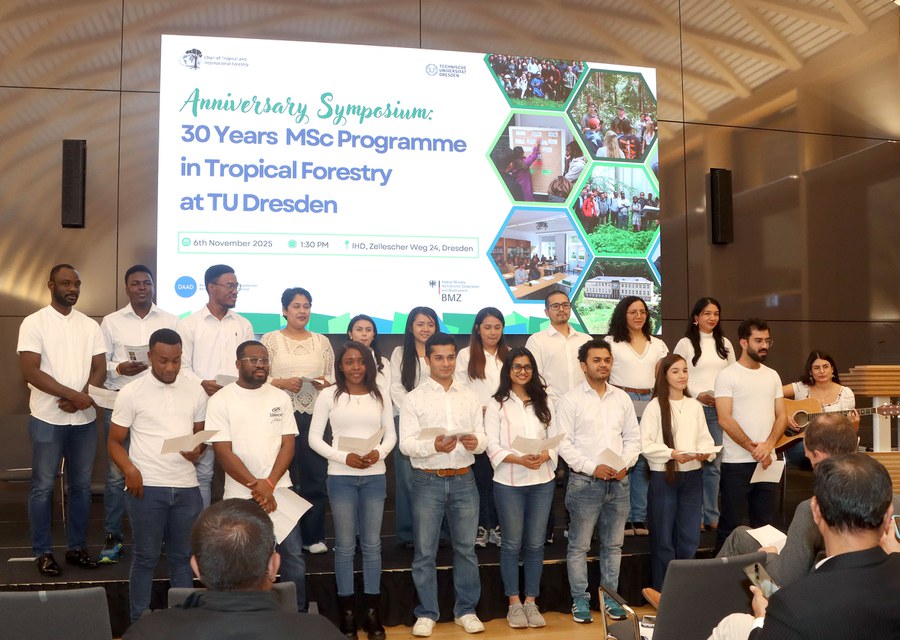
Current Tropical Forestry students at the symposium in fall 2025.
Research and networks
There are currently five research groups led by experienced postdocs at the Chair. These groups focus on international forest governance and multilateralism, forest institutions and international development, power for sustainable forest management outcomes, socio-economics in forestry, and landscapes in critical development perspective.
- International Forest Governance & Multilateralism
- Forest Institutions and International Development (FIID)
- Power for Sustainable Forest Management Outcomes (PSFMO)
- Socio-Economics in Forestry
- Landscapes in critical development perspective
The institute is also involved in international university cooperation. "We don't conduct our own research in these networks, but rather exchange ideas with universities around the world about possible improvements to the courses on offer," says Professor Lukas Giessen.
Contact:
TU Dresden
Faculty of Environmental Sciences
Institute of International Forestry and Forest Products
Chair of Tropical and International Forestry
Prof. Lukas Giessen
Tel: +49 351 463-31824
Email: lukas.Gieß
Since conducting the interview with Prof. Giessen, he has accepted the appointment to a W3 Chair for Forest Policy and Land-Use Governance at the Georg-August University of Göttingen .