
Oct 05, 2026
Professional expertise brings people together; human relationships make the difference

The Alumna of the Month for October 2026 is a physicist.
(interview from 2026)
Thomas Scheufler
“TU Dresden didn’t just teach me all the scientific course content, it also gave me the ability to pull knowledge from other disciplines and bring people together. My work lets me see the benefit of this, day in day out, especially as my work covers the area where science and industry overlap.”
Dr. Julia Lyubina did her PhD in physics at TU Dresden and is now Head of Academic Partnerships at Evonik, a global leader in specialty chemicals. She cultivates collaborations between science and industry, initiates interdisciplinary partnerships and innovation projects at the intersection of research and real-life application. And all this thanks to the excellent education she received at TU Dresden.
|
Name: |
Dr. Julia Lyubina |
|
Degree program |
PhD in Physics |
|
Faculty |
School of Science |
|
At the university: |
2002 - 2006 |
|
Current work: |
Head of Academic Partnerships, Evonik Operations GmbH |
Where are you employed today and what are your responsibilities?
I work at Evonik, a global leader in specialty chemicals. After completing my PhD at TU Dresden in the field of permanent magnetic materials, I initially worked as a researcher at the Leibniz Institute for Solid State and Materials Research Dresden (IFW Dresden). After that, I moved on to conducting research as a Marie Curie Fellow at Imperial College London on magnetocaloric materials and electrochemical processes.
In 2012, I made the jump to working in industry and started at Evonik in Hanau. Since then, I have held various positions in the areas of process engineering, strategy & new growth business, as well as research, development, and innovation. My focus has been on developing new products and business areas. As head of global new business development in the Silanes business line, my responsibilities included the development and market launch of silicon-based materials for anodes in lithium-ion batteries.
Today, I work as the Head of Academic Partnerships at Evonik. This role enables me to cultivate collaborations between science and industry, as well as to initiate interdisciplinary partnerships and innovation projects at the intersection of research and real-life application.
In addition, I am a guest professor for Sustainable Energy Storage and Conversion at TU Darmstadt. That’s where I’m establishing a new field of research on magnetic electrocatalysts for hydrogen production. I am also active on several industrial advisory boards that promote exchange between science and industry.
What still has a lot of value for you today? What would you like to have had more of?
I never seem to stop reaping the rewards of my time at TU Dresden. Having the chance to build networks, initiate collaborations, and familiarize myself with new subject areas was a particularly valuable experience. And working on my PhD was an opportunity for me to grow both scientifically and personally. I learned to take on responsibility, communicate clearly, and show initiative.
I particularly appreciated the freedom to pursue my own scientific interests in a highly interdisciplinary environment. The interweaving of experiment and theory was inspirational, as was being able to work with people from a wide variety of disciplines, such as physics, chemistry, materials science, and engineering, and collaborations with research groups and business partners from around the world.
Now, working in the chemical industry, I’m constantly reminded of just how important this experience is: Bringing people together from different disciplines, and with diverse cultural backgrounds, and finding a common language. This is often a critical factor for success.
What I would have wished for back then was a greater awareness of the myriad career opportunities that did not involve staying on the academic path. Initiatives like “Alumni of the Month” make an important contribution to this by highlighting the different career paths available.

Co-chair and organizer of the “Evonik meets Science” science forum in Heidelberg in 2026.
Why did you decide to study at TU Dresden?
While I was studying for my Master’s, I met Karl-Hartmut Müller at a conference – he was the head of department at IFW Dresden at the time. He invited me to Dresden as a visiting student. It didn’t take long for me to get excited about the academic environment and the city itself. Thanks to Karl-Hartmut Müller and the then-director of IFW Dresden, Ludwig Schultz, who was also a professor at TU Dresden, I was eventually offered a position as a PhD student. Of course, I jumped at this opportunity.
What made you choose this degree program?
Before moving to Dresden, I already had a Master’s degree in physics from the National University of Science and Technology MISIS in Moscow. I was particularly interested by the physics of metals and magnetism. The research group in Dresden was working on precisely these topics, so it was an easy decision for me to make. It later became abundantly clear that this was the right choice: for my PhD thesis, I was awarded the Georg Helm Prize, which honors three outstanding scientific theses by TUD students every year.
What researchers or lecturers influenced you the most during your studies?
This question is particularly difficult to answer because there wasn’t just any one person. During my time in Dresden, I was fortunate enough to work with a number of extraordinary people who influenced me both professionally and personally. For all of this, I am eternally grateful. Unfortunately, some of them are no longer with us, but their ideas, their attitude towards science, and their humanity continue to guide me even now.
I would say that Karl-Hartmut Müller, Ludwig Schultz, Oliver Gutfleisch, and Dietrich Hinz had a particularly profound influence on me. They not only taught me a great deal academically, they also taught me the value of curiosity, scientific integrity, teamwork, and responsible leadership. Equally formative for me was being able to work closely with my colleagues and other PhD students. The list of people I’d like to thank is actually much longer. Every conversation has left its mark and contributed to my professional and personal journey.
Another important lesson I learned at that time was that professional exchange takes place regardless of hierarchies. I learned how to communicate openly and respectfully with people at all levels. And these are skills that I need day in, day out: whether it be during conversations with my colleagues or discussion with the board of directors.
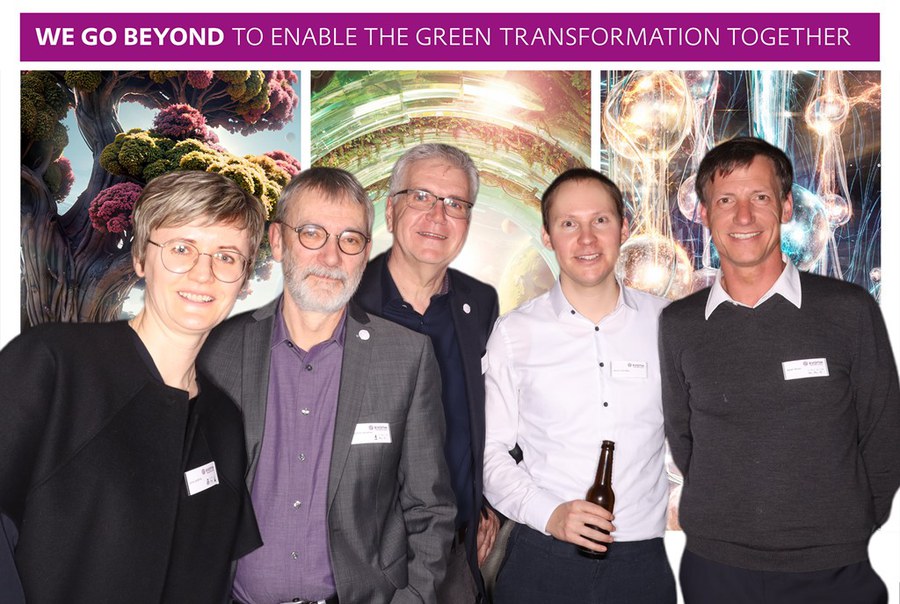
At Global Evonik RD&I Leadership Conference with colleagues.
What advice would you give to our current first-years?
Working in my current job means that I have a lot of contact with undergraduate and PhD students. And I do my best to show them how many different career paths are open to them. Apart from an academic career, there are lots of exciting jobs in industry, at start-ups, in consulting firms, or at large corporations. It’s really easy to underestimate how different the roles you’ll be expected to cover over the course of your career can be. I’m a physicist and I’m now employed at a chemical company.
It’s also a good idea to remind students that most of them will likely not end up doing exactly what they originally studied. Much more important are the skills that you acquire in your time at the university: Communication and teamwork skills, the ability to quickly familiarize yourself with new topics, and, above all, critical thinking. These skills are definitely something to be cherished, especially considering how pervasive AI has become. And university is the best place to develop and hone them.
What do you remember most fondly about your time as a student?
I really loved the doctoral seminars back then. We would all go away together for several days at a time. During the day, we would present our research findings and have in-depth discussions about various academic topics. But just as valuable were the long evenings, when our conversations went well beyond the realm of science.
Looking back, that was also excellent preparation for professional life. Being good at the job is important, but being good with people is how successful cooperation is made. Academic conferences, networking events, and even informal conversations play a major role in this. I already gained all this experience during my time studying for my PhD.
What was your favorite place on campus?
Without a doubt the Alte Mensa canteen. Over the course of my career, I’ve been to countless student canteens dotted around various countries. The Alte Mensa was definitely the best I’ve seen so far.
What tips do you have for hitting the ground running in your industry?
Curiosity and a willingness to learn are pivotal. You need to be open to change and enjoy familiarizing yourself with new topics over and over again. The days where people stayed in one job for their whole career are pretty much over. Anyone who can remain flexible and view change as an opportunity for growth has excellent prospects.
What connects you to TU Dresden today?
In my current role as Head of Academic Partnerships, I’m still keep my connection to TUD alive. It’s the perfect opportunity for me to establish and continue to develop collaborations between science and industry. So I am elated to be working with TUD again, albeit on a different level.
Contakt:
Dr. Julia Lyubina