
Mar 18, 2026
Vanessa Ospina from Colombia
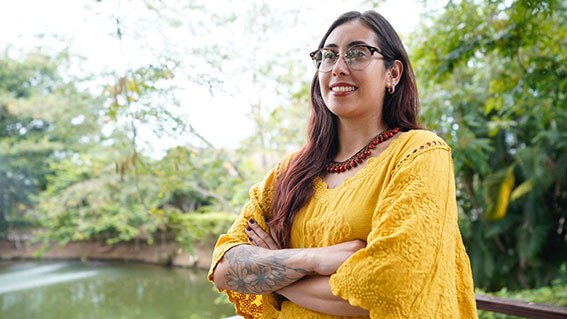
(interview from 2026)
Thomas Scheufler
Vanessa Ospina from Colombia coordinates forest conservation projects with indigenous peoples in six Amazonian departments to reduce deforestation and promote sustainable development.
A brief statement about your studies at TU Dresden:
"I never thought I would be able to study in Germany until I heard about DAAD scholarships. As a student from a Latin American country, going to an European country is very complicated due to the language barrier and financial resources, but this opportunity opened up many doors in my life. I am the first in my family to obtain a degree of this magnitude, something that makes me feel very proud."
|
Profile of |
Vanessa Ospina |
|
Degree program |
Tropical Forestry and Management |
|
Faculty |
Faculty of Environmental Sciences |
|
Studienzeit |
2014 - 2016 |
|
Current activity |
Focal point at the Vision Amazonia international program |
Why did you decide to study at TU Dresden?
I decided to study at the TU Dresden University because I attended a presentation given by a professor Jürgen Pretzsch from the Institute of International Forestry and Forest Products here in Colombia. I was very impressed by his work, so I decided to find out more about the institute via internet. I was very interested in the work they were doing in Africa and Vietnam, and I was very keen to gain international knowledge and experience in forest management so that I can apply it in the future in my work within the rural communities in the Colombian Amazon.
What factors drove you to choose your field of study?
From a very young age, I grew up on a farm in Colombia surrounded by forests, which led me to develop a green spirit. At the age of 18, I went to live in an indigenous community in the Colombian Amazon for a year, where I did my university internship as an ecologist. I fell deeply in love with the jungle and promised that I would devote my life to caring for the forests so that my children, grandchildren, and future generations could see the majesty that I was able to see.
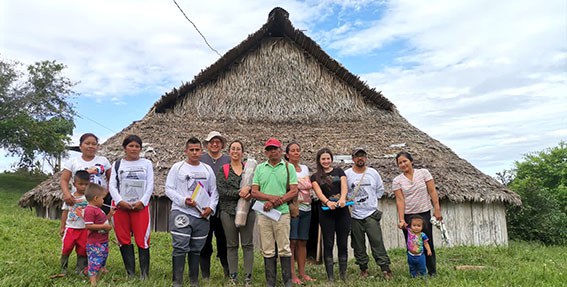
Community monitoring workshop in Solano, Caqueta. Within the framework of the service provision contract for the NASCA 00258/2021 project “Conservation of Watersheds in Colombia within indigenous peoples.” Between TNC Colombia and Fundacion Proterra.
Who from research and teaching influenced you the most during your studies?
During my studies at the TU Dresden university, I was very impressed by the work of Professor Jürgen Pretzsch, specifically how he integrated social, cultural and governance issues into forestry. I found it impressive how he changed paradigms to unify biological sciences, especially forestry, with social aspects into the tropical forest governance.
Where are you employed today, and what are your responsibilities?
Colombia presented voluntary commitments to the United Nations Framework Convention on Climate Change (UNFCCC) to reduce emissions, including deforestation. As a result of these commitments, Colombia government created Vision Amazonia in 2015, to reduce deforestation in the Amazon through a sustainable development model that contributes to improving the socioeconomic conditions of the Amazonian population, while reducing their high dependence on the extractive exploitation of natural resources. As a cooperation program It is funded by the governments of Norway, England, and KFW. My main responsibility in this program is to coordinate forest conservation projects with the indigenous peoples of the six departments of the Amazon region. This includes capacity building about project management, carrying out administrative and financial monitoring, and forging alliances with local, national, and international actors, among other things.
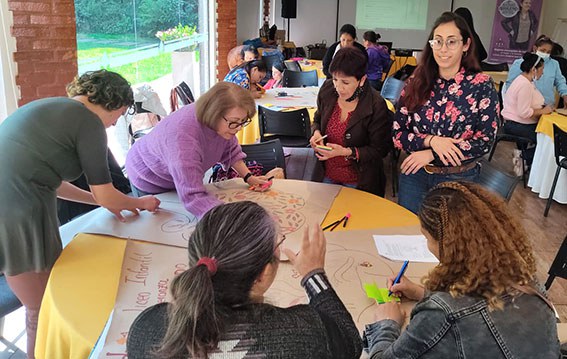
Workshop on strengthening gender equality for officials of the UNDP. Within the framework of the service provision contract with Proterra Ngo for the United Nations Development Program
What advice would you give to today's first-year students?
Follow your dreams, not the dreams of others. Sometimes the academy institutions can lead you down paths that maybe you don’t want to choose, but you must give the academy the tools to build your dreams. That is the true secret to becoming an excellent professional, be able to enjoy what you do, and turn you work in a interesting part of your life.
What do you remember most fondly from your student days?
I remember the wonderful evenings with my international friends. Every month we could cook at someone's house, preparing traditional dishes from their country. We became like family during those two years of the master's program. Their stories, food, dances, and long nights became unforgettable moments in my life, and unforgettable friends that became as a family until today.
Where was your favorite place at university?
My favorite place was the library. It was incredible to see such a large and well-stocked library, with such old books and unlimited access to so much international knowledge, to books that even I didn't know about. I discovered unique spaces and a wonderful infrastructure in this space, which seems unreal.
What do you still benefit from today/would you have liked more?
With this opportunity to study in a foreign country, with people from such a diverse culture, taught me to be a flexible and adaptable person, something that was very important when I returned to my country and when I had to work with diverse stakeholders, from the political and scientific spheres to grassroots organizations. Likewise, this experience gave me a broad of international network that is very important nowadays for my cooperation work. I consider myself as an important bridge, connecting knowledge and people from Germany and Colombia.
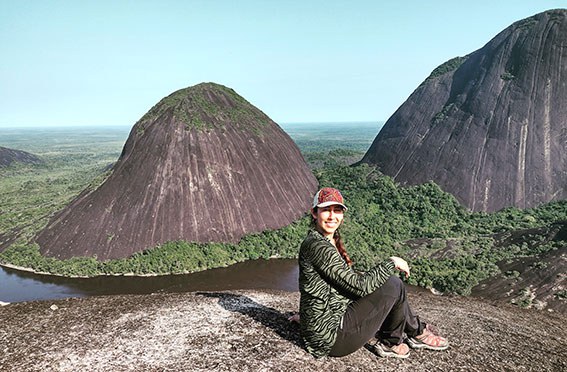
Cerros de Mavicure, Puerto Inirida. Field trip as part of the monitoring and follow-up for the indigenous projects. Vision Amazonia Program
How do you manage a good career start in your industry?
The most important thing when someone wants to be part into an international program is to have a good network of contacts, which is very useful when you are in a foreign country. It is essential to learn how to interact in different spaces and with different actors in order to secure a position and to learn the tools of an assertive communication. As well as, the methodologies and knowledge that brought my colleagues from around the world, some of which I could replicate in my own country and work.
What connects you with TU Dresden today?
I am an active member of the alumni network, specially at the Institute of International Forestry and Forest Products. I have participated in diverse events organized by the Institute and I am interested in staying connected with the faculty and, above all, in sharing my experience with current students, as well as being a network for them when they want to return to their country of origin in Latin America.