
Nov 11, 2025
Full-circle moments
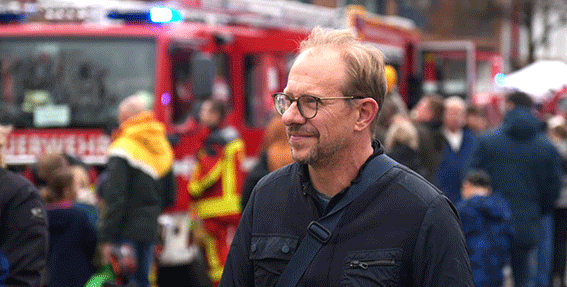
Tobias Bergmann
(interviewed in 2025)
Dagmar Möbius
Tobias Bergmann was born in Munich and grew up in Lower Bavaria. In 1992, he came to TUD Dresden University of Technology to study Economics. After holding various positions in business, Tobias Bermann became Lord Mayor of the city of Neumünster in Schleswig-Holstein in 2021.
Tobias Bergmann first encountered economic and societal problems when he was just a small child. As a result of the 1972 Olympic Games, his parents, who were still students at the time, could no longer afford their apartment in Munich and moved to the countryside, where his father later served as mayor.
Eastern adventure
At 21 years old, math-aficionado Tobias Bergmann came to TUD to study Economics. “Moving to the East to study capitalism was illogical,” says the 54-year-old today. He could have also studied at the University of Regensburg. But he found Dresden incredibly interesting and laughs, “This was just after the fall of the Berlin Wall, and it felt like a real adventure for me as a ‘Wessi’ or West German.” East German universities were not included in the university rankings, but TUD was among the top universities for economics. “The newly established faculty, headed by Dean Ulrich Blum, offered opportunities for young professors. They were too young for the West, and it was a real talent factory. I really liked that,” says Tobias Bergmann.
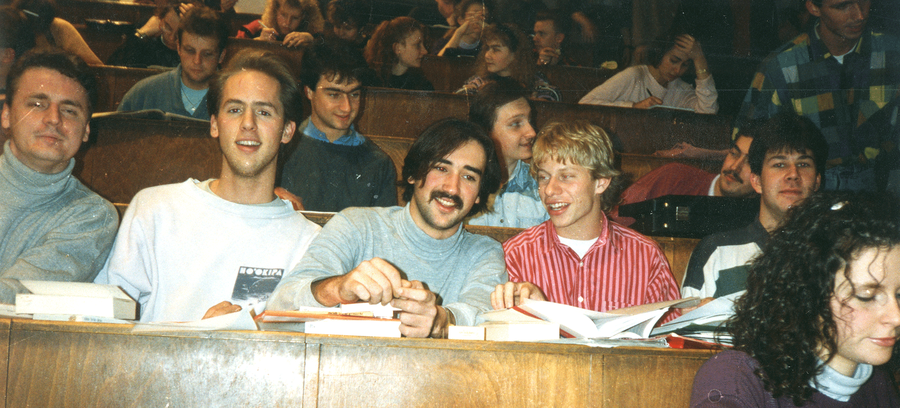
In the lecture theater in the Willers Building
Political interest for a better society
He was already very interested in politics back then. He was also convinced that you need to have an understanding of economic interrelationships in order to shape and improve a society. He witnessed major economic upheavals and discord in his neighborhood, in addition to a formative economy, which Kurt Biedenkopf, who was at the time Minister President of Saxony, was committed to promoting. “Economics was happening outside of the classroom too – and I wouldn’t have found that in Regensburg,” he is convinced.
No fear of the language of mathematics
And there was something else that appealed to Tobias Bergmann: “Economics has its own language: mathematics. And I wasn’t afraid of that.” He had strict, but good math professors. “They had all studied in Leningrad,” he recalls. Unfortunately, he can’t remember their names. “When you were able to speak the language, you could appreciate the beauty of economics,” he says, comparing it to “Shakespeare's poetry in English.”
Rock and roll in Plattenbau
Tobias Bergmann didn’t live in a student dormitory. Instead, he founded a flatshare, christened the WG Casablanca in a prefab concrete building in Dresden-Niedersedlitz. This was uncharted territory for the housing cooperative that owned the property, and there was some resistance to the idea. But for the entirety of his studies until 1999, Tobias Bergmann lived there with other students on Schönaer Straße. “Back then, Dresden was rock and roll for me. Or, to quote the words of East-German rock band the Puhdys, ‘ein Aufbruch in eine neue Zeit’ (The dawning of a new era).”
Freemover abroad
Every Monday evening, he would go to Italian classes at TUD. “I never really made any quantum leaps in the subject,” he laughs. But: “I was the first Dresden student who wanted to go to Italy with Erasmus. Most went to England or France.” Tobias Bergmann spent two semesters in Parma. But not as part of Erasmus. As a freemover, he didn’t live in student dorms, but instead found that he could learn Italian better by living with the locals. Their approach to economics was also different from that of neoclassical Dresden. "Professor Seravalli, my professor there, had been a member of the Italian Communist Party for many years. There is no single truth,” he concluded, viewing different approaches as equally valid.
Career paths and meta-skills
Tobias Bergmann worked as a student assistant for Prof. Bernd Raffelhüschen. The well-known economist made a lasting impression on him.
After completing his studies, he then worked in a number of small jobs in Berlin and Cologne. In 2000, he joined the management consultancy Ramboll in Hamburg and learned how to develop consulting skills as an economist in junior staff programs. “Scandinavian culture made a big impression on me,” he says. In 2009, he and his colleagues founded Nordlicht Management Consultants GmbH. He describes his meta-skills as: “Breaking down complex issues and separating the important from the unimportant.” He then worked as a freelance consultant for four years.
A switch to the decision-making side
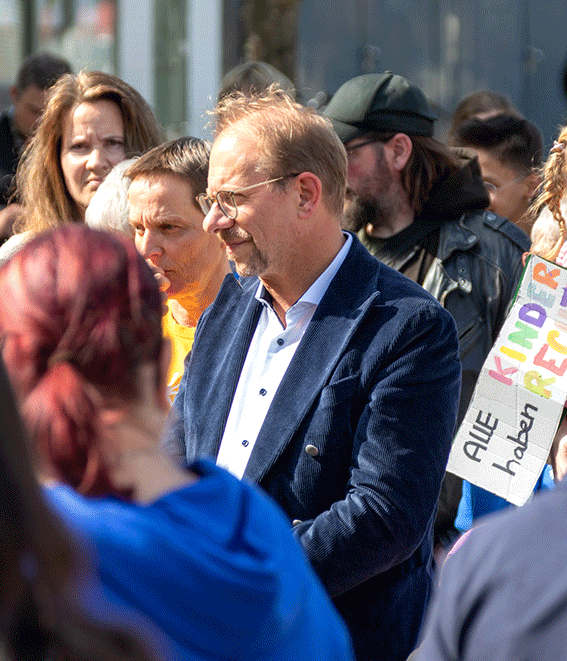
Tobias Bergmann's name was recommended when the city of Neumünster was electing a new mayor. A member of the SPD since his youth, he was more focused on his professional career than holding a political office. Biographically, he had no connection to the city, which has a population of 80,000 and is located in Schleswig-Holstein. But making the change from consultant to decision-maker appealed to him. In September 2021, he was elected Lord Mayor and has been the head of the autonomous city of Neumünster ever since. His daily challenges are considerable: “We're not a university town and are facing a difficult financial situation.”
Priorities instead of a list of 20 bullet points
Tobias Bergmann would nevertheless describe himself as a happy Lord Mayor. Why? Because, “As Lord Mayor, you always need to reach political decisions within an economic framework. A solid understanding of economics and business is therefore a huge advantage. Of course, I take legal advice, but when it comes to economics, I am able to assess many things myself.”
He most benefits from the mindset he developed during his studies: Economists transpose problems into models—in doing so, they inevitably have to reduce complexity and learn to distinguish the essential from the nonessential. You can't rely on 20 bullet points to make your case. You have to prioritize, structure, and think in terms of models. This skill still helps me today."
An indirect on-stage personality
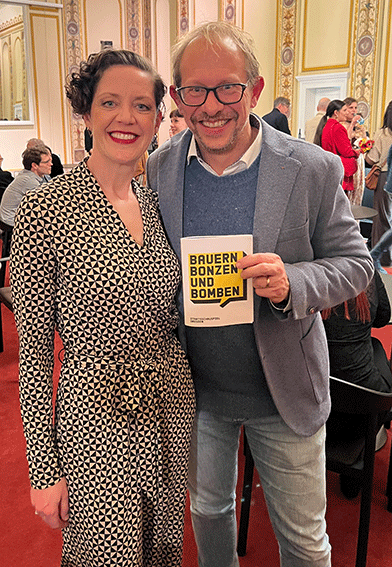
Lord Mayor Tobias Bergmann meets actress Betty Freudenberg at the Dresdner Schauspielhaus
Tobias Bergmann visits Dresden regularly. He maintains private contacts in the city, and his godson recently graduated from high school here. At the beginning of 2025, he bumped into the Rector, Prof. Ursula Staudinger. “I met her at a premiere at the Schauspielhaus Dresden,” he says. The play performed was A Small Circus, which is based on the novel by Hans Fallada. "The play is set during the Weimar Republic in a small town in northern Germany. Unmistakably Neumünster. One of the main characters is the town’s mayor,” grins Tobias Bergmann. He sees many parallels with the present day. “Novels and plays show how conflicts escalate and democracy comes under pressure.”
And so we come full circle.
Contact:
Tobias Bergmann