
Aug 28, 2026
Accompanying Dr. Simon Syga to a conference — amongst the ranks of Nobel prize winners and early-career researchers
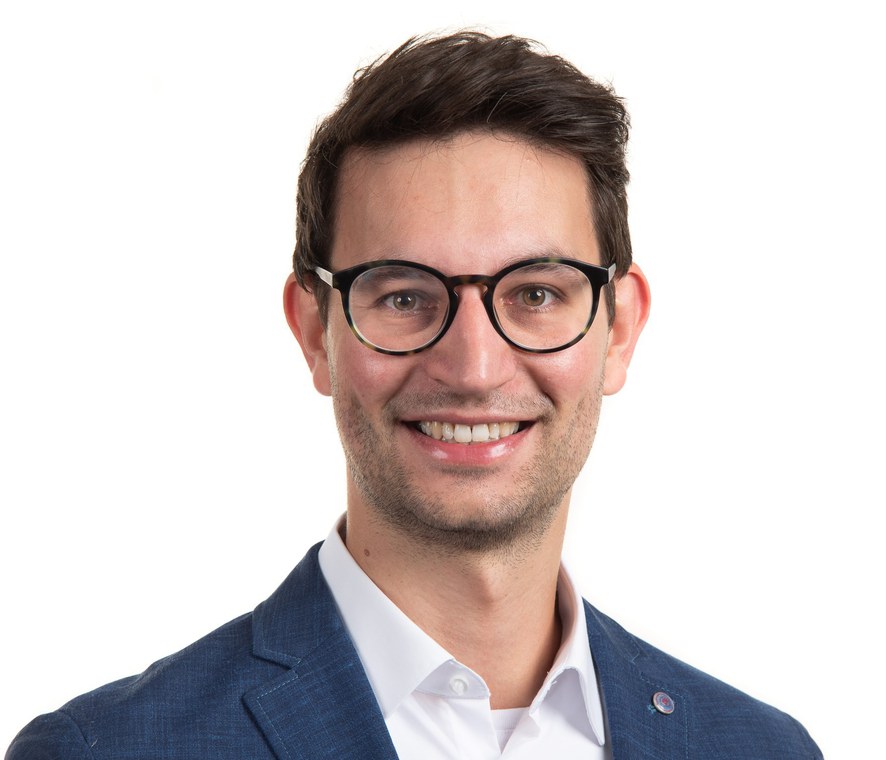
Dr. Simon Syga, mathematician at the Center for Interdisciplinary Digital Sciences (CIDS), achieved a dream of meeting leading figures in science in person this summer. The 75th Lindau Nobel Laureate Meeting brought together 75 Nobel prize winners and several hundred early-career researchers from around the world. For any young researcher, it is an honor and a distinction to be invited to the Nobel Laureate Meeting. Dr. Syga was nominated for the conference by Prof. Andreas Deutsch from the Center for Information Services and High-Performance Computing (ZIH).
Simon Syga combines mathematics, physics, and oncology, using mathematical models to investigate how tumors develop and where therapies can be applied. He also demonstrates how science can be accessible to a broad audience as a co-author of the book “The Mathematics of the Pandemic.”
We asked him what he thought of the intensive week at Lake Constance — and what unforgettable encounters and fascinating insights he’s bringing back with him to Dresden.
Dr. Syga, can you explain to everyone not involved in research: How do you get an invitation to the famous Lindau Nobel Laureate Meeting?
Answer: It’s usually the case that you’re nominated first by a university or research institution. I was nominated by the Center for Interdisciplinary Digital Sciences (CIDS) at TUD and then put forward alongside Dr. Tianyi Zhang from the Faculty of Physics. The next step involved the application itself, for which I needed to submit a CV, a letter of motivation, a list of publications, and two letters of recommendation.
The 2026 anniversary conference was deliberately designed to be interdisciplinary — a perfect fit for you as a scientist, researching where mathematics, physics and oncology overlap.
Answer: Yes, I studied physics, earned my PhD in mathematics, and now work on solving problems in medicine and biology. The conference gave me the opportunity to get into conversation with Nobel laureates and young scientists from a wide variety of disciplines. I also found the interdisciplinary discussion panels particularly interesting, such as those on “food security” and “science in changing climate.”
Was there any specific Nobel laureate that you found particularly impressive? What can you tell us about them?
Answer: I particularly remember Katalin Karikó, who received the Nobel Prize in Physiology/Medicine in 2023. She gave a very personal lecture and told us not only about her research, but also about the highs and lows of her career. There were a number of major scientific breakthroughs, but also setbacks to deal with, such as rejected grant applications, a demotion, and the loss of research positions. Her story showed me that good ideas and important research aren’t always immediately recognized nor rewarded, and that it really takes perseverance, support and a certain amount of luck.
Which conversation, lecture or specific moment was the unexpected highlight of the week for you?
Answer: The unexpected highlight were definitely the Laureate lunches, which were small group lunches with some of the Nobel laureates. This was where I learnt about Saul Perlmutter’s initiative “Scientific thinking for all.” Alongside his colleagues from other disciplines, he developed a course that focuses less on learning scientific facts off by heart and more on teaching scientific thinking: How do you deal with uncertainty? How do you evaluate evidence? How do you deal with counterarguments, and when should you be willing to change your own opinion? This is a very important issue and I would love to see similar courses and lessons offered here at TUD as well.
You use mathematical methods to model how tumors develop and thus pave the way for new therapeutic approaches. Did you gain any insights in Lindau that might be relevant to your work at CIDS?
Answer: With my own research in mind, it was especially interesting for me to meet potential project partners from the field of clinical biology. Especially for mathematical models in cancer research, collaboration with researchers working in experimental and clinical settings is crucial so that models can be tailored to specific biological matters and data. Several Nobel laureates also shared insights into how they lead their own research groups.
The week really reinforced my belief that science is not just about answering increasingly specialized questions within one’s own field. It’s also about engaging with other disciplines and contributing scientific insights to societal debates. This all makes me cautiously optimistic that we can also overcome major challenges, such as the climate crisis or water and food shortages, if scientific findings are taken seriously and incorporated into political decisions.
Thank you very much for the interview!