
Jan 01, 2026
Funding start for the five TUD Clusters of Excellence
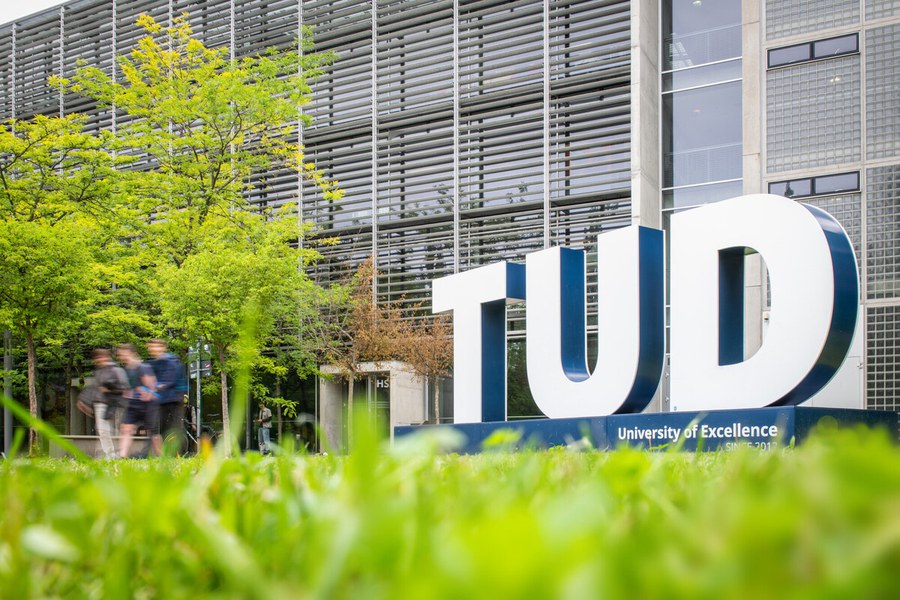
This makes it one of the five most successful universities nationwide in this funding line of the Excellence Strategy and also the strongest technical university.
The seven-year funding phase for the five clusters of excellence at TUD began on January 1. Last year, TUD not only defended its three established clusters of excellence, CeTI, ctd.qmat (formerly ct.qmat), and PoL, but also successfully acquired two more: CARE and REC2.This makes it one of the five most successful universities nationwide in this funding line of the Excellence Strategy and also the strongest technical university.
All projects contribute to expanding knowledge in frontier areas of research, all seek solutions to major global challenges, and all are interdisciplinary in nature. This is no coincidence: groundbreaking discoveries arise from the interplay of many perspectives. That is why TUD sees itself as “The Collaborative University.”
TUD manages three of the Clusters entirely on its own, the other two are university consortia, one with Julius-Maximilians-Universität Würzburg and the other with RWTH Aachen University. The five Clusters of Excellence cover the fields of resource-efficient construction, sustainable microelectronics, robotics and tactile internet, quantum physics, as well as physics of life.
The areas of research that will receive funding are diverse and future-orientated:
CARE is driving the disruptive transformation of the construction industry towards climate-neutral, resource-efficient and socially sustainable solutions. The team develops innovative mineral materials and circular construction principles and transfers them into scalable applications using digital methods, automated production and holistic sustainability assessment. Demonstrators, joint research and transfer platforms as well as close industrial partnerships accelerate the path to practical application - and enable the early involvement of society and politics.
Through close interdisciplinary collaboration, CeTI aims to enable humans and machines to interact in real time in global real and virtual environments. The second funding phase focuses on researching specific areas of application, including immersive remote collaboration, AI-supported workforce assistance, sensory augmentation in healthcare, and telepresence to reduce travel. The goal is to develop technological solutions for global challenges such as pandemics, aging societies, climate change, and skills shortages.
ctd.qmat researches and develops novel quantum materials with tailor-made properties. Around 300 researchers from more than 30 countries are laying the foundations for the technologies of the future at the interface between physics, chemistry, and materials science. In the second funding period, the focus has expanded to include the dynamics of quantum processes. A better understanding of quantum dynamics is considered key to harnessing novel phenomena in quantum materials for applications such as green energy technologies, quantum computing, and highly sensitive sensor technology.
Over the next 7 years, PoL wants to uncover the physical principles that govern spatiotemporal organization in living matter. The team will specially focus on physical mechanisms that enable biological robustness and function at molecular, cell, and tissue scales. By developing new quantification techniques, and leveraging computational approaches and AI, PoL will bring the study of living matter to the next level. This interdisciplinary approach, along with the collaborative environment in Dresden, will help to achieve PoL’s ultimate goal: understanding what brings matter to life.
Over the upcoming 7 years, REC2's main goal is to establish the scientific foundation for responsible electronics. The cluster will create new material libraries that enable component reuse, investigate biodegradable materials for short-lived devices, and demonstrate self-sufficient sensing and communication systems that significantly reduce e-waste and energy demand. By uniting an interdisciplinary team of natural scientists, engineers, social and environmental scientists, economists, as well as resource management and recycling experts, REC2 will pave the way for responsible electronics – ultimately, the electronics of the future.
A total of 70 Clusters of Excellence receive up to EUR 10 million per year from the Federal and State governments.
Further information on the five Clusters of Excellence
© TUD