
Sep 24, 2026
Fruity Flavors for Greener Solar Cells
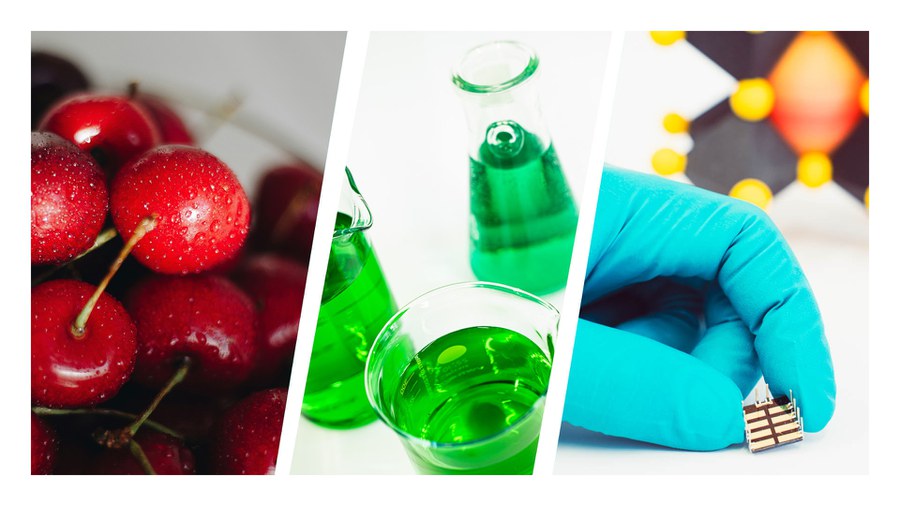
From the food industry to solar cells: Researchers at the REC² Cluster of Excellence are investigating environmentally friendly solvents for the more sustainable production of perovskite solar cells.
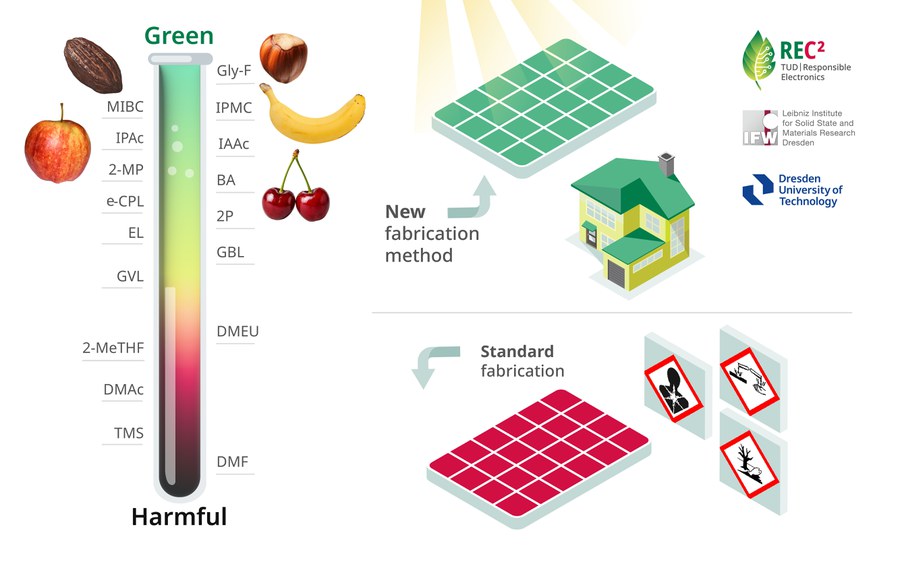
Fascinating findings: Researchers from the REC² Excellence Cluster at TUD Dresden University of Technology and IFW Dresden have developed a new method for fabricating more environmentally-friendly perovskite solar cells. Using computer models, scientists from TUD and the Leibniz Association’s Cluster of Excellence “REC² – Responsible Electronics in the Climate Change Era” can predict which less harmful solvents are suitable for manufacturing the cells. Some of these substances have previously been used primarily as flavoring agents in the food industry. Initial solar cells produced using these solvents perform similarly to conventional cells made with toxic solvents, pointing to a promising path toward more responsible manufacturing of electronic technologies.
Perovskite solar cells are considered a promising technology for next-generation photovoltaics because they can achieve high efficiencies using solution-based manufacturing processes. However, their production commonly relies on solvents that can be harmful to human health and the environment. Finding suitable alternatives is challenging because the properties of a solvent can strongly influence how solar-cell materials are processed and how well the resulting device performs.
The search for new solvents has traditionally relied on experimental trial and error. Researchers test different substances in the laboratory until they find a combination that works. The team from the REC² Excellence Cluster at TU Dresden, IFW Dresden, and the Universidad Nacional del Sur in Argentina has now developed a predictive approach that changes this starting point. By combining several physical and chemical models, the researchers can identify promising green solvents before they are tested experimentally.
“We noticed a complete absence of approaches to systematically address the problem of toxic solvents in solution-based solar cells. That made us ask whether we could rethink the way we search for suitable solvents altogether,” says Prof. Dr. Yana Vaynzof, Director of the IFW Institute for Emerging Electronic Technologies (IET) and Chair for Emerging Electronic Technologies at Technical University Dresden.
The researchers used their approach to identify previously unexplored green solvents, including edible additives used in the food industry, and demonstrated their suitability for perovskite solar-cell fabrication. The resulting devices were just as effective as those produced using conventional toxic solvents. Because the method can also be applied to the search for additional solvent candidates, it could reduce the number of experiments needed and help researchers explore a much broader range of sustainable alternatives.
The work reflects the approach of the REC² Excellence Cluster, which aims to make electronics more responsible across their entire life cycle. It contributes to three of the cluster’s six Responsible Aim Programs: Replace, Reduce, and Recycle. By reducing reliance on toxic substances and the resources required to identify suitable alternatives, the approach could help lower the environmental impact of solar-cell manufacturing while supporting the development of more sustainable electronic technologies.
The researchers’ next step is to investigate the potential of green solvents for improving the recyclability of perovskite solar cells. The predictive approach could also be transferred to other solution-processed electronic technologies, opening new routes towards more sustainable manufacturing.
The study “A predictive approach for fabricating efficient perovskite solar cells using green solvents” was published online in Energy & Environmental Science on August 11, 2026.
Publication: J. R. Bautista-Quijano, H. Heffner, V. V. Shilovskikh, B. Rivkin, I. López Corral, Y. Vaynzof, A predictive approach for fabricating efficient perovskite solar cells using green solvents, Energy & Environmental Science (2026). DOI: 10.1039/d6ee02509a.
REC²
The Cluster of Excellence REC² at TUD Dresden University of Technology catalyzes a paradigm shift in electronics by placing ecological, social, and economic sustainability on an equal footing with technological performance throughout the full life cycle of electronic devices.