
Nov 06, 2026
Outstanding Contributions to German Neurology—Honorary Award for Prof. Heinz Reichmann
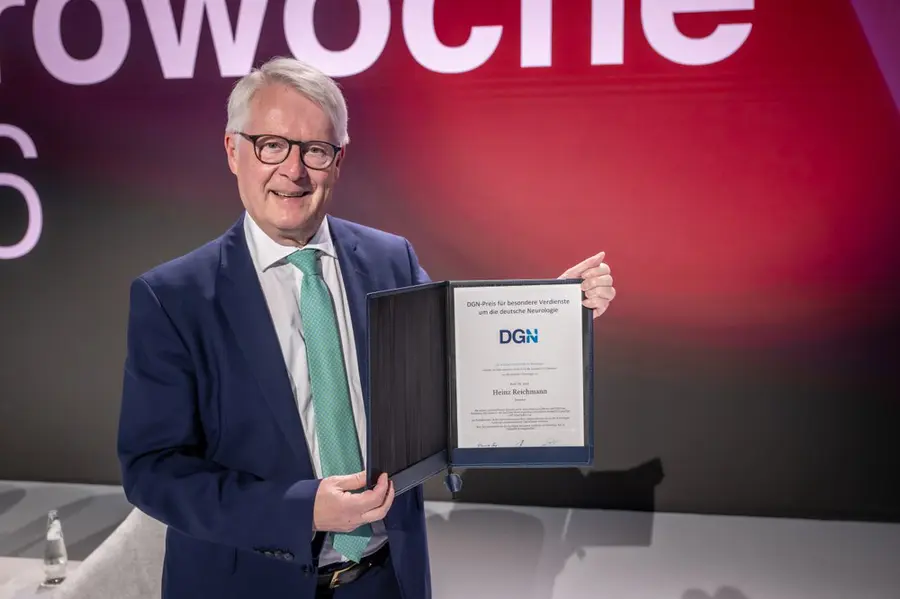
Die Deutsche Gesellschaft für Neurologie (DGN) zeichnet Prof. em. Heinz Reichmann mit dem „DGN-Preis für besondere Verdienste um die deutsche Neurologie“ aus.
The German Society of Neurology (DGN) is honoring Prof. em. Heinz Reichmann with the “DGN Award for Outstanding Contributions to German Neurology.” The award ceremony took place on November 4, 2026, as part of the opening event for the DGN’s annual meeting in Berlin. With this honorary award, the Executive Board recognizes Prof. Heinz Reichmann’s scientific and clinical excellence, as well as his decades-long commitment to the advancement of neurology in Germany and Europe. For Dresden University Medical Center, the award presented to Prof. Heinz Reichmann also serves as a tribute to a figure who has played a decisive role in shaping the institution over many years. As Director of the Department of Neurology at Dresden University Hospital and Dean of the Faculty of Medicine at TUD Dresden University of Technology, he has combined the advancement of patient care with the expansion of structures with high research capabilities and a forward-looking medical education program.
“For many years, Heinz Reichmann has shaped the Faculty of Medicine with foresight, drive, and a special knack for scientific collaboration. As dean, he brought people and disciplines together and was committed to advancing both research and medical education in equal measure. It was particularly important to him to inspire young people to pursue medicine and to provide them with opportunities for their scientific development. This award honors an outstanding neurologist and university professor to whom Dresden’s academic medicine owes a great deal,” says Prof. Esther Troost, Dean of the MF-TUD.
“Heinz Reichmann is one of the pioneers of Dresden’s university medical system. He is among those who played a decisive role in building up and shaping the institution after 1990. This applies not only to the important field of neurological disorders but to the entire Dresden University Hospital. He recognized early on what structures were needed to bring cutting-edge medicine to the broader community and implemented forward-looking projects accordingly. We warmly congratulate him on this well-deserved honor and thank him for his lasting contribution to university medicine in Dresden,” says Prof. Uwe Platzbecker, Chief Medical Officer at Dresden University Hospital.
“As department director, Heinz Reichmann played a decisive role in shaping the development of university neurology in Dresden. His work embodies the commitment to bringing together scientific curiosity, clinical excellence, and responsibility for patients. In doing so, he has not only strengthened neurological care at our University Hospital but also created an environment in which research and the next generation of physicians could thrive,” adds Prof. Hagen Huttner, who succeeded Heinz Reichmann as Director of the Department of Neurology.
Pioneering Work from Dresden for Germany
Prof. Heinz Reichmann is one of the leading figures in German neurology. Since his appointment as Professor of Neurology at the TUD Dresden University of Technology in 1996, he has played a key role in shaping and advancing university-based neurological care at the institution. In the years that followed, structures were established that cover the entire spectrum of modern neurological care—including one of the first stroke units in Saxony, one of the first telemedical stroke networks in Germany, and a center of excellence in movement disorders with national and international relevance and visibility.
Networking Research, Advancing Teaching
As dean from 2005 to 2021, Reichmann worked to integrate Dresden’s university medical system into scientific networks with strong capabilities. During his tenure, three German Centers for Health Research were established in Dresden: the German Center for Diabetes Research, the German Center for Neurodegenerative Diseases Dresden, and the German Consortium for Translational Cancer Research. By leading a graduate research training program with partners from the Max Planck Society and the Center for Regenerative Therapies Dresden, he fostered collaboration across disciplinary and institutional boundaries. The training of the next generation of medical professionals was a particular priority for him. Prof. Heinz Reichmann played a key role in launching the MEDiC model degree program in human medicine, which began in 2020. His tenure also saw the expansion of the faculty’s internal funding program, MeDDrive, to include teaching support, and the founding of the Medical Interprofessional Training Center as a pilot project. In doing so, he provided impetus for a practice-oriented and innovative education for future physicians.
Commitment to German and European Neurology
Beyond Dresden, Prof. Heinz Reichmann also took on responsibility for the development of his field. As president of the DGN in 2009–2010 and as president of the European Neurological Society in 2012–2013, he shaped the field of neurology both nationally and internationally. In its citation, the DGN particularly highlights his pivotal contribution to the merger of the European Neurological Society and the European Federation of Neurological Societies into today’s European Academy of Neurology. “With the DGN Award for Outstanding Contributions to Neurology, the German Society of Neurology therefore honors not only his outstanding scientific and clinical achievements throughout his career. It honors a neurologist who has taken responsibility for his field, shaped the DGN as president, and worked with great dedication to foster a strong, united European neurology. His work exemplifies a field of neurology that drives scientific progress, shares knowledge, and collaborates across borders,” reads the laudatory speech delivered at the award ceremony.
The award ceremony took place as part of the opening event of the DGN Congress (Neurowoche) on Wednesday, November 4, 2026, in Berlin. https://www.dgn.org/dgn-kongress