
02.04.2026
DFG fördert neue Dresdner Forschungsgruppe zur Immunsteuerung nach Herzinfarkt mit sieben Millionen Euro
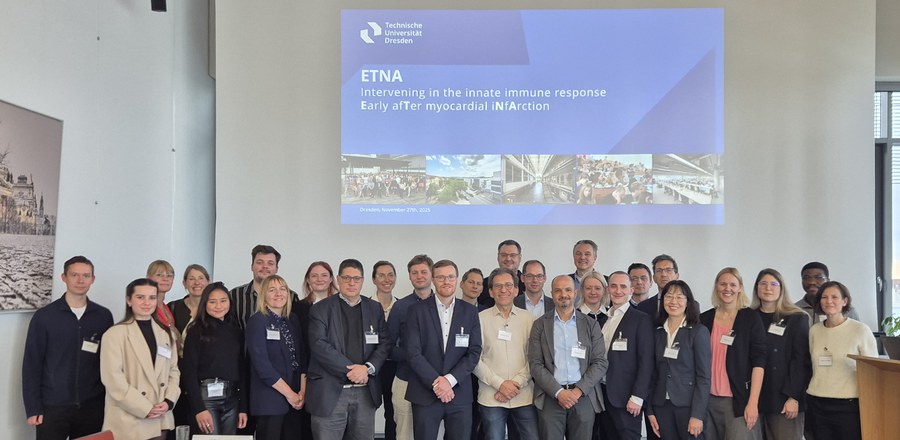
Die Forschungsgruppe FOR 5953.
Herzinfarkt und die daraus entstehende Herzmuskelschwäche gehören weltweit zu den häufigsten Todesursachen. Nach einem Infarkt reagiert das Immunsystem mit einer starken Entzündungsreaktion, die einerseits notwendig für die Heilung ist, andererseits aber auch zusätzliche Gewebeschäden verursachen kann. Wie stark und in welcher Form diese Reaktion abläuft, entscheidet maßgeblich über den Heilungsverlauf und die spätere Herzfunktion. Die neue Forschungsgruppe an der Technischen Universität Dresden (TUD) untersucht, wie diese Immunreaktion gezielt gesteuert werden kann, um schädliche Prozesse zu begrenzen und heilungsfördernde Mechanismen zu stärken. Die Deutsche Forschungsgemeinschaft (DFG) fördert das Projekt mit rund sieben Millionen Euro für zunächst vier Jahre.
Die Forschungsgruppe FOR 5953 wird von Prof. Ali El-Armouche, Direktor des Instituts für Pharmakologie und Toxikologie an der Medizinischen Fakultät der TU Dresden und Sprecher der Forschungsgruppe, sowie von Prof. Kaomei Guan geleitet. Gemeinsam untersucht das Team spezifische Untergruppen von Immunzellen, deren Aktivität und Zusammenspiel in der frühen Phase nach einem Herzinfarkt für den weiteren Verlauf entscheidend sind. Während bisherige Therapien versuchen, diese Immunreaktion zu unterdrücken, werden im Projekt „Modulation der angeborenen Immunreaktion in der Frühphase des Myokardinfarkts (ETNA)“ neue Behandlungsansätze entwickelt, die die beteiligten Zellen nach dem Infarkt pharmakologisch verändern. Auf diese Weise sollen schädliche Entzündungsreaktionen begrenzt und heilende Mechanismen verstärkt werden.
Die Forschungsgruppe ist nahezu vollständig an der Medizinischen Fakultät der TUD verankert. Forschende aus Herz‑Kreislauf‑Forschung, Immunologie und Pharmakologie arbeiten eng zusammen, um neue Erkenntnisse schneller in die Anwendung zu bringen. „Die Förderung ermöglicht uns, ein leistungsfähiges Netzwerk aufzubauen und die kardioimmune Forschung am Campus der Hochschulmedizin Dresden nachhaltig zu stärken“, erklärt Prof. El‑Armouche. „Gemeinsam wollen wir neue Wege gehen, um die Behandlung von Patientinnen und Patienten nach Herzinfarkt entscheidend zu verbessern.“
„Ich gratuliere allen Beteiligten herzlich zu diesem Erfolg, der die wissenschaftliche Breite der Medizinischen Fakultät im Bereich der Herz‑Kreislauf‑Forschung sichtbar macht. Künftig wollen wir die enge Verbindung von universitärer Forschung und klinischer Expertise durch eine intensive Zusammenarbeit mit klinischen Partnern wie dem Herzzentrum Dresden vertiefen, um neue therapeutische Ansätze schneller in die Versorgung zu überführen“, sagt Prof. Esther Troost, Dekanin der Medizinischen Fakultät der TUD.
Angesichts der weltweit steigenden Zahl betroffener Patientinnen und Patienten ist Herzinfarktbehandlung ein Thema von zunehmender gesellschaftlicher Relevanz. Die Forschungsgruppe FOR 5953 strebt an, eine wichtige Grundlage für zukünftige Therapien zu schaffen und neue Perspektiven für langfristige wissenschaftliche Kooperationen zu eröffnen. Die DFG‑Förderung gibt dem Verbund dabei die wertvolle Möglichkeit, umfangreiche Forschungsstrukturen aufzubauen und innovative pharmakologische Ansätze konsequent weiterzuentwickeln.
Hintergrund
Forschungsgruppen der Deutschen Forschungsgemeinschaft (DFG) ermöglichen Wissenschaftlerinnen und Wissenschaftlern, sich aktuellen und drängenden Fragen ihrer Fachgebiete zu widmen und innovative Arbeitsrichtungen zu etablieren. Sie werden bis zu acht Jahre lang gefördert. Die neuen Forschungsgruppen erhalten insgesamt rund 65,7 Millionen Euro inklusive einer Programmpauschale in Höhe von 22 Prozent für indirekte Projektausgaben. Zusätzlich zu den 14 Neueinrichtungen wurde die Verlängerung von sieben Forschungsgruppen für eine weitere Förderperiode beschlossen. Im Ganzen fördert die DFG zurzeit 196 Forschungsgruppen, neun Klinische Forschungsgruppen und 17 Kolleg-Forschungsgruppen.
Wissenschaftlicher Kontakt:
Prof. Ali El-Armouche, Prof. Kaomei Guan
Institut für Pharmakologie und Toxikologie
Fiedlerstr. 42
01307 Dresden
Tel.+49 (0) 351 458 6255
E-mail: ,
Kontakt für die Medien:
Anne-Stephanie Vetter
Stabsstelle Öffentlichkeitsarbeit
Medizinische Fakultät Carl Gustav Carus
der Technischen Universität Dresden
Tel. +49 (0) 351 458 17903
E-Mail: