
Feb 11, 2026
Online citizen participation: TUD-led study reveals "eastern effect" in medium-sized and small towns and urban-rural divide
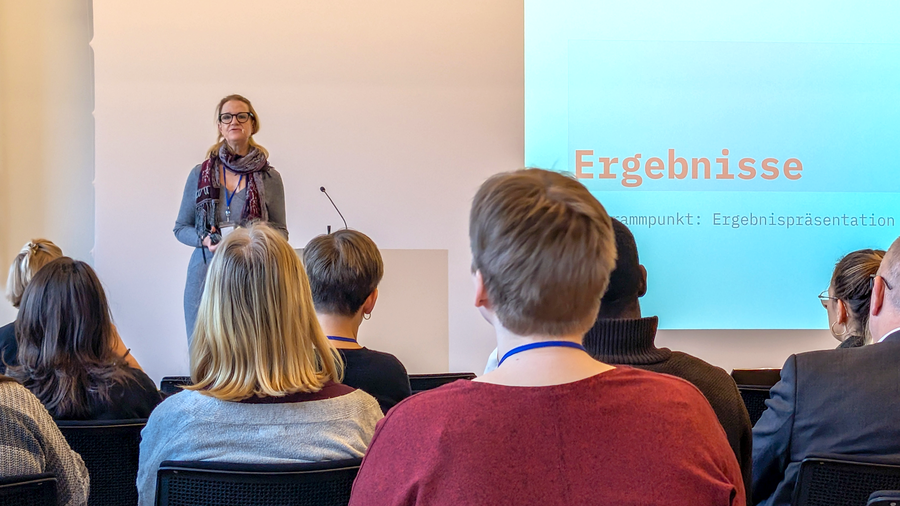
Prof. Marianne Kneuer, Chair of Political Systems and Comparative Politics at TUD, presenting the results of the study on success factors for online participation.
How widespread is online citizen participation in Germany? Researchers from TUD Dresden University of Technology, Heinrich Heine University Düsseldorf and the Universities of Leipzig and Koblenz surveyed over 10,000 cities and municipalities, looking closely at their online citizen participation. 2,390 cities and municipalities (22 percent) responded to the survey. More than half of Germany’s population (45 million people, or 54 percent) live in these locations. The sample shows that East German municipalities are ahead in terms of online citizen participation: On the whole, more cities and municipalities in East Germany offer opportunities for online participation than in the areas surveyed in western Germany. The lead is clearly distinguished in medium-sized and small cities. While 85 percent of medium-sized cities in East Germany offer online citizen participation, only 70 percent of medium-sized cities in western Germany follow suit; of small towns, the figure drops to 62 percent in eastern Germany and only 43 percent in western Germany. In the major cities, on the other hand, the West German municipalities take the lead.
The research project "Success factors for local e-participation” (German: Erfolgsfaktoren lokaler E-Partizipation), led by spokesperson Prof. Marianne Kneuer, Chair of Political Systems and Comparative Politics at TUD, provides the first overview of which methods for online participation municipalities utilize, what goals they pursue and how successful these measures are. The data collection is not representative. The researchers primarily document structural differences between large cities, smaller cities and municipalities in eastern and western Germany. According to the study, the primary aim, when looking at the methods of participation, is to make decision-making processes in politics and administration more transparent.
"The results of the survey were received extremely positively by stakeholders in the municipalities. They underlined that this knowledge resource had not been properly uncovered until now and will undoubtedly fill a gap," explains Prof. Marianne Kneuer. A dashboard on the project website provides a central overview platform for analyzing the data collected in the research project. It enables municipalities to compare approaches to participation, derive best practice procedures and improve what they can offer.
Small municipalities reluctant to turn to online participation methods
Whether cities and municipalities offer online participation at all depends heavily on certain location factors: This kind of access is primarily offered by large, populous municipalities with a high tax base and corresponding personnel resources in the administrative bodies. The average population of the municipalities in question is 47,000. While large cities in the sample almost exclusively provide online opportunities for citizen participation (96 percent), this is significantly less common in smaller cities and municipalities.
Municipalities in rural areas and small towns not only focus on online citizen participation much less frequently than larger cities - it is noteworthy to mention that when they do, they do so under different conditions and with different objectives. As a result, they tend to organize online participation more flexibly and without dedicated roles, while 63 percent of large cities in the sample have their own department or designated staff for it
It also makes a difference whether there are other municipalities in the area that offer these online methods of citizen participation: Municipalities that employ such methods have an above-average number of other municipalities in their area that also offer online participation.
The municipality types also differ noticeably in terms of their focus: The major cities focus on traffic development as well as climate and environmental protection: In both areas, more than 50 percent of major cities offer online participation. The smaller cities and municipalities, on the other hand, focus on urban and community development and the management of deficiencies.
Transparency: The most important goal of online citizen participation
In the sample surveyed, the most important goal for almost all municipalities is to make political decision-making processes more transparent. Almost 90 percent of large cities and more than 80 percent of small and medium-sized towns including rural communities make explicit reference to this objective. Reaching underrepresented groups is in 2nd place for large cities. The other types of municipality are more concerned with getting more people involved in politics in general.
"Online citizen participation can be a building block for a resilient democracy. Democracy starts at the local level. Our study shows the existing potential here and encourages an exchange of experience, traversing the gap between practice and science," summarizes Prof. Stefan Marschall, head of the study at Heinrich Heine University Düsseldorf.
Background: ErLE research consortium
TUD, Leipzig University, Heinrich Heine University Düsseldorf and the University of Koblenz are working together on the "Success factors for local e-participation" (German: Erfolgsfaktoren lokaler E-Partizipation, ErLE) project. The aim of the consortium is to identify what is necessary for ensuring the success of online citizen participation and to make this usable for municipal practice. Prof. Marianne Kneuer from TUD is the spokesperson for the research consortium. The project is funded by Stiftung Mercator.
Contact:
Bastian Stock
Institute of Political Science
Chair of Political Systems and Comparative Politics
Email: