
Dec 10, 2025
Dresden PROTHOR study provides new insights for greater patient safety in major lung surgery
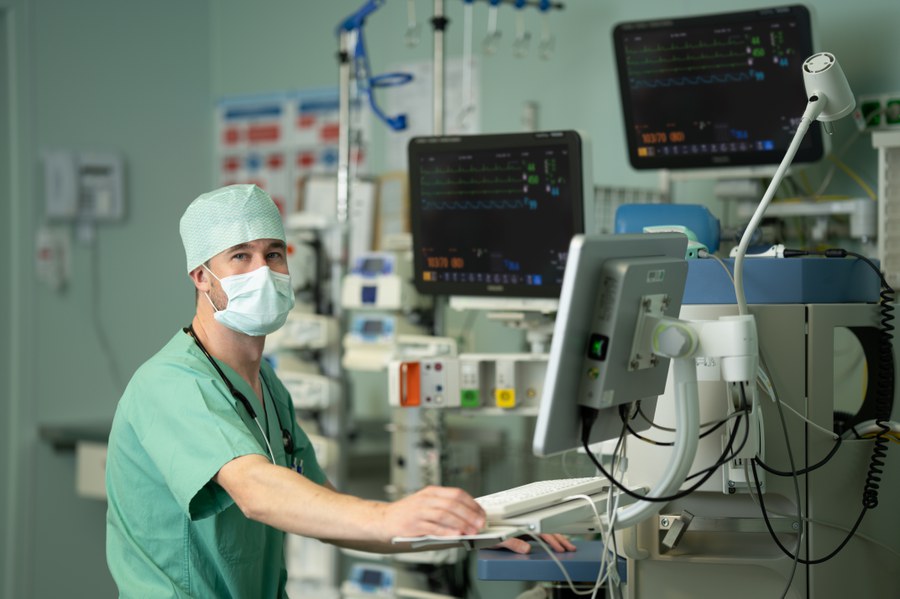
Dr. Jakob Wittenstein, international coordinator and first author of the PROTHOR study.
The Department of Anesthesiology and Intensive Care Medicine at the Carl Gustav Carus University Hospital in Dresden and the TU Dresden Faculty of Medicine has conducted the world's largest study on patient safety in major lung surgery. Until now, it was not clear how different ventilation strategies during lung surgery affect the risk of possible complications. The PROTHOR study now provides physicians with guidance on choosing the most appropriate ventilation approach during such anesthesia. The results of the study were recently published in the renowned journal Lancet Respiratory Medicine.
During lung surgery, the lung that is being operated on must be selectively collapsed while the other lung is mechanically ventilated. This process is known as one-lung ventilation. It places increased mechanical strain on the ventilated lung, raising the risk of postoperative pulmonary complications such as respiratory failure and pneumonia. Which ventilation strategy can reduce these complications during major lung operations had not been clarified until now.
The PROTHOR study, initiated and led by the Department of Anesthesiology and Intensive Care Medicine at the UKD and the Faculty of Medicine of TU Dresden, investigated whether ventilation with a higher positive end-expiratory pressure (PEEP) and recruitment maneuvers can reduce the risk of pulmonary complications compared to a strategy with lower PEEP without such maneuvers. PEEP refers to the pressure that exists in the lungs at the end of exhalation. Recruitment maneuvers help reopen closed alveoli. However, higher PEEP and recruitment maneuvers can also negatively affect blood pressure. Over a period of eight years, 2,200 patients at 74 centers in 28 countries were examined for this purpose.
The results showed that ventilation with increased PEEP and recruitment maneuvers led to better gas exchange in the lungs, whereas lower PEEP was associated with more stable circulatory conditions during anesthesia. The incidence of postoperative pulmonary complications did not differ between the groups. The choice of ventilation concept should therefore be made on an individual basis and after careful consideration of the patient's condition during surgery.
“These new research findings enable improved ventilation during complex lung surgery and contribute to patient safety. The PROTHOR study shows the responsibility we take on in patient care,” said Prof. Uwe Platzbecker, Medical Director at the University Hospital.
“University medicine in Dresden stands for close exchange between research and clinical care. The PROTHOR study impressively proves this and sets standards far beyond Germany,” said Prof. Esther Troost, Dean of the Faculty of Medicine at TU Dresden.
"This success was only possible thanks to the close and dedicated collaboration of 248 scientists from four continents. Our sincere thanks go to everyone involved—without their efforts, this study would not have been possible,” emphasized Dr. Jakob Wittenstein, international coordinator and first author of the study.
”Our clinic is particularly committed to transferring findings from clinical research into routine care. This is why we lead and support large international studies such as PROTHOR,” said Clinic Director Prof. Thea Koch.
“Especially in such complex procedures, anesthesia and differentiated ventilation play a crucial role in the success of the treatment. The PROTHOR study also shows us surgeons: That optimal ventilation strategy must be selected individually to enhance patient safety,” said Dr. Alexander Kern, who has been working as an additional specialist in thoracic surgery at the Dresden University Hospital since October.
Original publication
“Effects of intraoperative higher versus lower positive end-expiratory pressure during one-lung ventilation for thoracic surgery on postoperative pulmonary complications (PROTHOR): a multicentre, international, randomised, controlled, phase 3 trial”
https://www.thelancet.com/journals/lanres/article/PIIS2213-2600(25)00330-3/abstract
Study design
The international Phase 3 PROTHOR study included 2,200 adult patients scheduled for lung surgery requiring one-lung ventilation lasting more than 60 minutes.
They were randomly assigned to one of two groups:
- High PEEP (10 cm H₂O) with regular recruitment maneuvers
- Low PEEP (5 cm H₂O) without routine recruitment maneuvers
The primary endpoint was the occurrence of postoperative pulmonary complications within the first five days after surgery.
Results:
Postoperative pulmonary complications (PPCs):
53.6% in the high PEEP group vs. 56.4% in the low PEEP group
No statistically significant difference (p = 0.155).
Intraoperative complications:
Significantly more frequent with high PEEP (49.8%) than with low PEEP (31.3%).
Most common:
- Hypotension (low blood pressure): 37 % vs. 14 %
- New cardiac arrhythmias: 10 % vs. 4 %
Conversely, the low-PEEP group experienced more episodes of low oxygen levels (hypoxemia) requiring intervention (9% vs. 3%).
- Other non-pulmonary postoperative complications were similarly frequent in both groups (approx. 10%).
The total number of serious side effects was also similar (209 vs. 204 events).
Contact:
Univ.-Prof. Thea Koch
Director of the Clinic and Polyclinic for Anesthesiology and Intensive Care Medicine
Carl Gustav Carus Faculty of Medicine of TUD Dresden University of Technology
+49 351 458 4110
Anne-Stephanie Vetter
Staff Unit Public Relations of the Carl Gustav Carus Faculty of Medicine of TUD Dresden University of Technology
National Center for Tumor Diseases (NCT/UCC) Dresden
+49 351 458 17903