
Nov 17, 2026
Energy-efficient and reliable AI: Researchers from Bavaria and Saxony present milestones at the 2026 AI Summit
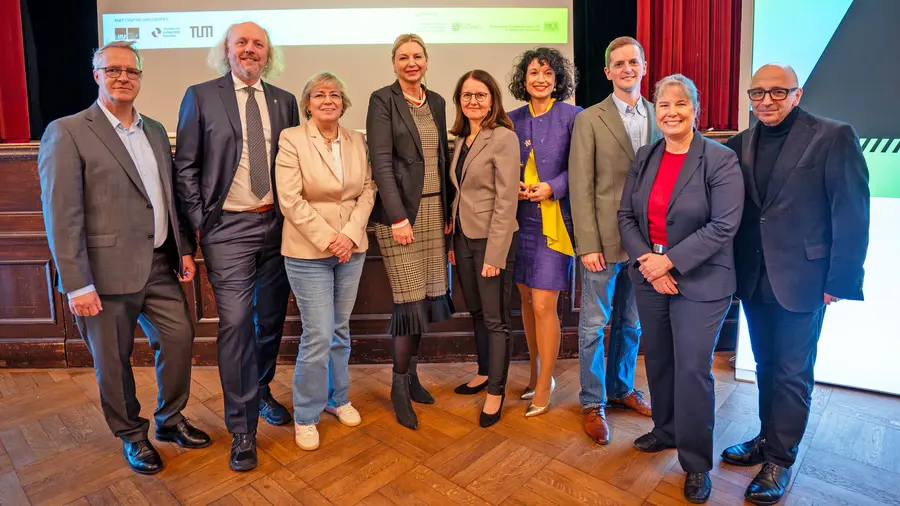
Vertreter:innen der Hochschulen und Länder beim gAIn-Summit in München, darunter Prof. Frank Fitzek, Prof.in Angela Rösen-Wolff und Prof.in Stefanie Speidel von der TUD.
At the AI Bavaria-Saxony Summit on November 16, 2026, researchers from TUD Dresden University of Technology, Ludwig-Maximilians-Universität Munich (LMU), and Technical University of Munich (TUM) presented key findings from their gAIn (Next Generation AI Computing) project. The high-level Bavarian-Saxon summit in Munich marked a strategic milestone and paved the way for the next phase of the project. With this initiative, Bavaria and Saxony are reinforcing their ambition to play a leading international role in the development of energy-efficient and reliable AI technologies.
Since the summer of 2024, renowned professors from TUD, LMU, and TUM have been working on the gAIn project to develop novel AI hardware and corresponding software concepts to solve problems in the areas of energy consumption, computability, reliability, and regulatory compliance. The researchers at TUD are pursuing a radical paradigm shift: analog computing.
Prof. Frank Fitzek, Deutsche Telekom Chair of Communication Networks and spokesperson for the Cluster of Excellence Centre for Tactile Internet with Human-in-the-Loop (CeTI) emphasizes: “With gAIn, we are revolutionizing today's digital AI solutions through analog and biological approaches to drastically reduce the enormous energy consumption of artificial intelligence. Today, we are demonstrating that analog computing can reduce energy consumption by a factor of 200." “
At the gAIn Summit, the team was able to present impressive interim results: By applying analog approaches to selected scenarios – such as the real-time classification of handwritten digits demonstrated at the summit – the researchers achieved 80 to 90 times greater energy efficiency than conventional digital hardware (CPUs), while maintaining an accuracy of around 90 percent. Where lower levels of accuracy are acceptable, energy efficiency can be increased by as much as a factor of 200.
Use Case: AI in the operating room
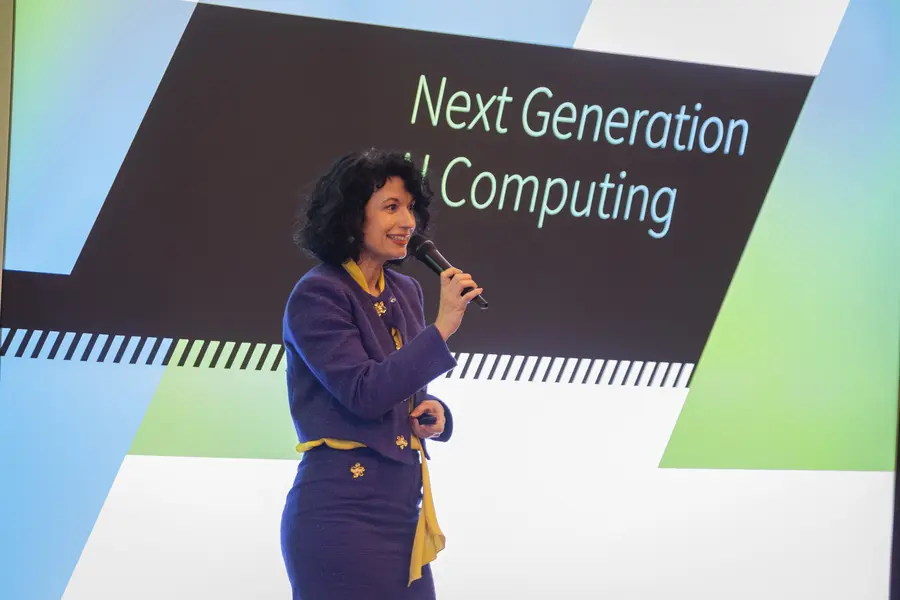
Prof. Stefanie Speidel, Professor for Translational Surgical Oncology, presentating intelligent assistive technologies for the operating theater.
In the medical field, TUD researchers are developing intelligent robotic assistance systems for use in the operating room. Using AI, these systems can recognize what is happening during surgery in real time and perform individual surgical steps semi-autonomously in response to voice commands. Thanks to the methods developed as part of gAIn, the models respond with significantly lower latency and run directly in the operating room rather than in a remote data center.
Prof. Ursula Staudinger, Rector of TUD, comments: “The results presented are impressive. They demonstrate the contribution our cutting-edge research can make to energy-efficient and reliable AI. By bringing together our strengths in information technology, mathematics, and hardware development in Dresden and Munich, we are strategically combining our areas of excellence while also advancing the technological sovereignty of Germany and Europe."
Mathematical foundations from Munich
LMU and TUM are investigating the mathematical foundations of reliable and energy-efficient AI. A key focus is on the fundamental possibilities and limitations of digital and analog computational models. Which computational challenges are amenable to diverse hardware architectures, and under what exact conditions can the correctness and dependability of their results be mathematically proven?
The researchers have demonstrated that digital methods reach fundamental limits when dealing with certain classes of problems, whereas analog computational models can provide solutions to these problems with mathematical guarantees. Examples include solving electrical circuit problems and detecting attacks on critical infrastructure. At the same time, these findings establish the theoretical foundations for closely integrating algorithms with novel hardware. The goal is to develop AI systems that not only consume less energy but also produce results that are both reliable and verifiable.
Against the backdrop of rapidly growing data volumes and the rising CO₂ costs associated with AI models, these findings represent a major breakthrough. Over the coming months of the first funding phase, the focus will be on further scaling up this technology and exploring its theoretical performance limits.
Strategic importance of the collaboration
The event was attended by Sebastian Gemkow, Saxon Minister of State for Science, Culture, and Tourism, and Stephanie Jacobs, Head of Department at the Bavarian State Ministry of Science and the Arts. Both emphasized the strategic importance of cooperation between the two states. “The close cooperation between our Free States of Saxony and Bavaria in the gAIn project is already paying off. One of the biggest problems with AI applications is their energy consumption. It’s impressive to see how it’s possible to develop AI systems with remarkable capabilities that require only a fraction of the energy of previous systems. This is what leading researchers in Bavaria and Saxony are making possible together," said Sebastian Gemkow, underscoring the significance of the project.
Stephanie Jacobs, Head of Department at the Bavarian State Ministry of Science and the Arts, added: “Bavaria and Saxony are a true powerhouse duo for next-generation AI: Bavaria and Saxony rely heavily on their Universities of Excellence and strategically combine their respective strengths. The two Munich universities — Ludwig Maximilians-Universität München and Technical University of Munich — are renowned for their cutting-edge research in mathematics and artificial intelligence, while TUD Dresden University of Technology is a leader in microelectronics and hardware development. Through the gAIn project, we are pooling this expertise and working closely across federal state borders to accelerate the development and practical application of energy-efficient and reliable AI. By doing so, we are strengthening Germany’s technological sovereignty and creating new opportunities for value creation in Europe.”
Background on the gAIn Project
The gAIn project is an interdisciplinary research collaboration among renowned scientists from LMU, TUM, and TUD. As part of this collaboration, innovative AI hardware components and corresponding software concepts are being developed to address challenges in the areas of energy consumption, computability, reliability, and legal implementation. The goal is to significantly reduce the energy consumption of AI-based applications while ensuring their computability and reliability. In addition, AI technologies are expected to meet applicable legal requirements.
Contact:
Doreen Böttcher
Public Relations
Deutsche Telekom Chair of Communication Networks at TUD
+49 351 463-40407