
Nov 16, 2026
Resounding success for Dresden and London: DFG awards a four-year extension of research training group on affective disorders

Researchers of IRTG 2773 investigate risk factors and disease mechanisms of affective disorders to pave the way to more precise diagnostics and more effective treatments.
The German Research Foundation (DFG) has approved the continuation of the “Risks and Pathomechanisms of Affective Disorders” (IRTG 2773) international research training group for another four years, with an extension until 2031. IRTG 2773 is a joint initiative of the Faculty of Medicine at TUD Dresden University of Technology and the Institute of Psychiatry, Psychology & Neuroscience at King’s College London (IoPPN). It currently provides an academic base for 73 international doctoral students and comprises ten research projects led by 29 project leaders from Dresden and London. With Prof Andrea Pfennig (Faculty of Medicine) and Prof. Katya Rubia (IoPPN) at the helm, these projects investigate risk factors and disease mechanisms of affective disorders to pave the way to more precise diagnostics and more effective treatments.
Depression and bipolar disorder are amongst the most common mental illnesses worldwide. They put not only those affected under considerable stress, but also their families and the healthcare systems. They are one of the main causes of employees’ inability to work. However, the reason behind why some people develop these conditions while others do not remains somewhat poorly understood.
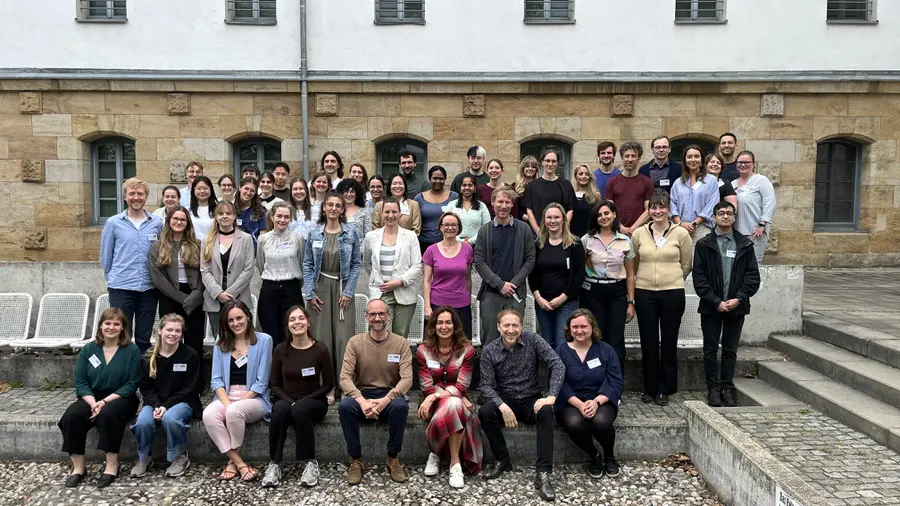
Group picture of the international research training group Risks and Pathomechanisms of Affective Disorders“.
IRTG 2773 approaches these issues using a broad methodological spectrum, ranging from imaging techniques and molecular genetic analyses to delving into psychological experiments and immunological processes. A translational focus takes center stage: Fundamental research findings will be translated into improved early detection, prevention and treatment. At the same time, clinical observations should generate new research questions.
Prevention and treatment tailored to individual risks
In its second funding period, the research group will build on the results of its first phase. The central question is: which combination of risk factors leads to the onset or manifestation of symptoms in certain individuals — and at what time — and which protective factors can influence the course of the disorder at critical turning points? The goal is stratified medicine that tailors prevention and treatment to better fit an individual’s risk of developing these disorders.
“Affective disorders often begin in early adulthood and can shape a person’s life for decades. This makes early, targeted interventions all the more important,” says Andrea Pfennig, Chair of Evidence-based Early Detection and Care for Young People with Affective Disorders at the Faculty of Medicine and spokeswoman of the IRTG. “The IRTG gives us the means to investigate fundamental questions about the origins of mental illness within an internationally outstanding and interdisciplinary framework.”
A new generation of researchers
Stefan Ehrlich, Professor of Psychosocial Medicine and Developmental Neuroscience at the Faculty of Medicine and deputy speaker of the IRTG, adds: “We are training a new generation of researchers who can confidently apply translational methods and integrate findings from neuroscience, fundamental research, and clinical practice. In the long term, we strive to identify high-risk groups earlier and to develop tailor-made, preventative treatment approaches.”
With its translational focus, the research group strengthens the link between fundamental research and clinical application at the University Hospital Dresden: It investigates the mechanisms of affective disorders on multiple levels and employs these findings to develop approaches for more precise diagnostics and earlier intervention. At the same time, it contributes to raising the institution’s international profile, as the Faculty of Medicine collaborates closely with King’s College London as part of transCampus through a strategic partnership that pools shared structures, expertise and infrastructure.
“The continuation of IRTG 2773 is a testament to the importance of our research in the area of neurological and mental health disorders. I would like to express my sincere gratitude to the participating researchers for their tireless dedication,” explains Prof. Esther Troost, Dean of the Faculty of Medicine at TUD. “The research group combines excellent fundamental research on affective disorders with clinical translation, thereby strengthening precisely the interface that defines our faculty’s research priorities. At the same time, it fosters outstanding early career researchers in an international environment and solidifies our long-term collaboration with King’s College London as part of transCampus. In this way, we are helping to further strengthen research on mental health and neurological disorders in Dresden, and to swiftly translate findings into better patient care.”
About IRTG 2773
The “Risks and Pathomechanisms of Affective Disorders“ / „Risiken und Pathomechanismen affektiver Störungen” (IRTG 2733) international research training group took up its work on July 1, 2022 and is funded by the DFG. The first funding period will last until December 31, 2026; the second funding period, which has now been approved, is scheduled to run from January 1, 2027 until June 30, 2031. The DFG endowed the research training group with EUR 5M for the first funding period.
The partners collaborating on the project are the Carl Gustav Carus Faculty of Medicine at TU Dresden and the Institute of Psychiatry, Psychology & Neuroscience at King’s College London. The cooperative venture is part of transCampus, TU Dresden’s first transnational strategic partnership, which brings together the two universities’ shared structures, programs and core research areas.
Scientific contact:
Prof. Andrea Pfennig, M.Sc.
Prof. Stefan Ehrlich, PhD
TUD Dresden University of Technology, Carl Gustav Carus Faculty of Medicine
Media contact:
Anne-Stephanie Vetter
Public Relations Office Carl Gustav Carus Faculty of Medicine
of TUD Dresden University of Technology
Tel.: +49 351 458 17903
Email: anne-stephanie.vetter@tu-dresden.de
www.tu-dresden.de/med