
26.03.2026
Heizen mit der Abwärme von Servern: Wärmepumpen an der TUD erzeugen ganzjährig CO2-freie Fernwärme
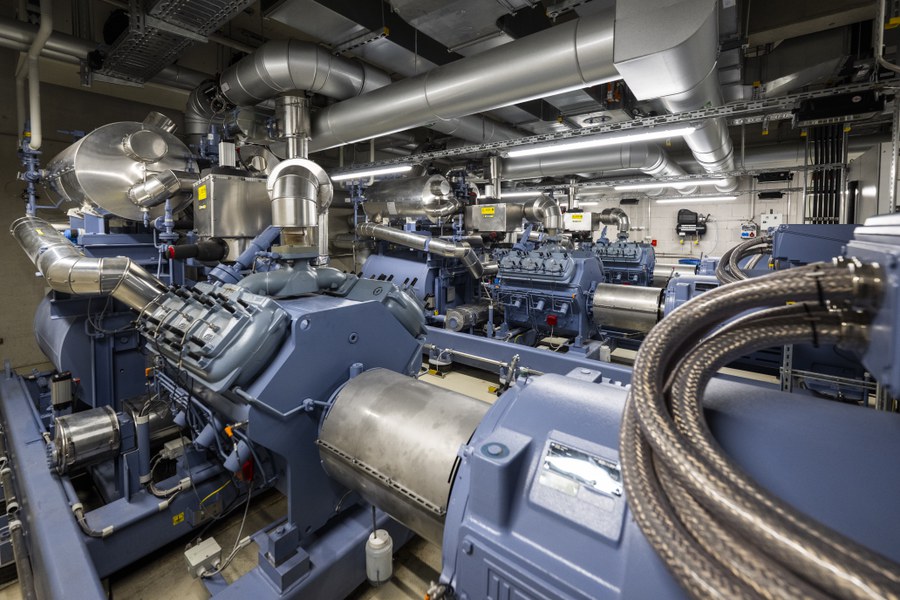
Wärmepumpenanlage, die Abwärme der Hochleistungsrechner der Technischen Universität Dresden in Fernwärme umwandelt.
Die Dresdner Fernwärme soll Schritt für Schritt durch den Einsatz verschiedener Technologien klimafreundlich ohne CO2 erzeugt werden. Eine der Technologien ist die Nutzung von Abwärme, die erstmalig in Dresden an der Technischen Universität Dresden (TUD) zum Einsatz kommt. Drei Großwärmepumpen mit einer Gesamtleistung von 3,9 Megawatt wandeln dabei die überflüssige Abwärme der Hochleistungsrechner der TUD in Fernwärme um. Dabei entstehen bis zu 24.000 Megawattstunden grüne Wärme pro Jahr, mit denen 3.700 durchschnittliche Dresdner Haushalte versorgt werden können. Verglichen mit der konventionellen Erzeugung von Fernwärme mit Gas, werden mit dieser Technologie rund 2.700 Tonnen CO2 vermieden. Gemeinsam haben der Staatsbetrieb Sächsisches Immobilien- und Baumanagement (SIB), der Kommunalversorger SachsenEnergie und die TUD seit 2023 eines der ersten Abwärmeprojekte dieser Art in Deutschland realisiert.
Für die sächsische Landeshauptstadt Dresden ist dies ein innovativer Schritt auf dem Weg zu einer klimaneutralen Wärmeversorgung. Oberbürgermeister Dirk Hilbert betont die Bedeutung des Projekts: „Die nachhaltige Nutzung der Abwärme der Hochleistungsrechner der TU Dresden ist beispielgebend dafür, wie wir in Dresden unsere Klimaziele erreichen können: mit maßgeschneiderten, innovativen und pragmatischen Lösungen der Partner vor Ort. Auf Basis moderner Technologien zeigen TU Dresden und SachsenEnergie, wie wir eine größere Unabhängigkeit von Gas in der Wärmeversorgung schaffen können. Diesen Weg zur Dekarbonisierung wollen wir auch weiterhin beschreiten.“
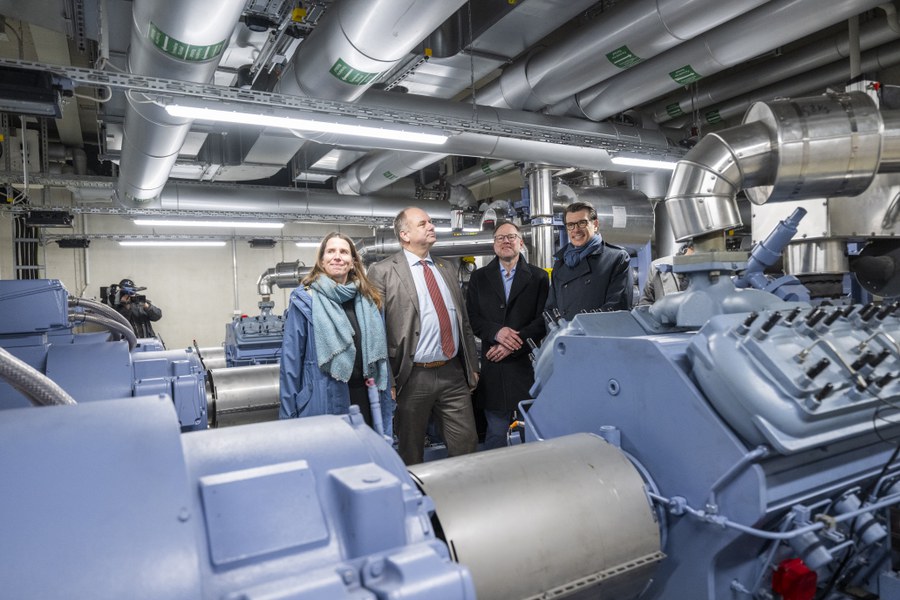
Maike Heitkamp-Mai, Nachhaltigkeitsreferentin der TUD, Oberbürgermeister Dirk Hilbert, Oliver Gaber, Kaufmännischer Geschäftsführer des SIB und SachsenEnergie-Vorstand Dr. Axel Cunow bei der Besichtigung der drei neuen Wärmepumpen.
Leuchtturmprojekt der Wärmewende für Dresden: ganzjährig nutzbare Wärme
SachsenEnergie betreibt derzeit drei Großwärmepumpenanlagen in Dresden. Das Besondere an der Abwärme des Rechenzentrums: diese nutzbare Wärme ist ganzjährig verfügbar. „Damit haben wir eine konstant verfügbare Wärmequelle für das Dresdner Fernwärmenetze“, freut sich Dr. Axel Cunow, Vorstand der SachsenEnergie, und erläutert: „Mit dem Betrieb der Wärmepumpenanlage erreichen wir einen weiteren entscheidenden Schritt in der Ergrünung der Dresdner Fernwärme. Das Projekt zeigt, dass die Wärmewende nur gemeinsam gelingt - mit innovativer Technik und starken Partnern. Innovation bedeutet bei solchen Leuchtturmprojekten auch, stetig dazuzulernen, anzupassen und zu optimieren.“
Maike Heitkamp-Mai, Nachhaltigkeitsreferentin der TUD erläutert: „Das Wärmepumpen-Projekt steht beispielhaft für unsere Nachhaltigkeitsstrategie, mit der wir uns als TU Dresden im Handlungsfeld Campus und Betrieb das Ziel gesetzt haben, bis 2035 treibhausgasneutral zu werden. Die enge Zusammenarbeit mit SachsenEnergie und SIB für die Nutzung der Abwärme unseres Rechenzentrums zeigt eindrucksvoll, wie Wissenschaft und Technologie die Energiewende mit konkreten Lösungen voranbringen.“
Umsetzung der Nachhaltigkeitsstrategie der TUD mit moderner staatlicher Infrastruktur
Das Technikbauwerk für die Wärmepumpen und die Tiefbauarbeiten für die Medientrasse wurden unter der Regie der SIB-Niederlassung Dresden II errichtet. Oliver Gaber, Kaufmännischer Geschäftsführer des SIB: „Als Immobilien- und Bauherrenvertreter des Freistaates Sachsen verstehen wir uns als Vorreiter für ökologische und ökonomische Verantwortung. Mit diesem zukunftsweisenden Projekt setzen wir nicht nur ein klares Signal für mehr Nachhaltigkeit und Energieeffizienz, sondern beweisen auch, dass innovative Lösungen und verantwortungsvolles Handeln Hand in Hand gehen. Die Nutzung der Abwärme und die Erkenntnisse aus dem ausgezeichneten Pilotprojekt sind wichtige Schritte auf dem Weg zu einer nachhaltigen Zukunft.“
Neben Sicherheit, Leistungsdichte und Hochverfügbarkeit war auch Energieeffizienz ein wichtiges Design-Ziel bei der Planung des TUD-Rechenzentrums. Das auf besondere Effizienz der Luftkühlung optimierte Gebäudekonzept wurde bereits 2014 mit dem Deutschen Rechenzentrumspreis in der Kategorie „Energie- und Ressourceneffiziente Rechenzentren“ ausgezeichnet. Die konsequente Nutzung der Warmwasserkühlung der Hochleistungsrechner erlaubt nun auch eine effiziente Nachnutzung der daraus entstehenden Abwärme.
So funktionieren die Wärmepumpen
Die an den Hochleistungsrechnern entstehende Abwärme wird von Kühlwasser aufgenommen und mit einer Temperatur von bis zu 55 Grad Celsius zu den Wärmepumpen geleitet. Die drei strombetriebenen Anlagen entziehen dem Wasser die Abwärme und erhöhen deren Temperatur auf rund 90 Grad Celsius. Anschließend wird die Wärme in das umliegende Fernwärmenetz eingespeist. Durch den Einsatz der Wärmepumpen kann die Abwärme ganzjährig genutzt werden und in bis zu 24.000 Megawattstunden grüne Fernwärme pro Jahr umgewandelt werden. Insbesondere in den Sommermonaten kann somit zusätzlich die Rückkühlung des Kühlwassers der Hochleistungsrechner vermieden werden.
Auszeichnung mit dem „Energy Efficiency Award“
Die Wärmepumpenanlage ist Teil eines vom Bundesministerium für Wirtschaft und Klimaschutz über die Nationale Klimaschutzinitiative geförderten Verbundprojekts. Das Vorhaben wurde bereits 2024 mit dem „Energy Efficiency Award“ der Deutschen Energie-Agentur (dena) in der Kategorie „Gemeinsam mehr erreichen!“ ausgezeichnet. Die Kombination aus energieeffizientem Rechenzentrumsbetrieb, 100 Prozent erneuerbarem Strombezug und intelligenter Abwärmenutzung macht das Projekt deutschlandweit einzigartig und zu einem Blaupausenmodell für Kommunen, Forschungseinrichtungen und Energieversorger.
Insgesamt investiert SachsenEnergie für die Anlage rund 4,4 Millionen Euro, die durch das BMWK im Rahmen der Nationalen Klimaschutzinitiative mit 2,1 Mio. Euro gefördert werden.
Kontakt
Nora Weinhold
Presse- und Mediensprecherin
SachsenEnergie
Telefon: +49 351 5630-23671
E-Mail:
Alwin-Rainer Zipfl
Pressesprecher
Staatsbetrieb Sächsisches Immobilien- und Baumanagement (SIB)
Tel.: +49 351 8135-126
E-Mail:
Jacqueline Papperitz
Projektkoordination/Öffentlichkeitsarbeit
CIDS - Center for Interdisciplinary Digital Sciences
Department Informationsdienste und Hochleistungsrechner (ZIH)
Technische Universität Dresden
Tel.: +49 351 463-32431
E-Mail: