
Nov 27, 2026
Awarding outstanding emerging talent in STEM: Winners of Dr. Hans Riegel Awards announced
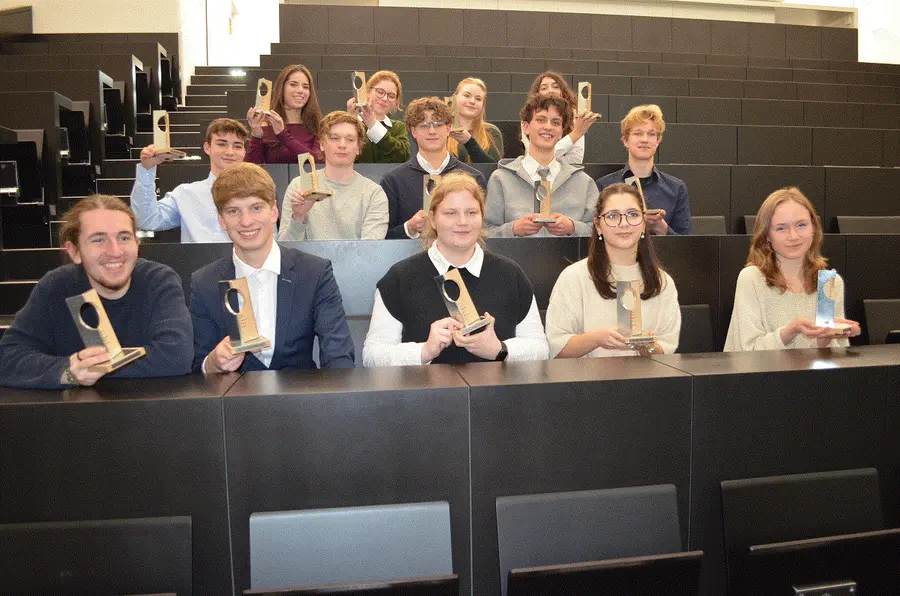
The winners of the 2026 Dr Hans Riegel Specialist Prizes for outstanding pre-university research projects by school pupils from Saxony.
On November 26, 2026, for the 13th time, TUD Dresden University of Technology and the Dr. Hans Riegel Foundation presented the Dr. Hans Riegel Awards for outstanding pre-scientific projects carried out by high school students from across Saxony. The award-winning works addressed a wide array of scientific questions, ranging from research into the causes of sea star wasting disease, the impact of training volume on muscle hypertrophy, and the use of bioluminescence as a sustainable light source. Other topics included the corrosiveness of fully desalinated water, sustainable mobility, agrivoltaics, artificial intelligence in medical diagnostics, aesthetics in mathematics, acoustic phenomena, and innovative cooling systems in microelectronics.
The promising future of emerging scientists in Saxony
The awards ceremony was held at TUD on November 26, 2026. As the award focuses on STEM subjects, the Dr. Hans Riegel Subject Awards honors school students for their outstanding work in biology, chemistry, geography, computer science, mathematics, and physics.
The winning projects highlight the bright future of emerging scientific talent in Saxony. Taking on tough questions in natural sciences, technology, and society, the projects combined deep scientific insight and fresh innovation with clear real-world value for society.
A panel of experts consisting of researchers from TUD evaluated the 75 submitted projects based on academic criteria. For Biology, Dr. Janina Hahn (DLR_School_Lab TU Dresden); for Chemistry, Prof. Inez Weidinger (Chair of Electrochemistry); for Geography, Prof. Arno Kleber (Chair of Physical Geography); Wolf Spalteholz and Torsten Goerke (Chair of Didactics of Computer Science) for Computer Science; Prof. Andreas Thom and Prof. Vadim Alekseev (Institute of Geometry) for Mathematics; and Prof. Walter Strunz (Chair of Theoretical Quantum Optics) for Physics.
The evaluation focused in particular on the originality of the topic, scientific methodology, and the significant contributions made by the schoolchildren themselves. This manifested itself through independent research, experimental approaches, mathematical analyses, technical applications, and thorough literature reviews, among other things. The award-winning projects clearly demonstrate the promising future of emerging scientists in Saxony.
Helping to promote young scientists
The Dr. Hans Riegel Awards honor school students for their particularly compelling scientific research projects and inspire them early on to pursue higher education and engage more deeply with science, technology, engineering, and mathematics. The award makes an important contribution to the promotion of promising scientific talent in Saxony.
The Dr. Hans Riegel Awards are endowed with EUR 600 for the first place in each subject, EUR 400 for second place, and EUR 200 for third place. Moreover, the schools of the first place winners receive a non-cash prize to the value of EUR 250 in recognition of supervising the students' work by the respective subject teachers.
In addition to prize money, the Dr. Hans Riegel Awards provide access to long-term support programs in the form of free seminars and conferences. The foundation established by Dr. Hans Riegel, former co-owner of HARIBO, is particularly committed to promoting education with the goal of helping young people shape their future.
For more information on the award-winning projects and the award recipients, please see the appendix and visit:
www.hans-riegel-fachpreise.com
Overview of this year's award winners:
Biology
1st place: Selma Becker, Goethe-Gymnasium, Leipzig,
topic: The road to success: Why did it take twelve years to identify the cause of sea star wasting disease (SSWD)?
2nd place: Luis Grüner, Gymnasium Dresden-Tolkewitz, topic: How training volume impacts muscle hypertrophy
3rd place: Alina Schindler, Lößnitzgymnasium Radebeul, topic: Potential use of bioluminescence as a sustainable light source
Chemistry
1st place: Georg Sagawe, Humboldt-Gymnasium Radeberg, topic: The corrosiveness of fully desalinated water when exposed to air
2nd place: Elena Döhnert, Evangelisches Kreuzgymnasium Dresden, topic: Effect of sage crushing on the yield of essential oils, and determination of the content of the main active compounds—cineol, camphor, and thujone
3rd place: Lysan Korkmaz, Wiprecht-Gymnasium Groitzsch, topic: The Effectiveness of anti-aging creams – myth or scientifically proven results
Geography
1st place: Oskar Liebig, Joliot-Curie-Gymnasium Görlitz, topic: The Görlitz transport system in transition – approaches for a sustainable and bicycle-friendly alternative
2nd place: Loris Haedicke, Julius-Ambrosius-Hülße-Gymnasium Dresden, topic: The potential of agrivoltaics as a climate change adaptation strategy in German agriculture
3rd place: Jonas Levi Kottwitz, Gymnasium Dresden- Klotzsche, topic: Urban farming in Singapore—opportunities and limitations for food security in a major city, as illustrated by a practical greenhouse experiment
Computer science
1st place: Magdalena Rülke, Anton-Philipp-Reclam-Schule Leipzig, topic: Artificial intelligence in medical diagnostics
Mathematics
1st place: Marlena Wünning, Pestalozzi-Gymnasium Dresden, topic: Aesthetics in mathematics
Physics
1st place: Ronja Quauke, Philipp-Melanchthon- Gymnasium Bautzen, topic: A comparison of the acoustic characteristics of various handpans
2nd place: Florence Große, Sächsisches Landesgymnasium St. Afra zu Meißen für Hochbegabtenförderung, topic: A parametric study of microsurface structures for the optimization of microelectronics hotspot cooling systems using CFD (Computational Fluid Dynamics).
3rd place: Peter Groß, Johann-Gottfried-Herder-Gymnasium Pirna, topic: Comparison of efficiency between a displacement hull and hydrofoils on a homemade model catamaran
3rd place: John Heinzelmann, Johann-Gottfried-Herder-Gymnasium Pirna, topic: Comparison of efficiency between a displacement hull and hydrofoils on a homemade model catamaran
Press inquiries:
Konrad Kästner
Press Office
TUD Dresden University of Technology
+49 351 463-32427
Madeleine Breuer
Public Relations
Dr. Hans Riegel Foundation
+49 228 227 447 0
www.hans-riegel-fachpreise.com