
Sep 22, 2026
Millions in funding for new DFG research group on heat treated dietary lipids and their role in evolution
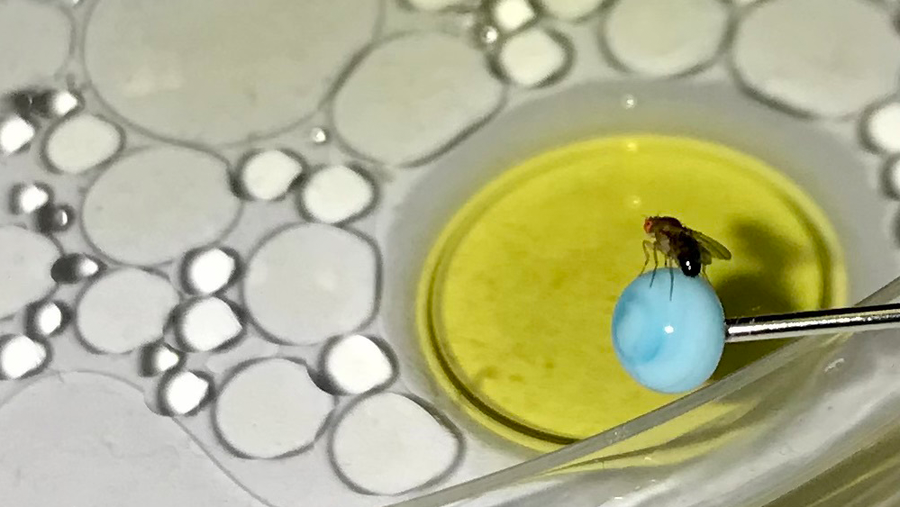
A fly on a drop of oil.
A new DFG research group led by Biology Professor Dr Klaus Reinhardt from Dresden University of Technology (TUD) is investigating how heated dietary fats (lipids) affect organisms and whether they can trigger evolutionary changes. The German Research Foundation (DFG) is providing around 3.1 million euros in funding for this project over four years. The group is being supported jointly with the Swiss National Science Foundation as part of the D-A-CH collaboration.
Cooking, frying and baking have been part of everyday life for humans for thousands of years. Heat treatment makes food easier to digest and alters its chemical properties. The effects of heat-treated sugar and protein on humans are established. However, little is yet known about the exact role of heated fats in our diet.
Dresden is a globally recognized hub for lipid research. A total of seven research groups from the disciplines of biology, food chemistry and molecular medicine at TUD and Dresden University Hospital now aim to pool their expertise in lipid research in this new project, in collaboration with a Swiss research team, to investigate a question that has scarcely been explored to date: what happens to plant- or animal-based dietary fats during heat treatment, how do these heat-altered molecules subsequently function, and what role do they play in the evolution of organisms.
The fruit fly Drosophila melanogaster serves as the model organism. In particular, the short life cycle of these flies offers researchers the opportunity to observe the effects of different dietary fats over many generations. The research will focus in particular on the relationship between dietary fats and reproduction, as well as adaptations to dietary availability over many generations.
“Although the findings from the flies cannot be directly extrapolated to humans, many fundamental biological processes and lipid transport systems are conserved between flies and humans. We therefore also intend, in the long-term, to investigate the potential significance of these findings for human nutrition and evolutionary history,” explains Dr Marko Brankatschk, Deputy chair of Plant Cell and Molecular Biology at TU Dresden.
With this new research group, TU Dresden is strengthening its interdisciplinary research at the interface of life sciences, chemistry and medicine, and is further expanding its international collaboration with Switzerland. Prof. Klaus Reinhardt, the project’s initiator and elected spokesperson, explains: “After a long period of preparation, I am now absolutely delighted to be working with everyone in this fantastic team.”
In addition to research, the group is also committed to engaging with the public. Plans include educational programs for schools designed to clearly illustrate to pupils the connections between nutrition, chemistry, biology and evolution. In the future, an ‘Open Lab’ is also to be set up, where interested members of the public can bring in their own food samples to investigate, together with the researchers, the effect of their dietary fats on fruit flies.
Contact:
Dr. Marko Brankatschk
Deputy Chair for Cell and Molecular Biology of Plants
Faculty of Biology
E-Mail:
Tel.: +49 351 463 40111