
Jan 27, 2026
Pilot project in Dresden: Apprentices' final mechanic exam digital for the first time
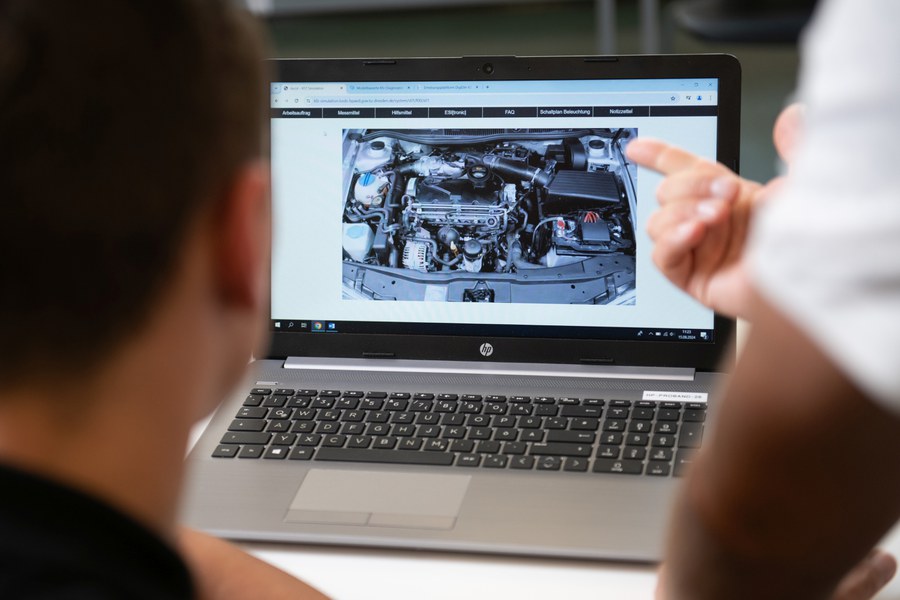
The digitalization of final exams in the skilled trades is progressing: Dresden is the first city to adopt a digital testing station, intended for vehicle mechanics' practical final exams. The computer simulation was developed by the Chair of Vocational Education at TUD Dresden University of Technology.
The exam will be offered for the first time from January 28 to February 2, 2026, at the Haus des Kfz-Gewerbes in Dresden. Around 100 candidates will complete the practical part of the fault diagnosis exam there, not only on a real vehicle, but also at a digital testing station. This was tested over several months in other examination districts in the region and approved by the responsible journeyman's examination board (Gesellenprüfungsausschuss).
The computer simulation was developed as part of the ESF project “InnoVET-Kfz” in close cooperation with vocational training stakeholders in Dresden. “Computer simulation enables us to realistically and reproducibly depict complex error scenarios—situations that would be difficult or impossible to simulate on real vehicles during an exam. This enables us to create practical, safe, and up-to-date testing conditions that meet the requirements of modern automotive technology," explains Max Hustig, Head of Vocational Education at the Haus des Kfz-Gewerbes Dresden.
This shift to digitalization is a response to shortcomings in the current training system. Studies show that a considerable number of apprentices in the automotive industry do not fully achieve the desired level of competence by the end of their training. In addition, there are concerns about the standardization of practical journeyman's examinations, as candidates are often required to work on different types of errors in the exams.
The new digital testing station provides a suitable solution: All candidates are given identical scenarios to work on, allowing their diagnostic skills to be assessed objectively and comparably. At the same time, this reduces the personnel and material costs involved for conducting the exams. At the same time, a digital independent study course is also being developed. Nevertheless, practical training remains a central component of training; a complete digitization of all exam content is not possible. “Technical skills remain a central component of the training and will continue to be tested on real vehicles to ensure the practical competence of the examinees,” says Max Hustig.
With this pilot project, Dresden is taking on a pioneering role in modern vocational training for the automotive industry. The computer simulation developed has the potential to be used in future audits in Saxony and nationwide.
Press inquiries:
Prof. Stephan Abele
Chair of Vocational Education
Email:
