
Nov 23, 2026
Model project for research data management at Dresden’s University Medicine receives DFG funding

Biomedical research is generating ever-larger and increasingly complex datasets. These range from pure image data to genomic analyses and clinical datasets.
Biomedical research is generating an ever-increasing volume of data, and this data is becoming all the more complex. This ranges from image data to genomic analyses, and even to clinical data sets. To ensure that this data remains usable in the long term, it needs to be managed in accordance with the FAIR principles: findable, accessible, interoperable, reusable. In day-to-day research, however, scientists often lack the time, staff and specialist support needed to consistently implement these principles. The availability of technical tools and guidelines alone are not enough to put them into practice. To support scientists in research data management (RDM), the German Research Foundation (DFG) is providing approximately EUR 1.4M in funding to establish a FAIR facility at the Faculty of Medicine of TU Dresden.
The project focuses on establishing a decentralized research data management service unit that supports researchers throughout the entire data life cycle. It will cover every stage, from data planning and collection, to storage, processing, archiving and publication. The goal is to ensure that research data remains usable over the long term, as well as to make data management an integral part of everyday research practice. At the Faculty of Medicine, the FAIR facility will serve as a central point of contact for all questions relating to research data management. Researchers will be able to seek advice on topics such as data management planning, suitable software solutions and strategies for the long-term preservation and provision of their data.
Workflow that can equally be adopted by other faculties and research institutions
The new services will initially be developed and tested in four pilot projects. Researchers from the Department of Cardiac Surgery, the Department of Visceral, Thoracic and Vascular Surgery, the Core Facility Cellular Imaging, the Institute of Pharmacology and Toxicology, and the Institute of Clinical Chemistry and Laboratory Medicine will all be involved. Drawing on the experience gained from these pilot projects, the team aims to develop a standardized service workflow that can equally be adopted by other faculties and research institutions.
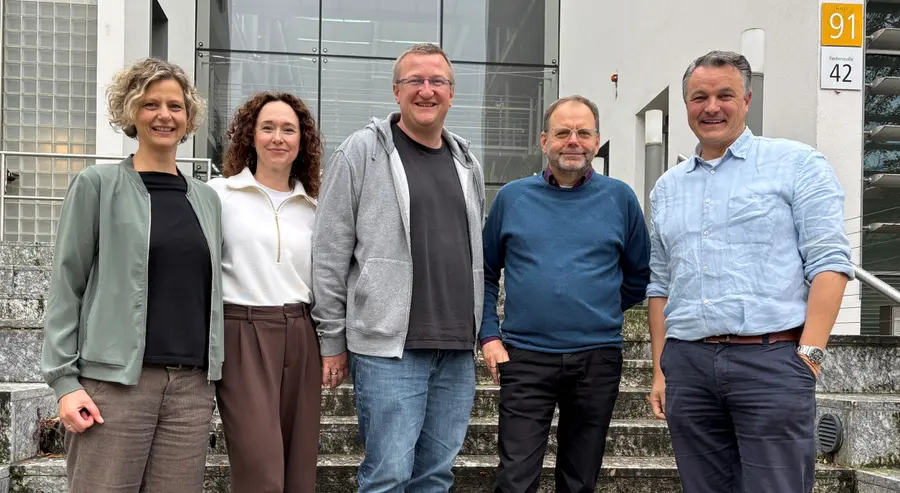
The FAIR Facility project team. From left to right: Silke Tulok, Dr. Anett Jannasch, Dr. Gunar Fabig, Prof. Thomas Müller-Reichert, Prof. Ben Wielockx.
The project entitled “Establishing a FAIR facility for resource-efficient, sustainable and scalable research data management,” is led by Prof. Thomas Müller-Reichert, head of the Core Facility Cellular Imaging (CFCI) and spokesperson for the Core Facilities Dresden University Medicine (CFDmed), as well as Prof. Ben Wielockx, Director of the Experimental Centre. Project coordination is handled by Silke Tulok and Dr. Gunar Fabig (both CFCI), in cooperation with Dr. Anett Jannasch (Department of Cardiac Surgery).
Prof. Esther Troost, Dean of the TUD Faculty of Medicine, says, "A reliable, quality-assured database is becoming increasingly important for medical research, particularly in an era of data-driven methods and artificial intelligence. With the FAIR Facility, we are investing in infrastructure that will support today's researchers while laying the groundwork for tomorrow's innovations."
Project builds upon existing research infrastructures
On the technical side, the project builds upon existing research infrastructures and established software solutions. One of the FAIR faculty’s core tasks will be to strengthen the links between centrally provided IT infrastructure and the specific needs of individual research areas. The processes developed will therefore be continuously refined in close collaboration with partners from the outset. These include TU Dresden’s Center of Medical Informatics (German: ZMI) and Center for Information Services and High-Performance Computing (German: ZIH). Project partners include as well Leipzig University, the University of Duisburg-Essen and the NFDI4BioImage, SaxFDM and I3D:bio networks.
Better conditions for the long-term use of valuable research data
For the first time, University Medicine Dresden will have a dedicated, specialist support service for research data management. Nevertheless, the processes developed as part of the project are also intended to be used beyond Dresden. These include a scalable service workflow, as well as a business and funding model that the other institutions can adapt to their needs. The project has therefore set itself the goal of driving the further development of the German National Research Data Infrastructure.
Structured, GDPR-compliant management of sensitive clinical and patient-related data will also create better conditions for the long-term use of valuable research data. This will ensure that datasets remain available beyond the scope of individual projects, prevent the duplication of work, and support future research. A transparent and reliable data foundation is also becoming increasingly important for AI-based analysis.
The initial funding period is three years as part of the DFG’s Scientific Library Services and Information Systems (LIS) program, within the “Information Infrastructures for Research Data” funding initiative.
Scientific contact:
Prof. Thomas Müller-Reichert
CFCI - Core Facility Cellular Imaging
Carl Gustav Carus Faculty of Medicine
TUD Dresden University of Technology
+49 351 458-6442
Media contact:
Anne-Stephanie Vetter
Public Relations Office Carl Gustav Carus Faculty of Medicine
of TUD Dresden University of Technology
+49 351 458 17903
Background Faculty of Medicine at TUD
The Faculty of Medicine at TUD Dresden University of Technology (MF-TUD) sets national and international standards through its research focus areas in oncology, metabolic diseases (particularly diabetes), and neurological and psychiatric disorders, supported by the use of digital technologies.
Students benefit from a diverse academic portfolio featuring innovative teaching in medicine, dentistry, public health, midwifery, medical radiation sciences, biomedical engineering, and the model medical degree program in Chemnitz.
Together with University Hospital Carl Gustav Carus Dresden, the Faculty forms Dresden University Medicine. Close collaboration with leading research institutions such as the Helmholtz-Zentrum Dresden-Rossendorf, Fraunhofer Institutes, and the Max Planck Institute of Molecular Cell Biology and Genetics makes Dresden a center of excellence for innovative, patient-oriented medicine and outstanding research.