
Nov 10, 2026
2026 Polarization Barometer: Support for Ukraine is the most divisive issue in Germany
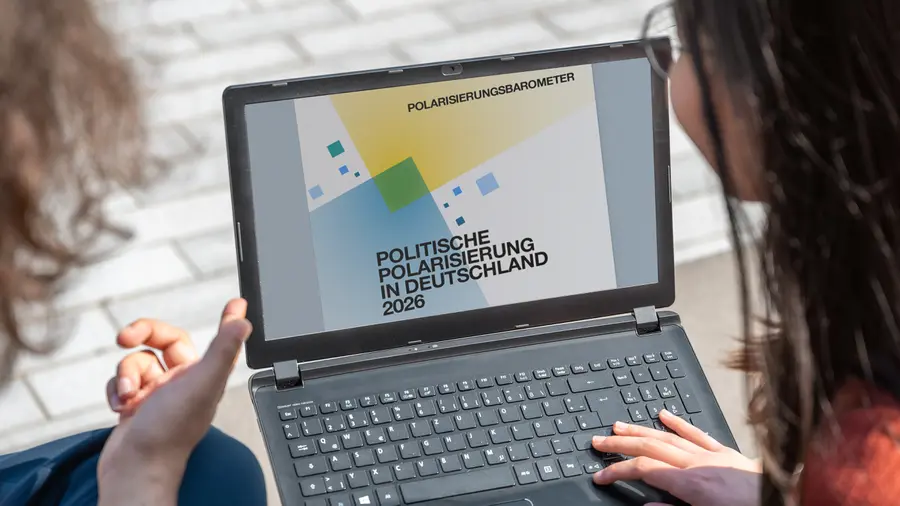
Support for Ukraine is Germany’s most polarizing issue in 2026, with the highest levels of both ideological and affective polarization. That is the central finding of the second Polarization Barometer from the Mercator Forum Migration and Democracy (MIDEM) at TUD Dresden University of Technology. The study finds no overall increase in polarization across the 15 issues examined. The fault lines are shifting on individual issues, however, and polarization is intensifying at the extremes.
A majority backs Ukraine as positions harden at the extremes
A majority of respondents (54.1 percent) want Germany to continue supporting Ukraine and distance itself further from Russia. By contrast, 28.8 percent favor closer ties with Russia. The latter group has shrunk slightly overall, but positions at its extreme have hardened: 17.3 percent of respondents selected the most pro-Russian position on the scale, up from 13.7 percent a year earlier. Of the eight EU countries surveyed, Germany shows the sharpest division into opposing camps on this issue. Support for Ukraine has also overtaken immigration as the most emotionally charged issue. “We are not seeing division across the board. But the fault lines are shifting,” says Professor Hans Vorländer, Director of MIDEM. “In 2026, support for Ukraine tops the list: the opposing camps are moving further apart, and negative feelings toward the other side are growing.”
A plurality expects immigrants to adopt German culture
Public views on what integration requires have shifted markedly. The share of respondents who believe immigrants must also adopt German culture and way of life now stands at 47 percent, up seven percentage points from 2025. Only 39 percent say learning the language and obeying the law are enough, down eight percentage points from a year earlier. This reverses last year’s balance of opinion. While ideological polarization on this issue has declined in six of the eight countries surveyed, it has risen sharply in Germany. Despite clear differences of opinion, negative feelings between the opposing camps remain relatively low. “On integration, the balance of opinion has shifted toward assimilation in just one year,” Vorländer says. “At the same time, this issue shows that sharp differences of opinion do not necessarily lead to mutual hostility.”
Redistribution: Germany has the sharpest ideological divide among the eight countries surveyed
Germany has the highest level of ideological polarization on wealth redistribution among the eight countries surveyed. 50.9 percent say efforts to redistribute wealth from the rich to the poor do not go far enough; 25.5 percent say they go too far. The share favoring more redistribution has fallen slightly over the past year, but support has become more concentrated at the extreme: 17.7 percent selected the pro-redistribution endpoint of the scale, up from 13.8 percent a year earlier. At the opposite end of the scale, the share in Germany (8.6 percent) is well above the average across the European countries surveyed (4.8 percent). Redistribution illustrates a pattern seen across several issues in 2026: opinions are increasingly concentrated at both ends of the scale. Negative feelings toward the opposing side have also increased.
83 percent see German society as divided
The perception of a divided society remains widespread: 83 percent of respondents see German society as divided, roughly two percentage points more than in 2025. A quarter of respondents describe society as very deeply divided. This perception is particularly pronounced among people who identify with the political right or support the AfD. It has grown stronger in both groups since last year. East Germans and people with low incomes are also more likely to see society as divided. “Four out of five people see our society as divided. But the Polarization Barometer also shows that polarization is not inevitable,” says Christiane von Websky, who heads Stiftung Mercator’s Center for Participation and Cohesion. “Conflicts can become entrenched, but they can also be defused. When we know where the real fault lines lie, we can focus our efforts on strengthening social cohesion.”
Other key findings
- Skilled workers: Support for easing entry for foreign skilled workers stands at 56 percent, down from 61 percent last year. Opposition has risen from 23 to 27 percent. The issue is more contentious than in 2025.
- Climate policy: On measures to combat climate change, 43 percent say they do not go far enough, while 37.8 percent say they go too far. Germany is the most polarized of the eight EU countries on all three climate-related questions examined.
- Defense spending: A majority (52 percent) favor higher defense spending to maintain peace, while 23.4 percent want spending reduced. Overall polarization on this issue has declined. However, respondents who favor lower spending express stronger negative feelings toward the opposing side than they did last year.
- Rainbow flags: Of the 15 issues examined, the display of rainbow flags in public spaces is the only one to show a marked decline in both ideological and affective polarization. In 2025, a plurality opposed such displays. Supporters (31.0 percent) and opponents (30.1 percent) are now nearly evenly matched.
- Attitudes toward people with opposing views: People who identify with the political right express the strongest negative feelings toward those who disagree with them. Among party supporters, this tendency is strongest among supporters of the AfD and the Greens.
- AfD supporters: Immigration is the issue that unites AfD supporters. On this issue, they are the most united in their views than supporters of any other party. On other issues, however, they are internally divided: on climate policy, they are more polarized than supporters of any other party, and substantial divisions also exist over support for Ukraine and the balance between markets and government.
About the study
In spring 2026, MIDEM and YouGov conducted the second wave of a three-year panel survey in eight EU countries: Germany, France, Italy, Poland, Sweden, Spain, Czechia, and Hungary. A total of 19,693 participants were surveyed again. In Germany, 2,785 people took part between March 6 and March 30, 2026. The findings are representative of the population aged 18 and older. The study examines 15 questions across five issue areas: immigration, security, climate change, economy and social policy, and values. It distinguishes between ideological polarization (the extent to which opposing opinion camps form) and affective polarization (how negatively people view those with opposing opinions and how positively they view like-minded people). The authors are Hans Vorländer, Felix Hormig, Konrad Nissen, Maik Herold, and Cyrill Otteni.
The full study is available for download at https://forum-midem.de/politische-polarisierung-in-deutschland-2026/.
About MIDEM
The Mercator Forum Migration and Democracy (MIDEM) examines how migration shapes democratic politics, institutions, and cultures, and how these in turn shape migration. MIDEM is a research center at TUD Dresden University of Technology, funded by Stiftung Mercator and directed by Professor Hans Vorländer.
Press Contact
Mathilde Rave
Communications
Mercator Forum on Migration and Democracy (MIDEM)
+49 174 2374249
Johanna Haupt
Communications
Mercator Forum on Migration and Democracy (MIDEM)
+49 351 463 35800