
Sep 01, 2026
IFW Dresden and TUD celebrate topping out of joint research building
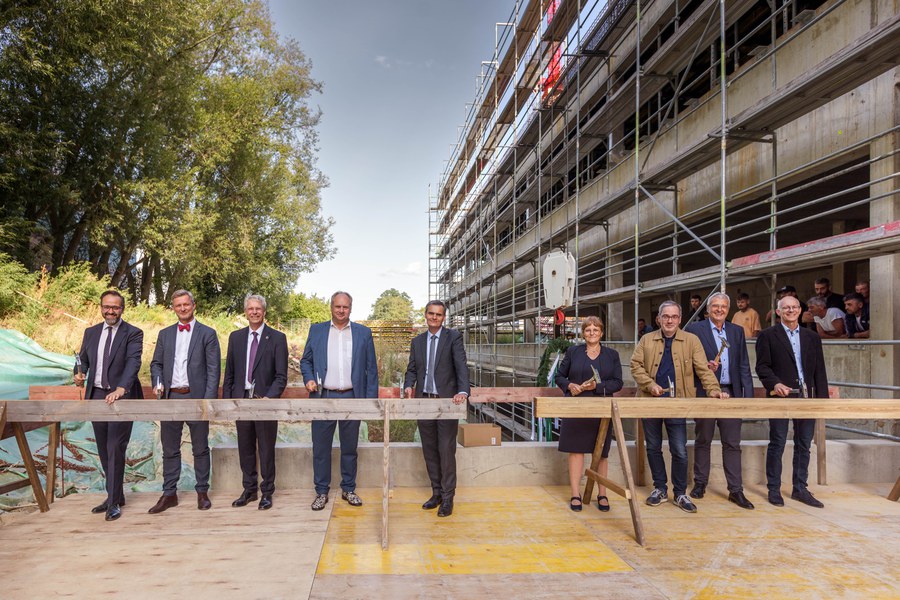
Traditional nail-driving ceremony at the topping-out celebration by representatives from the political and academic communities.
Optimal conditions for joint cutting-edge research on innovative quantum materials and semiconductor technologies: With the topping-out ceremony on September 1, 2026, the Leibniz Institute for Solid State and Materials Research Dresden (IFW Dresden) and the Cluster of Excellence Complexity, Topology and Dynamics in Quantum Matter (ctd.qmat) at TUD Dresden University of Technology will reach an important milestone in the construction of their joint research building.
Hightech laboratories, offices and collaboration spaces
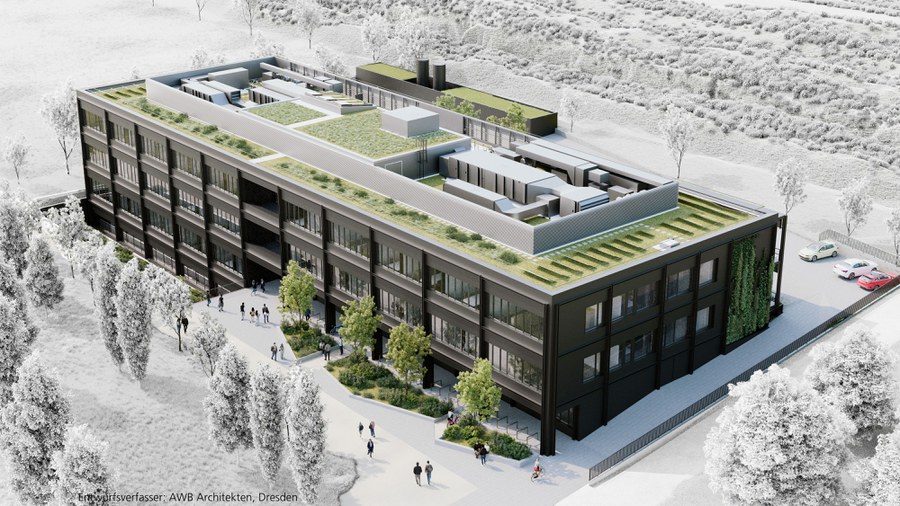
Visualization of the new research building
The building is being constructed on TUD’s Südvorstadt campus on Nöthnitzer Straße and will provide hightech laboratories, offices and collaboration spaces for researchers. Their work will focus on researching and designing novel materials, including materials for energy-efficient quantum chips and highly sensitive quantum sensors. The completed building is scheduled to be inaugurated in mid-2029. Construction costs, funded by the Free State of Saxony and the German federal government, amount to around €70 million.
Dorothee Bär, Federal Minister for Research, Technology and Space:
“The economic and societal potential of quantum technologies and the quantum materials associated with them is enormous. This is why, through its High-Tech Agenda Germany, the Federal Government is consistently focusing on quantum technologies as one of the key technologies of the future. Our goal is to make Germany a global leader in the development and application of quantum technologies. The joint research building of IFW and TU Dresden, where the underlying materials technology for quantum and semiconductor materials will be researched and developed, will contribute to this goal.
Sebastian Gemkow, Saxon State Minister for Science, Culture and Tourism:
“This highly complex and state-of-the-art infrastructure project will become Saxony’s new center for quantum materials and research into entirely new semiconductor technologies. Semiconductors, superconductors and magnetic materials are fundamentally changing our understanding of technology. This is about robust microelectronics, ultra-fast and energy-efficient quantum computers, innovative solutions for energy generation and storage, and highly sensitive sensors. This forward-looking research will strengthen Saxony’s position as a world-leading location for microelectronics and quantum electronics for the long term. And bringing IFW and ctd.qmat together under one roof, closer than ever before, also embodies the idea of short distances and combined expertise – interdisciplinary exchange will be actively fostered here.”
Dr. Andreas Handschuh, Head of the Saxon State Chancellery and State Secretary for Federal and European Affairs:
“The joint new research building of IFW Dresden and TU Dresden is successfully taking shape. This demonstrates that greater responsibility as the project owner helps advance cutting-edge research in Saxony. In the future, the new building will also make the close cooperation between the two institutions visible in their shared research infrastructure. The fact that the Leibniz Institute IFW Dresden, as the project owner, has assumed responsibility for the planning and implementation of a research building to be jointly used with the ctd.qmat Cluster of Excellence represents a new model of cooperation in Germany.”
Prof. Dr. Bernd Büchner, Scientific Director of IFW Dresden:
“The joint research infrastructure opens up excellent opportunities for us to investigate quantum materials in both theory and experiment. It creates ideal conditions for close scientific exchange and new joint research approaches. We look forward to working even more closely together under one roof in the future.”
Prof. Dr. Matthias Vojta, Spokesperson of the Cluster of Excellence ctd.qmat:
“Anyone aiming to conduct quantum physics research at the highest international level relies on collaboration. A joint building is therefore more than simply a place where two strong partners share laboratories and offices. The new research building brings together our expertise, combines our strengths, and enables exchange – from the moment you enter the building to conversations over coffee. This is where a hotspot for cutting-edge research on quantum materials in Saxony is taking shape.”
Background: Facts and figures about the new research building
Across more than 8,000 square meters, researchers will investigate the extraordinary properties that quantum materials exhibit under extreme conditions, e.g. ultralow temperatures, and the potential these properties offer for novel devices. The aim is to develop quantum materials that can enable new green energy technologies, energy-efficient electronics, or robust quantum bits. The new building will thus become a center for international cutting-edge research on quantum materials.
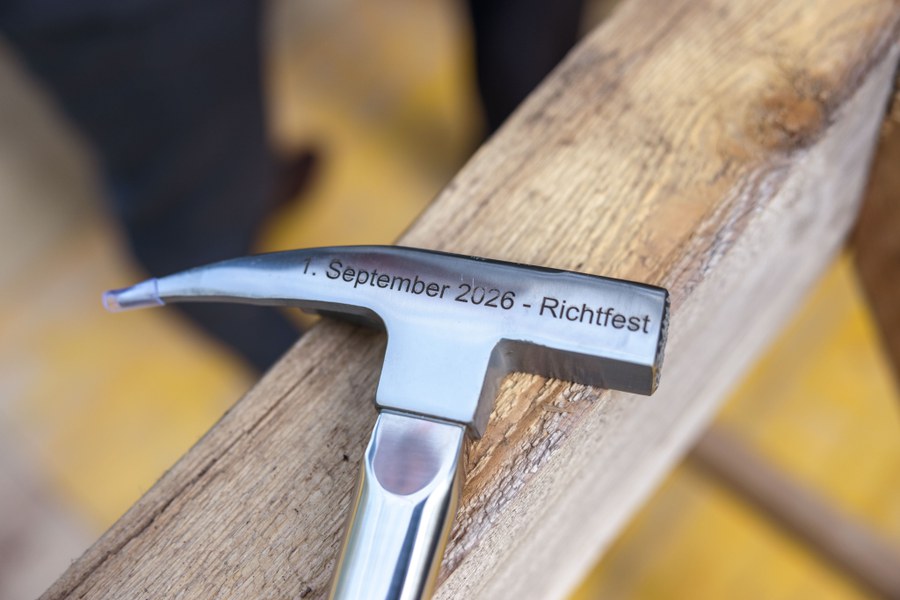
Carpenter's hammer
From the outset, IFW Dresden has assumed responsibility for the planning, coordination, and implementation of the joint research building. IFW Dresden’s responsibility for the construction of a research building to be jointly used with TUD represents an exceptional model of cooperation in Germany between a non-university research institution and a university. At the same time, the new building creates space for the further development of existing collaborations and for new joint research initiatives between the two institutions.
Press contacts
IFW Dresden
Patricia Bäuchler
Science Communication
Phone: +49 351 4659 249
Email:
TUD Dresden University of Technology
Matthias Fejes
Press Officer, TU Dresden
Phone: +49 351 463 32398
Email:
Cluster of Excellence ctd.qmat
Katja Lesser
Press Officer
Phone: +49 351 463 33496
Email:
About IFW Dresden
The Leibniz Institute for Solid State and Materials Research Dresden (IFW Dresden) is an independent non-university research institution and a member of the Leibniz Association. Around 500 employees from more than 40 nations research the physics and chemistry of solids and materials to develop new functionalities for quantum materials, 2D materials, and technologies for energy applications. Across five institutes, an interdisciplinary team from experimental physics, theoretical solid-state physics, chemistry, materials research, and electrical engineering combines fundamental and application-oriented research.
About the Cluster of Excellence ctd.qmat
The Cluster of Excellence ctd.qmat – Complexity, Topology and Dynamics in Quantum Matter — at Julius-Maximilians-Universität Würzburg and Technische Universität Dresden explores and develops novel quantum materials with tailored properties. Around 300 researchers from over 30 countries work at the interface of physics, chemistry, and materials science to lay the foundations for tomorrow’s technologies. In 2026, the cluster entered the second funding period of the German Excellence Strategy of the Federal and State Governments — with an expanded focus on the dynamics of quantum processes.