
Mar 06, 2026
Seismologically suitable and open to design: TUD leads feasibility study for the Einstein Telescope in Lusatia
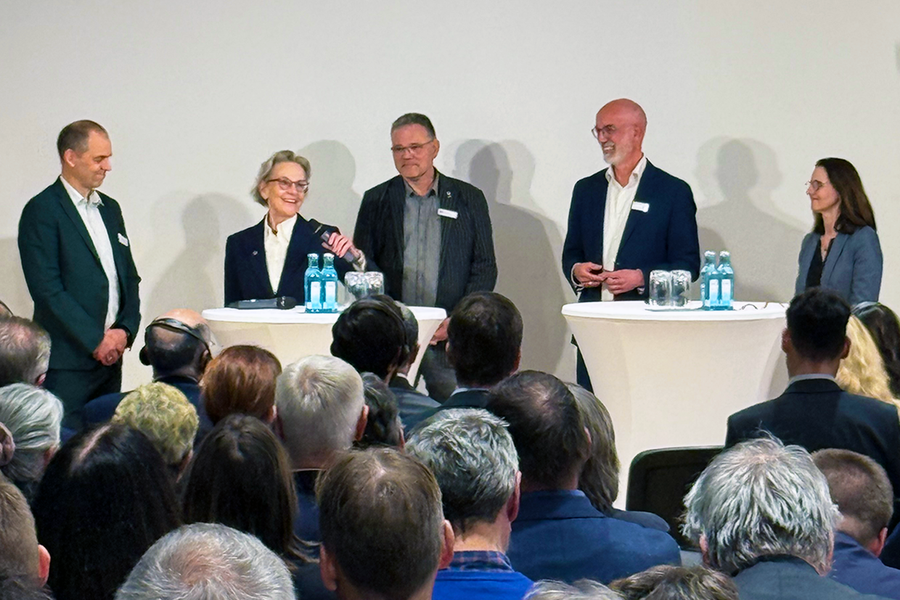
Panel discussion in Berlin with (from left to right): Frank Bösenberg (Managing Director of Silicon Saxony), Prof. Ursula Staudinger (Rector of TU Dresden), Dr. Harald Lück (Deputy Spokesperson for the ET Scientific Collaboration), Prof. Christian Stegmann (Scientific Co-Director of the feasibility study), Prof. Heike Graßmann (State Secretary at the Saxon State Ministry of Science, Culture, and Tourism (SMWK)).
Leading scientists and representatives of the Free State of Saxony, including Prof. Ursula Staudinger, Rector of TUD Dresden University of Technology, presented Saxony's ambitions for the Einstein Telescope (ET) at the state representation in Berlin on March 5, 2026. The Free State of Saxony is applying for Lusatia to be the location for this cutting-edge research project. It is the largest large-scale research infrastructure in the field of astrophysics that has been planned in Europe for decades. Led by TUD, a feasibility study on the suitability of the Lusatian granite massif is being developed.
“The entire world of physics has long dreamed of building an Einstein Telescope,” said Minister President Michael Kretschmer at the opening. “But the technology for this has been unavailable so far. And now the moment has finally arrived.” He advocates a science-based approach to finding the best location and the best concept. “This experiment will be conducted only once worldwide due to its high cost.”
Prof. Christian Stegmann, scientific co-leader of the feasibility study on the suitability of the Lusatian granite massif, conducted under the direction of TUD Dresden University of Technology; Dr. Harald Lück, deputy spokesperson of the ET Scientific Collaboration; Prof. Heike Graßmann, State Secretary at the Saxon State Ministry for Science, Culture and Tourism; Frank Bösenberg, Managing Director of Silicon Saxony; and TUD Rector Prof. Ursula Staudinger provided information on the Lusatia region’s site application, the significance of the project for research, innovation, and European cooperation, as well as the opportunities it presents for the region.

TUD Rector Prof. Ursula M. Staudinger
TUD Rector Staudinger emphasized the strong university environment: “Saxony has always been a hub for science and innovation,” said Staudinger, referring to the excellence of TUD and the appeal of its five Clusters of Excellence. “Scientists go where they can conduct their research best, where the conditions are like nowhere else in the world.” With new courses such as the international Master's degree program in Astrophysics and Technological Methods, a further foundation is being laid for attracting and developing talent for this field of research worldwide.
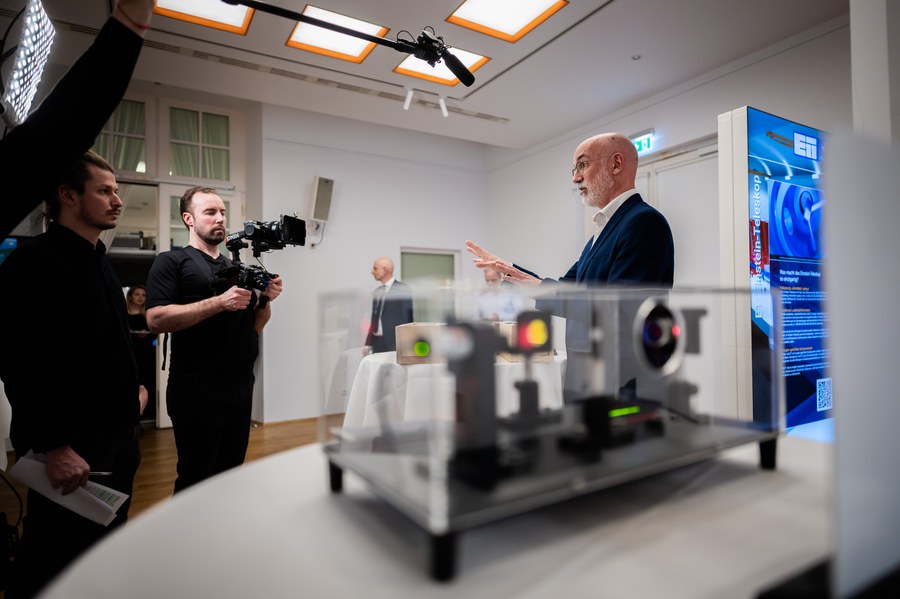
Prof. Christian Stegmann
"The Einstein Telescope symbolizes world-class research. This project brings leading international researchers to Lusatia and permanently anchors the region on the European research map,“ said astroparticle physicist Christian Stegmann.
”Lusatian granite offers exceptional stability and homogeneity," explained geophysicist Prof. Andreas Rietbrock, who is leading the study alongside Prof. Christian Stegmann. “These are ideal conditions for an underground observatory, the likes of which are rarely found anywhere else in the world,”
said Silicon Saxony's Frank Bösenberg , referring to the economic impact of science. The German and European chip industry is looking for new areas of application. There is enormous interest in the Einstein Telescope.
According to Harald Lück, a researcher at the Max Planck Institute for Gravitational Physics and Leibniz University Hannover, it is also highly significant for supraregional development. Lück is regarded as one of the “fathers” of the Einstein Telescope and is actively involved internationally in its implementation.
The Free State of Saxony is supporting the application with the aim of positioning the region as a leading international location for the Einstein Telescope and strengthening its role in the European Research Area.
Among the approximately 200 guests were Italy's ambassador Fabrizio Bucci and the president of the Autonomous Region of Sardinia, Alessandra Todde. The Mediterranean island and Saxony have been linked since January in a cooperation with the aim of closer scientific collaboration.
Background: Einstein Telescope
The Einstein Telescope is designed to measure gravitational waves with unprecedented precision, thereby providing crucial insights into the universe and the fundamentals of physics. With its international dimension, the project strengthens European cooperation. The Euregio Meuse-Rhine (EMR) with Belgium, the Netherlands, North Rhine-Westphalia, and Sardinia are also candidates in the upcoming application process for the construction of the underground observatory. The selection will be made at the European level.
“If we succeed in bringing the Einstein Telescope to Lusatia, it would mean that the first major research infrastructure of European significance with global appeal would be located in the heart of Europe,” said Saxony's Minister of Science Sebastian Gemkow. "But I am convinced that a decision on the location for the Einstein Telescope can only be made on the basis of transparent scientific criteria. When comparing potential European locations, a decision must be made based on the best overall package of scientific benefits, geological and seismic conditions, and economically viable costs."
The feasibility study in the Lusatian granite massif on geological, infrastructural, and scientific requirements is funded by the Federal Ministry for Economic Affairs and Energy as part of the STARK program. The area is one of the most seismologically stable regions in Europe and, according to experts, therefore offers excellent geological conditions for the Einstein Telescope. A unique selling point compared to the other candidates is the design flexibility of the site, where a triangular or double L-shaped structure could be realized – in conjunction with Sardinia.
Detailed information is available at www.einsteintelescope-lausitz.de