
Nov 20, 2026
Suzanne Eaton Awards: TUD's Cluster of Excellence PoL honors two researchers for achievements at the intersection of physics and biology
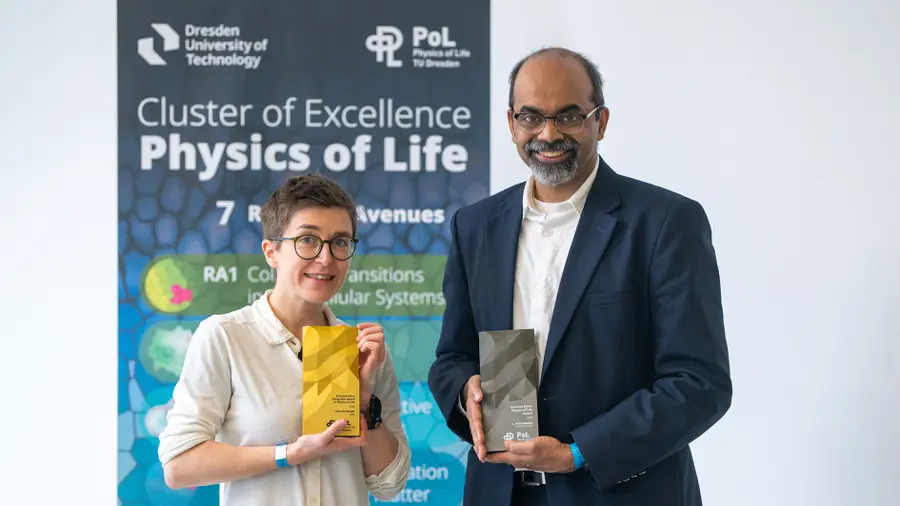
The recipients of the Suzanne Eaton Awards: Dr. Anna Erzberger and Prof. L. Mahadevan.
On November 20, 2026, the Cluster of Excellence "Physics of Life" (PoL) at TU Dresden (TUD) presented the Suzanne Eaton Awards for the very first time. The Suzanne Eaton Physics of Life Award, worth EUR 10,000, went to Prof. L. Mahadevan of Harvard University, while the Suzanne Eaton Rising Star Award, worth EUR 2,000, went to Dr. Anna Erzberger of the European Molecular Biology Laboratory (EMBL). The awards recognize outstanding achievements at the intersection of physics and biology and honor the legacy of scientist Suzanne Eaton, who passed away far too soon in 2019.
“We decided to create an international award for 'Physics of Life' to honor the scientists who make outstanding contributions to understand the physics of living systems. There could be no better way to do so than to honor also one of the pioneers of the field and former PoL PI, Suzanne Eaton,” explained Prof. Otger Campàs, Chair of Tissue Dynamics who spearheaded the awards initiative.
Prof. Helmut Schießel, spokesperson for the Cluster of Excellence “Physics of Life”, said on the occasion of the award ceremony: “It is a privilege for Physics of Life to host these two esteemed scientists in Dresden. Both have made outstanding contributions to the physics of living matter, and in presenting them the awards, we celebrate the life and legacy of Suzanne Eaton.”
Research topics attests to remarkable scientific creativity
Professor L. Mahadevan holds the Lola England de Valpine Professorship of Applied Mathematics, Organismic Biology, and Evolutionary Biology, as well as Physics, at Harvard University. He investigates how matter is organized in space and time, and has made significant contributions to the field of Physics of Life. Prof. Mahadevan has shed light on the biophysics underlying the development of multicellular tissues, organs, and organisms; the intelligence of social insects; and the mathematical physics behind art forms such as origami and kirigami. The breadth of his research topics attests to his remarkable scientific creativity, which has fostered the exchange of ideas between physics, biology, engineering, and mathematics—to the benefit of each of these disciplines.
“It is a tremendous honor to be the inaugural recipient of the Suzanne Eaton Physics of Life prize,” said the awardee, Prof. L. Mahadevan. “Suzanne Eaton’s infectious enthusiasm for science without boundaries has long been a driver for the field, and I was fortunate to have been part of the circle that she influenced and led. Working at the interface of physics and biology with a wonderful group of students, postdocs and colleagues has been a privilege that I am grateful for, and the award is a recognition of our collective efforts.”
Research on the mechanics of early mammalian development
Dr. Anna Erzberger is a group leader at the European Molecular Biology Laboratory (EMBL). Her research explores the theoretical principles of self-organization in complex systems. Her research contributions range from the mechanics of early mammalian development to cellular signal transduction.
Dr. Anna Erzberger expressed her gratitude for the award: “Having our work recognized in association with Suzanne Eaton’s legacy is an incredible honor. To me, her achievements and the way of conducting science revealed under what conditions an enormous domain of problems can become scientifically accessible. A big part of that was an uncompromisingly collaborative approach, that continues to serve as the highest standard of effective interdisciplinarity in our community.”
The award ceremony and the laureates’ presentations can be viewed on the PoL Cluster of Excellence’s YouTube channel.
About Suzanne Eaton
Prof. Suzanne Eaton (1961–2019) was a research group leader at the Max Planck Institute of Molecular Cell Biology and Genetics (MPI-CBG) and a professor of developmental cell biology of invertebrates at the Biotechnology Center of the TUD (BIOTEC). She played a key role in founding the Cluster of Excellence Physics of Life and was one of the cluster’s founding speakers. Suzanne Eaton made fundamental contributions to our understanding of how tissues acquire their shape and size. These awards symbolize the enduring legacy of this scientist, who passed away far too soon, and the spirit of interdisciplinary thinking she brought to the study of life itself.
About the "Physics of Life" Cluster of Excellence
Physics of Life is one of five Clusters of Excellence at TUD. PoL's objective is to identify the physical laws that underlie the organization of life in molecules, cells, and tissues. In this Cluster, researchers working in physics, biology, and computer science are investigating how active matter in cells and tissues organizes itself into specific structures and gives rise to life. PoL is funded by the DFG as part of the Excellence Strategy. It is a collaboration between researchers based at TUD and the research institutions of the DRESDEN-concept network, including the Max Planck Institute of Molecular Cell Biology and Genetics (MPI-CBG), the Max Planck Institute for the Physics of Complex Systems (MPIPKS), the Leibniz Institute of Polymer Research (IPF) and the Helmholtz-Zentrum Dresden-Rossendorf (HZDR).
Media inquiries:
Ryan Henne
Science Communication Officer
Physics of Life Cluster of Excellence
+49 351 463-41517