
Nov 10, 2026
Science needs freedom: Persecuted researcher Gubad Ibadoghlu has started his research fellowship at TU Dresden
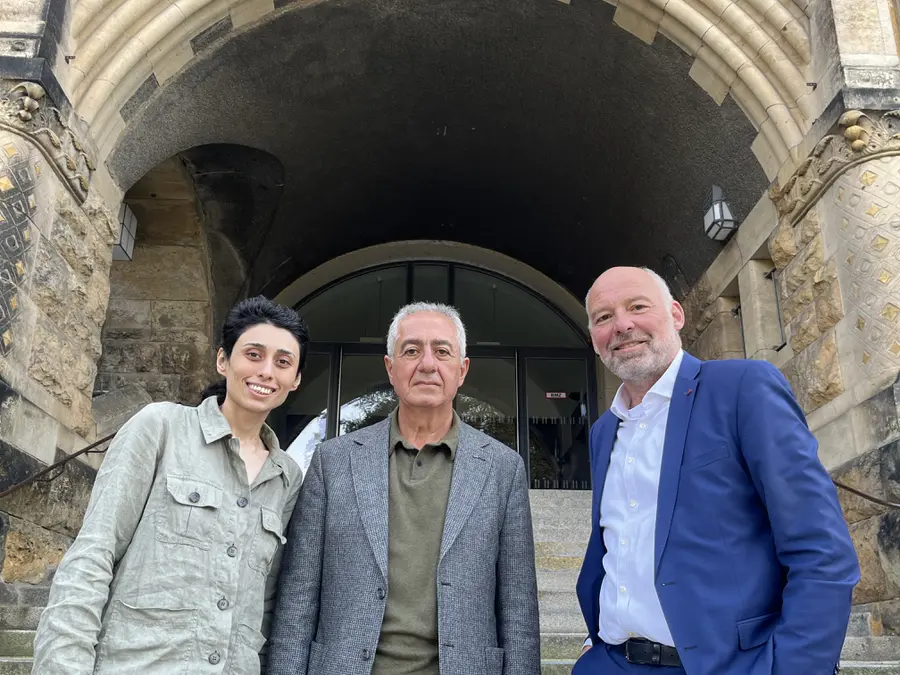
Gubad Ibadoghlu (center) with his daughter Zhala (left) and Prof. Marcel Thum upon their arrival at TU Dresden.
On UNESCO World Science Day for Peace and Development on November 10, 2026, TUD Dresden University of Technology has reaffirmed its commitment to academic freedom. A good example is Azerbaijani economist Prof. Gubad Ibadoghlu: After spending around three years in detention and under house arrest, he was able to leave his home country and take up a research fellowship at TUD, thanks in part to the university’s ongoing efforts.
Science lays the foundation for peace, social progress, and sustainable development. A prerequisite for doing so is that researchers can carry out their work freely and without fear of political persecution. This is what UNESCO’s World Science Day for Peace and Development, observed annually on November 10, draws attention to. TUD has been taking this occasion to highlight a specific case where academic freedom is at risk.
After spending around three years in detention and under house arrest, Azerbaijani economist Prof. Gubad Ibadoghlu was able to leave his home country in October 2026 and travel to Germany. For the next two years, he will conduct research at TUD’s Faculty of Business and Economics as a fellow of the Philipp Schwartz Initiative of the Alexander von Humboldt Foundation. This allows the internationally renowned scholar to begin a research fellowship that had originally been scheduled for 2023. By welcoming Prof. Ibadoghlu as part of the Philipp Schwartz Initiative, TUD underscores its responsibility as an internationally networked academic institution. The initiative was launched by the Alexander von Humboldt Foundation in collaboration with the German Federal Foreign Office. It enables researchers at risk to continue their research at institutions in Germany within a protected academic environment.
Ibadoghlu’s departure and the commencement of his research activities in Dresden are therefore not only a significant step for the researcher himself. They also exemplify the international solidarity of the scientific community and the responsibility of universities to offer prospects to threatened researchers.
Prof. Ursula Staudinger, Rector of TUD: “Academic freedom cannot be taken for granted. It is the indispensable foundation for new discoveries, social progress, and a peaceful future. As a university, we bear the responsibility to defend this freedom even where it is under threat. The fact that Gubad Ibadoghlu can now conduct research here in Dresden after years of uncertainty is a great joy for us and, at the same time, a powerful sign of international scientific solidarity. His life story shows that our commitment to academic freedom must not end at national borders.”
Prof. Marcel Thum, Chair of Economics, esp. Public Economics, at TUD: “We had already invited Gubad Ibadoghlu to Dresden in 2023 to jointly conduct research. At the time, no one could have anticipated that this would turn into nearly three years of waiting and uncertainty. We have maintained contact with him and his family during this difficult time and have repeatedly drawn public attention to his predicament. I am all the happier that we can now finally welcome him in person to our faculty. I am very much looking forward to our academic collaboration with such an internationally renowned colleague.”
Background: Research on corruption and natural resource policy
In July 2023, Ibadoghlu was arrested during a stay in Azerbaijan. The arrest was allegedly linked to his criticism of corruption and government actions in his home country. Gubad Ibadoghlu focuses in particular on how resource-rich countries use their revenues from natural resources. His research explores corruption, the misappropriation of public revenues, and the economic consequences of autocratic rule. In doing so, he contributes to our understanding of political and economic structures that are crucial for societal development, transparency, and good governance. His detention sparked international protests. TUD had also campaigned for his release for several years. Along with his family, human rights organizations, and other supporters, the university drew attention to his plight and the threat to academic freedom.
Ibadoghlu has published more than 20 books on natural resource policy and the management of revenue from natural resources. He has conducted research and taught at numerous international academic institutions, including the London School of Economics, Duke University, and the Institute for Advanced Study in Princeton. From 2013 to 2019, he served on the international board of the Extractive Industries Transparency Initiative (EITI). In 2024, he was one of the three finalists for the European Parliament’s Sakharov Prize for Freedom of Thought.
More information
- Alexander von Humboldt Foundation’s Philipp Schwartz Initiative: https://www.humboldt-foundation.de/
- TU Dresden: https://tu-dresden.de/
Media inquiries:
Press Office
TUD Dresden University of Technology
+49 351 463-32398