
May 18, 2026
Two new research facilities: TU Dresden opens state-of-the-art labs for quantum technology and human-machine interaction
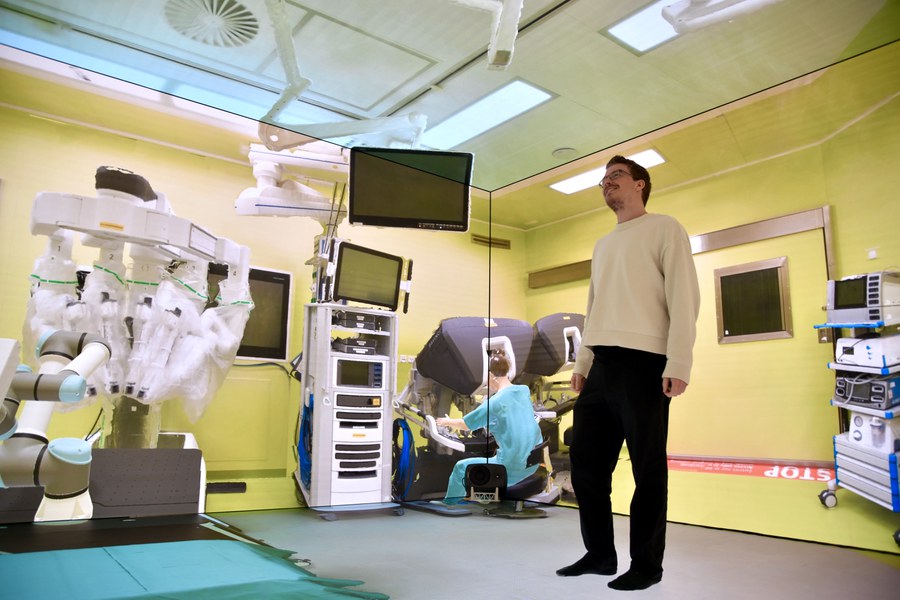
Person in an immersive operating room installation on the holodeck.
Today, May 18, 2026, TUD Dresden University of Technology opened two groundbreaking research labs: the “Quantum Communication, Computing, and Sensing Lab” and the Holodeck. The facilities are intended to advance research on the communication networks of the future and to drive innovation at the interface between humans and technology.
Quantum Communication, Computing and Sensing Lab: A Holistic Approach to the Quantum World

Dr. Caspar Hopfmann, TUD President Ursula M. Staudinger, and Prof. Fitzek in the newly opened quantum laboratory.
The quantum lab will focus on integrating quantum communication, quantum computing, and quantum sensing—an interdisciplinary approach aimed at unlocking pioneering possibilities beyond current network technologies. By combining these fields, researchers at TUD aim to develop fundamentally new architectures to push the performance limits of next-generation communication systems.
“Our goal is to move beyond isolated quantum applications and instead create integrated systems in which communication, computing, and sensing work together to enable real commercial applications,” says Junior Professor Riccardo Bassoli. “This holistic approach enables us to redefine what future networks like 6G are capable of.”

TUD President Ursula M. Staudinger during the opening ceremony.
Quantum technologies offer transformative potential for public networks. While quantum key distribution (QKD) has been one of the most visible applications to date, researchers in the new lab will investigate a much broader spectrum of quantum-based methods. These include entanglement-based communication, advanced coding strategies in the spirit of post-Shannon theory, and novel approaches to information processing and sensor technology.
Based on world-leading research in the field of quantum technologies conducted at TUD, the researchers will also investigate how quantum systems can be integrated into existing network infrastructure, such as 5G networks. The aim is to set new standards in terms of performance, security, and functionality.
The Holodeck: Experiencing digital worlds together and without barriers
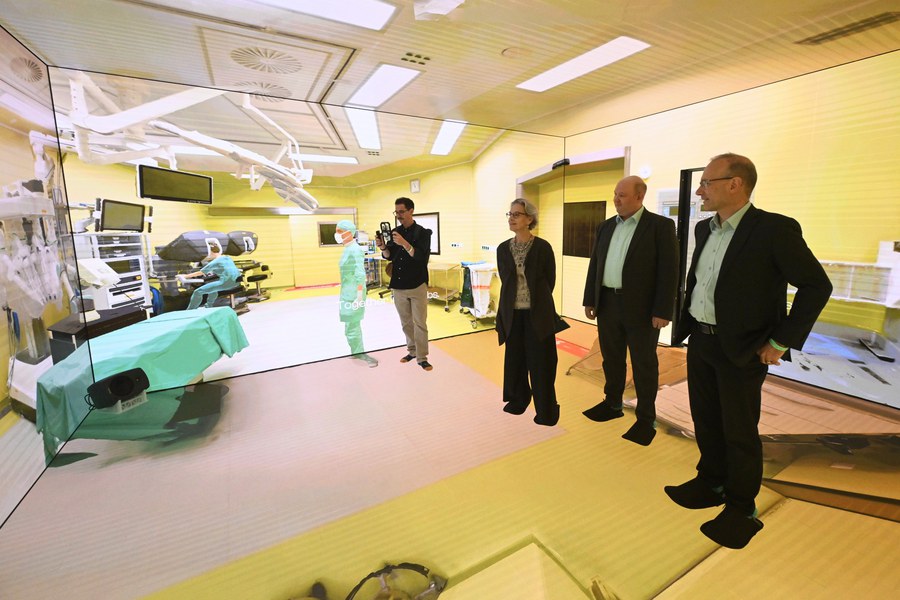
Benjamin Griebe (TUD), TUD President Ursula M. Staudinger, Martin Kiefer (Saxon State Ministry of Economic Affairs, Labor, and Transport), and Alexander Keller (NVIDIA) (from left) in the Holodeck.
Simultaneously, the Holodeck started operating today. The Holodeck is a fully LED-based, immersive space for real-time visualizations. Unlike conventional virtual reality solutions, this environment enables shared experiences without the need for VR headsets. This makes it possible to analyze social interactions in a controlled digital world.
It serves as a testing ground for innovations at the intersection of people and technology. Application scenarios include, for example:
- Interaction in Space: Researchers analyze human behavior in highly immersive scenarios to better understand the interaction between people and their environment.
- Industry of the Future: Whether it’s virtual production or simulation-based design, the Holodeck allows teams to collaborate on complex industrial value chains and test prototypes in a virtual space.
- Design of digital decision-making processes: Researchers are investigating how immersive media affect human perception and decision-making in order to define the technical requirements for future work environments.
A milestone for the science region
The opening ceremony was attended by TUD Rector Professor Ursula M. Staudinger and Professor Frank Fitzek, holder of the Deutsche Telekom Chair of Communication Networks and spokesperson for the CeTI Cluster of Excellence.
This groundbreaking project was made possible by funding from the Federal Ministry of Research, Technology and Space, the German Research Foundation, and the State of Saxony. The technological implementation is being carried out in close collaboration with the partner projects Transfer-Hub 6G-life, QUARKS, and the CeTI Cluster of Excellence.
Contact
TUD Dresden University of Technology
Deutsche Telekom Chair of Communication Networks
Doreen Böttcher
Public Relations
+49 351 463-40407