
Previous "Plant of the Week" — the coral bush
Erythrina crista-galli L.
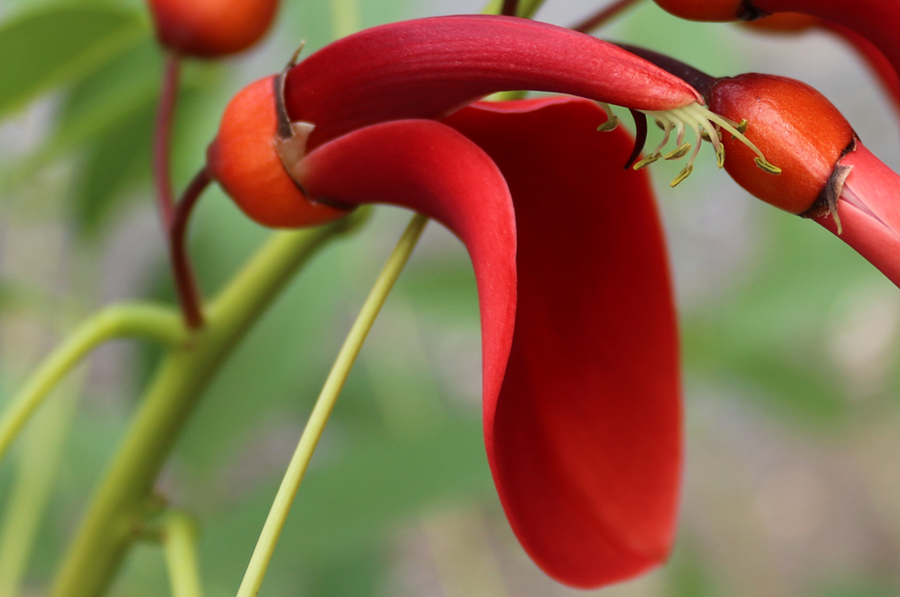
A rather atypical appearance for a legume: the tubular keel of the flower points upward, the standard points downward, and the lateral wings are very small.
Among the container plants, an ornamental species currently in bloom is widespread from the tropics to Mediterranean regions—the coral tree, also known as the “rooster comb tree.” This pioneer tree can reach a height of up to ten meters. It occurs naturally in southern Brazil, southern Bolivia, northern Argentina, Paraguay, and Uruguay. In Argentina and Uruguay, the “ceibo” is the national flower.
The coral-red flower clusters reveal only at second glance that the species belongs to the pea family (Fabaceae):
The “standard,” the largest petal of the scentless flowers, points downward. In search of the abundant nectar, not only hummingbirds but also carpenter bees and honeybees ensure successful pollination.
All parts of the plant contain highly toxic alkaloids. In the traditional medicine of the plant’s native countries, the leaves and bark are used, among other things, for wound healing, hemostasis, as an antiseptic, and as an anesthetic. Indigenous cultures recognize numerous other species of the genus Erythrina as useful and medicinal plants. Studies confirm a wide variety of secondary plant compounds, including alkaloids, flavonoids, and terpenes. Their promising potential for the development of new pharmaceuticals is currently being investigated scientifically.
The tree has received special attention since an environmental disaster in 2000,
during which approximately four million liters of crude oil spilled in southern Brazil: Surprisingly, some specimens of the species survived the event. A scientific study* on germination and growth behavior in contaminated soils found thatErythrina crista-galli offersgood prospects for revegetation and soil remediation at oil-contaminated sites.
Pigments from the plant’s red flower pigment are also suitable for the production of dye-sensitized solar cells (DSSC). **
*https://link.springer.com/article/10.1007/s12010-009-8531-1
**https://www.sciencedirect.com/science/article/pii/S1386142517300021?via%3Dihub
(CW 29/2026)