
Sep 28, 2026
Kurt Beyer Award Presented for Outstanding Theses
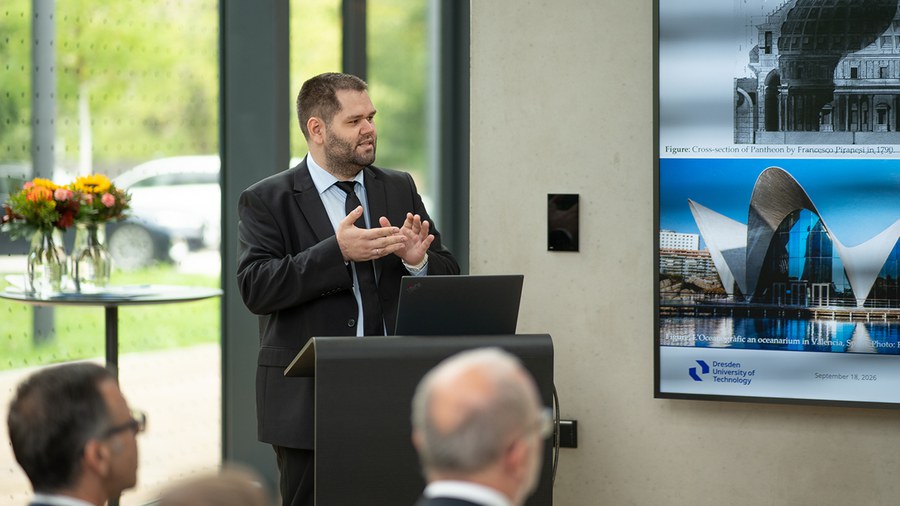
Prof. Dr.-Ing. Ivo Herle, Adrian Diaconu (HOCHTIEF Infrastructure GmbH, Southeast Germany) and Prof. Dr.-Ing. Dr.-Ing. E.h. em. Manfred Curbach present the award to Iurii Vakaliuk
On September 18, 2026, the Kurt Beyer Prize was awarded at TU Dresden. Since 1996, this award has been presented annually for outstanding theses by students and young researchers in the fields of civil engineering and architecture. The prize, which comes with a total award of 5,000 EUR, is sponsored by HOCHTIEF Infrastructure GmbH, Southeast Germany branch. The award ceremony took place in the carbon-reinforced concrete building “CUBE” on the TU Dresden campus.
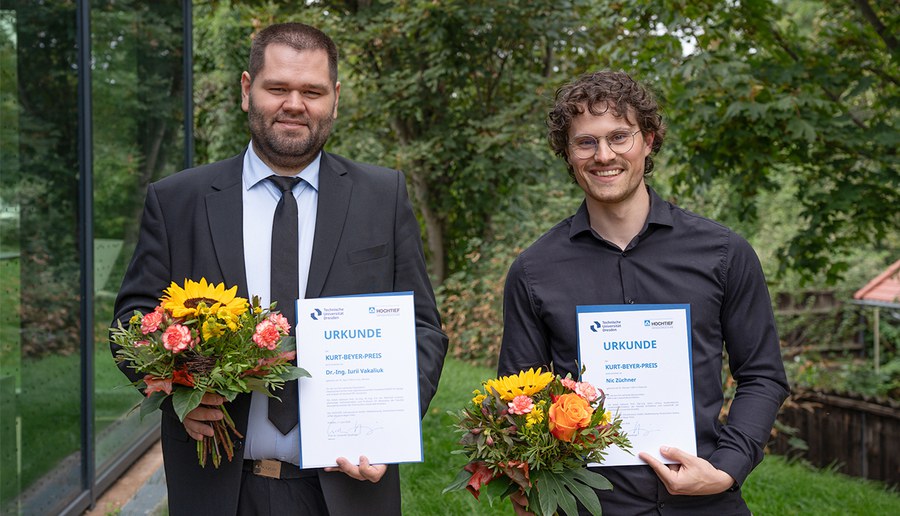
The 2026 Kurt Beyer Prize winners: Dr.-Ing. Iurii Vakaliuk and Nic Züchner, M.Sc.
The latest Kurt Beyer Prize was awarded to Dr.-Ing. Iurii Vakaliuk from the Faculty of Civil Engineering (Institute of Concrete Structures) for his dissertation “Development of the Multi-Objective Parametric Framework MOET for Design and Analysis of Resolved TRC Structures” and to Nic Züchner, M.Sc., Faculty of Architecture and Landscape Architecture, for his master’s thesis: “BIM in Landscape Architecture.”
Vakaliuk’s dissertation, titled “Development of the Multi-Objective Parametric Framework MOET for the Design and Analysis of Resolved TRC Structures,” addresses one of the most pressing questions in modern Civil Engineering: How can digitally supported design methods advance the development of material-efficient concrete structures and thereby significantly reduce resource consumption and CO₂ emissions in the construction sector? At the heart of the work is the development of the Multi-Objective Evolutionary Tool (MOET)—a parametric and numerical framework that utilizes biologically inspired optimization principles to holistically design, analyze, and optimize ultra-thin, textile-reinforced concrete (TRC) structures under multiple objective functions.
Key findings and achievements: The developed system combines state-of-the-art optimization methods with the requirements of future AI applications by serving as a generator of reliable synthetic datasets for surrogate models. To ensure the optimized, delicate structural systems could be constructed without errors, Iurii Vakaliuk developed a specialized, innovative vacuum-assisted casting technology. Experimental validation confirmed the high load-bearing capacity with minimal self-weight and demonstrated that digital design methods, manufacturing innovation, and environmental metrics such as life-cycle analyses can be successfully integrated into a consistent approach.
In his letter of recommendation for the award, Director of the Institute of Professor Steffen Marx emphasizes:
“Mr. Vakaliuk conceived MOET with the goal of optimizing TRC structures using evolution-based methods while also serving as a generator of synthetic datasets for future surrogate models. From the outset, this work has thus combined Civil Engineering, optimization theory, and the demands of the AI era into a consistent methodological approach. […] Mr. Vakaliuk mastered this extremely challenging task with dedication, demonstrating the highest degree of creativity, independence, technical expertise, and goal-oriented approach. His very clever and inspiring use of modern digital methods has brought enormous added value not only to the specific research project; rather, his approach has served as an inspiration to many of our researchers in SFB/Transregio 280. In addition to its substantive and technical content, the submitted work impresses with its excellent formal and linguistic style as well as its outstanding graphic design.”
HOCHTIEF Infrastructure GmbH, Southeast Germany Branch, annually honors particularly outstanding academic theses by students and early-career researchers at TU Dresden with the Kurt Beyer Prize. The prize is awarded for one or two theses—doctoral dissertations, diploma theses, master’s theses, or comparable works—in the fields of civil engineering or architecture.
Prize Money
HOCHTIEF Infrastructure GmbH, Southeast Germany Branch, sponsors this prize, which is endowed with €5,000. If the jury selects two works as worthy of the prize, the individual amount is halved to €2,500 each.
Selection
The theses must have been completed and defended between November of the previous year and the end of the current year. Nominations may be submitted by the deans of the Faculties of Civil Engineering and Architecture at TU Dresden.
Judging Panel and Award
The jury consists of representatives of the sponsor as well as representatives of the Faculty of Architecture and the Faculty of Civil Engineering. The award ceremony takes place in a festive setting with representatives of the sponsor and the University Executive Board in attendance.