
Sep 29, 2026
Green Light for DFZ Construction
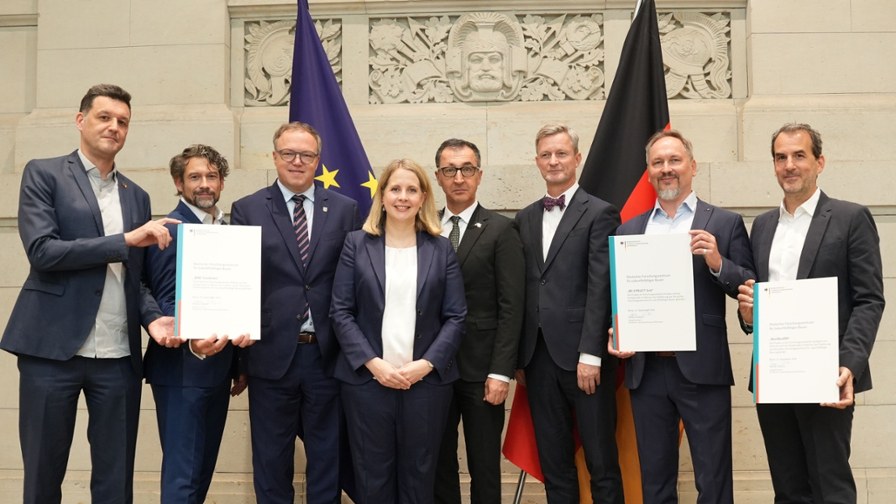
First research projects of the German Research Centre for Sustainable Construction launched
TU Dresden and the CARE Cluster of Excellence help shape the establishment of DFZ-Bau
An important step has been taken for construction research in Germany: on 25 September, the first funding certificates were presented in the Bundesrat, and the first projects of the future German Research Centre for Sustainable Construction (DFZ-Bau) have begun their work. The centre's formal founding is still planned for 2026.
DFZ-Bau aims to link research, the construction industry and public-sector practice more closely and to bring scientific findings into application faster. Its focus is on the resource consumption and CO₂ emissions of construction, as well as the sustainable development of the existing building stock.
TU Dresden is taking part with its own initial project
TU Dresden has been one of the centre's scientific partners from the outset. Its initial project asks how existing buildings can be renovated and converted in a resource-saving way and with as little intervention as possible, rather than being demolished and rebuilt. To this end, municipal building stocks are being examined, real-world laboratories are being prepared, and first solutions are being tested on site. This keeps the research closely aligned with the demands of construction practice.
The CARE Cluster of Excellence as a driving force
Two Clusters of Excellence played a key role in conceiving the research centre: IntCDC – Integrative Computational Design and Construction for Architecture at the University of Stuttgart, and CARE – Climate-Neutral and Resource-Efficient Construction at TU Dresden and RWTH Aachen University. CARE brings together expertise from many disciplines to further develop technical systems and infrastructures in a circular, resilient and resource-efficient way. Materials research, preservation of existing buildings and circular economy, complemented by digital and experimental methods, form an important foundation for the centre's future work.
The Institute of Construction Materials at TU Dresden also makes a contribution. It develops and characterises novel, resource-saving construction materials. These are essential for keeping structures in service for a long time while reducing the resource and CO₂ footprint of construction.
The Dresden approach thus exemplifies the idea behind DFZ-Bau: research should not take place in the laboratory alone, but should be tested and further developed under real conditions together with partners from practice and industry.
Three locations, one shared goal
To start with, the federal government and the founding states are funding three initial projects in Dresden, Stuttgart/Karlsruhe and Weimar. They are preparing the future research clusters and are being scientifically supported by the Federal Institute for Research on Building, Urban Affairs and Spatial Development (BBSR).
In Stuttgart and Karlsruhe, two experimental platforms are being set up in real existing buildings. In these real-world laboratories, researchers, companies and public partners are testing how construction robotics, artificial intelligence, digital building twins, sustainable materials and renewable energy systems can enable new renovation concepts. In the "BIM-Condition" project, Bauhaus-Universität Weimar and its partners are developing a digital renovation twin for prefabricated panel buildings (Plattenbauten). The Dresden project complements these approaches with the resource-saving transformation of the existing building stock.
The DFZ-Bau research clusters are expected to start in the first half of 2027. For TU Dresden, and for CARE in particular, this is an opportunity to pool existing expertise and, together with partners from science, industry and the public sector, develop solutions for the transformation of the construction sector. The Institute of Construction Materials contributes its experience with innovative materials, working towards construction that uses resources more efficiently, keeps buildings in use for longer, and deploys new materials deliberately for climate-conscious, circular building practice.