
Oct 08, 2026
A Fresh Coat of Paint for the Carbon Concrete House: Why There's Scaffolding at the CUBE Right Now
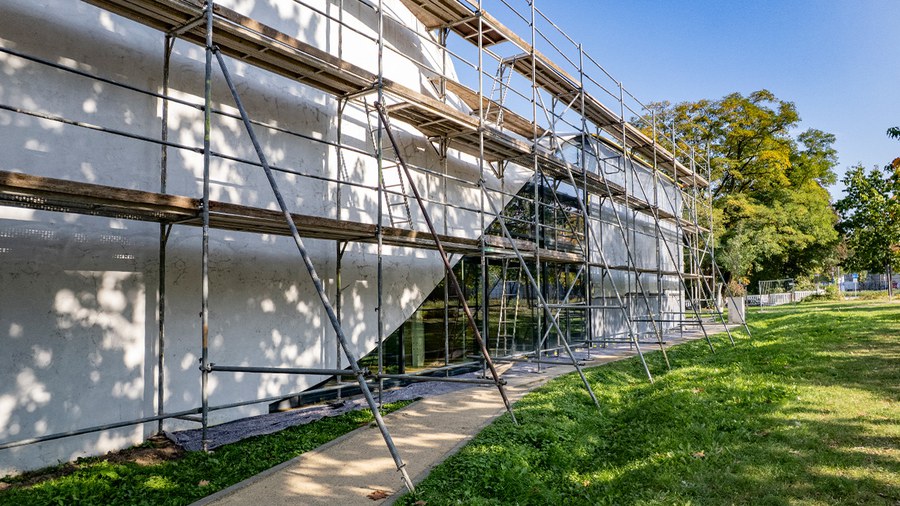
Renovation work on the facade of the CUBE carbon-reinforced concrete building
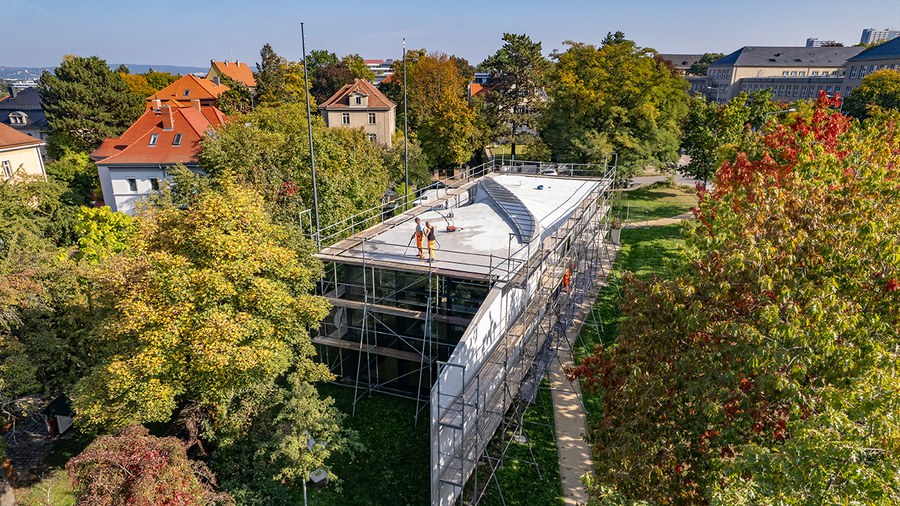
Anyone passing by Dresden’s Fritz-Foerster-Platz these days will see our CUBE research building covered in scaffolding. What might seem at first glance like premature damage repair is actually a routine part of life in a real-world laboratory: After four years of intensive observation, the seamless carbon concrete facade is undergoing a mineral-based refresh.
Since it opened just over four years ago, in September 2022, the CUBE—the world’s first building made entirely of carbon concrete—has symbolized a fundamental shift in the construction industry: moving away from rust-prone reinforcing steel toward resource-efficient, durable carbon fibers and free-form, curved shapes. The fact that construction work is now taking place on the facade understandably raises some questions among passersby.
Physics in a Real-World Laboratory: The Story of the Seamless Wall
The reason for the current work is the presence of fine cracks on the exterior facade, which have become visible to the naked eye and have already sparked some rather sensational headlines. For the research team at the Institute of Concrete Structures, however, this condition is by no means a sign of material failure—but rather the precise manifestation of structural engineering principles.
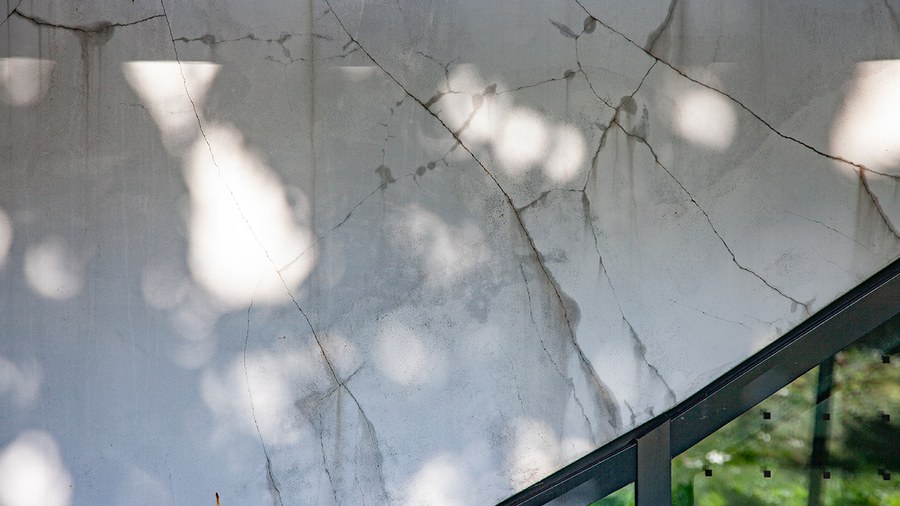
Typically, buildings are equipped with an expansion joint every four to five meters to accommodate weather-induced changes in length and stresses. With the CUBE, a seemingly bold experiment was deliberately undertaken: constructing a wall approximately 20 meters long that is completely jointless. The formation of fine cracks (0.2 to 0.5 millimeters) due to temperature and weather influences was physically expected and scientifically intended, says Manfred Curbach —a carbon concrete pioneer, recipient of the Nobel Sustainability Prize, and, yes, also the developer of the CUBE carbon concrete building on the campus of TU Dresden.

Bauherr Prof. Manfred Curbach
“The CUBE is not an ordinary residential or office building, but a real-world laboratory on a 1:1 scale. Here, we deliberately pushed the boundaries of what is considered taboo in standard construction—such as a 20-meter-long wall without expansion joints. The fact that the physics play out as expected and expansion cracks form was exactly what we anticipated. What’s important for the public to know is that these cracks do not affect the building’s load-bearing capacity or durability in the slightest.”
Comprehensive Monitoring Confirms Unrestricted Safety
Using sensors inside the structure and ongoing measurements, the cracks and the wall’s deformation behavior were carefully documented over a period of four years. The result: The structural stability and serviceability of the CUBE were never compromised at any time. Since the measurement data fully confirmed the computational models, the internal sensors were removed some time ago as planned.
The cracks that are now visible therefore represent a purely aesthetic issue that has become somewhat more pronounced over the years due to surface weathering.
Cosmetic Touch-Up Instead of Renovation: A Mineral Protective Coating
The current measures are therefore not a structural restoration, but rather a planned cosmetic repair. The CUBE’s exterior is being treated with a special mineral coating that visually seals the fine cracks and restores the desired aesthetic appearance.
The applied coating is even designed to be reversible (“peelable”). Should future research projects again require direct surface measurements on the original wall, access to the concrete will remain guaranteed at all times.
“With the mineral coating, we are restoring the CUBE’s original appearance without obstructing access for research. As an experimental test structure, our CUBE has a projected lifespan of 15 years—but the findings to date impressively demonstrate just how robust and sustainable the material is. You don’t simply tear down a building that has proven itself so excellently in terms of structural engineering after just 15 years.”
Work on the facade is expected to be completed shortly. Afterward, this eye-catching structure on Fritz-Foerster-Platz will once again present its familiar, elegant appearance to visitors and the TU Dresden campus.