
18.03.2026
Promotion Raúl Enrique Beltrán Gutiérrez
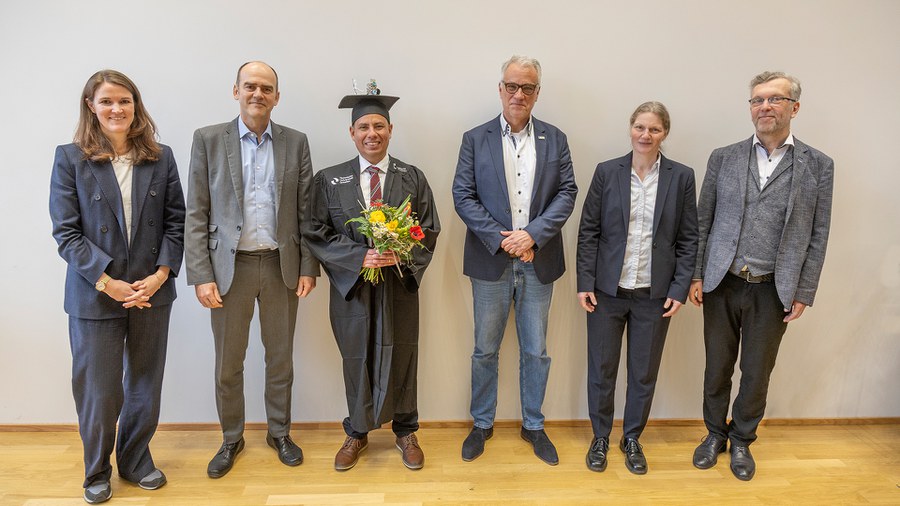
Rául Beltran und die anwesende Promotionskommission
Am 16. März 2026 hat Raúl Enrique Beltrán Gutiérrez seine Dissertation 👨🎓 mit dem Titel „Modellbildung für das frequenzabhängige Ermüdungsverhalten von Beton basierend auf nichtlinearen Ultraschallmethoden“ erfolgreich verteidigt. Die Veranstaltung fand im Beyer-Bau der TU Dresden statt.
Abstract:
Die vorliegende Dissertation untersucht das nichtlinear-elastische Ermüdungsverhalten von Beton unter zyklischer Belastung und verknüpft experimentelle Beobachtungen mit einer physikalisch basierten Modellbeschreibung. Im Fokus steht der Einfluss von Belastungsfrequenz, Temperatur und dissipativen Mechanismen auf die Schädigungsentwicklung sowie deren konsistente Beschreibung im Rahmen eines materialphysikalischen Ansatzes.
Hierzu wurden umfassende quasistatische und dynamische Versuchsreihen durchgeführt, die eine simultane Charakterisierung der Materialantwort aus makroskopischer niederfrequenter und mikroskaliger hochfrequenter Perspektive ermöglichen. Die Ergebnisse zeigen, dass der Ermüdungsprozess wesentlich durch thermomechanische Kopplung gesteuert wird: Erhöhte Belastungsfrequenzen führen zu verstärkter nichtlinearer, teilweise reversibler Dissipation, geringer makroskopischer Dissipationsenergie sowie zu einer signifikanten Temperaturerhöhung. Diese Temperaturentwicklung beeinflusst die effektiven Materialeigenschaften und beschleunigt die Schädigung.
Die Analyse der Dissipationsmaße zeigt, dass makroskopische und mikroskalige Beiträge unterschiedliche physikalische Mechanismen abbilden. Während die makroskopische Dissipation irreversible viskoelastische Verluste beschreibt, erfassen mikroskalige Messgrößen reversible Steifigkeitsmodulationen und reibungsinduzierte Prozesse im Materialgefüge.
Eine ausgeprägte Korrelation zwischen der Dehnungsrate in Phase II und der Ermüdungslebensdauer (R² ≥ 0,9) wird als robuster, zustandsbasierter Indikator identifiziert. Auf dieser Grundlage wird ein stochastisches Degradationsmodell formuliert, das die Lebensdauer als Folge eines fortschreitenden, frequenzabhängig beeinflussten Schädigungsprozesses beschreibt und Versagenswahrscheinlichkeiten in Abhängigkeit von Spannungsniveau und Belastungsfrequenz vorhersagt.
Die Ergebnisse zeigen, dass beschleunigte Ermüdungsversuche bei erhöhten Frequenzen ohne Berücksichtigung thermischer Effekte zu systematischen Fehleinschätzungen führen können. Gleichzeitig eröffnet die Kombination aus dynamischer akustoelastischer Prüfung und makroskopischen Messgrößen einen experimentellen Zugang zur quantitativen Beschreibung der Schädigungsentwicklung.
Insgesamt wird gezeigt, dass die Ermüdungsfestigkeit von Beton als zustandsabhängige Materialeigenschaft zu verstehen ist, die durch gekoppelte thermomechanische und nichtlineare Prozesse bestimmt wird. Damit liefert die Arbeit eine Grundlage für physikalisch konsistente Modellansätze und eine verbesserte Übertragbarkeit von Laborergebnissen auf reale Beanspruchungssituationen.
Lieber Raúl, wir wünschen dir an dieser Stelle viel Erfolg für die weitere wissenschaftliche Karriere und alles Gute für deine Zukunft. 🥳 👍