
Aug 18, 2026
Promotion Thomas Schubert
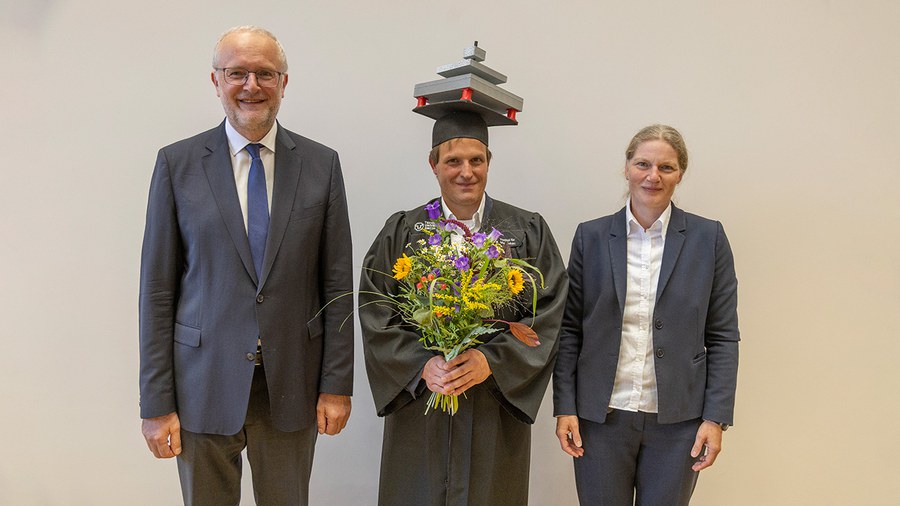
Thomas Schubert with Prof. Dr.-Ing. Birgit Beckmann (TU Dresden) and Prof. Dr.-Ing. habil. Ivo Herle (TU Dresden)
On August 12, 2026, Thomas Schubert successfully defended his dissertation 👨🎓 entitled "Skalierung und Wiederholbarkeit bei Anprallversuchen an Stahlbetonbauteile – Experimente zu hartem und weichem Impakt". The event took place in the Beyer Building of TU Dresden.
Abstract:
This thesis investigates the behaviour of reinforced concrete slabs subjected to high dynamic impact loading, with particular focus on experimental aspects related to result scatter, scalability and multiple impact scenarios. The objective was to establish a valid and systematic database in order to support and further develop existing design approaches. More than 30 impact experiments on reinforced concrete slabs were conducted, including laboratory-scale tests as well as experiments on large-scale specimens. In addition to experiments with increasing impact velocity, identical tests were deliberately performed in order to quantify the experimental scatter of results. The investigations revealed a moderate scatter in the maximum values of support reactions and structural deflections, whereas the time-dependent force histories exhibited significantly larger variations. To investigate scalability, a geometric scaling factor of 2 was implemented. Although individual peak values were comparable, differences in the failure mechanisms and in the load transfer behaviour were observed. Consequently, a purely geometric transferability of the results could not be fully confirmed. In particular, nonlinear and fracture-mechanical effects were found to play an increasingly important role in such impact scenarios. A further focus of the study was the experimental investigation of double-impact events consisting of an initial impact by a rigid projectile followed by a second impact using a deformable projectile. The results show that damage caused by the first impact significantly reduces the remaining load-bearing capacity of the structure and strongly influences its response to subsequent loading. Second impact tests exhibited a linear increase in structural damage with increasing impact velocity. In contrast, single impact events involving liquid-filled projectiles did not produce directly visible structural damage within the investigated parameter range.
The work provides a consistent experimental database for the assessment of high dynamic impact events and identifies significant characteristics regarding scaling behaviour and variations in structural load-bearing capacity. The findings and experimental data are of particular relevance for the design and assessment of protective structures forming part of critical infrastructure.
Dear Thomas, we would like to take this opportunity to wish you every success in your scientific career and all the best for the future. 🥳 👍