
Mar 31, 2026
Starting signal for the C-Factory: pilot plant for CO₂-storing carbon concrete components in Leipzig
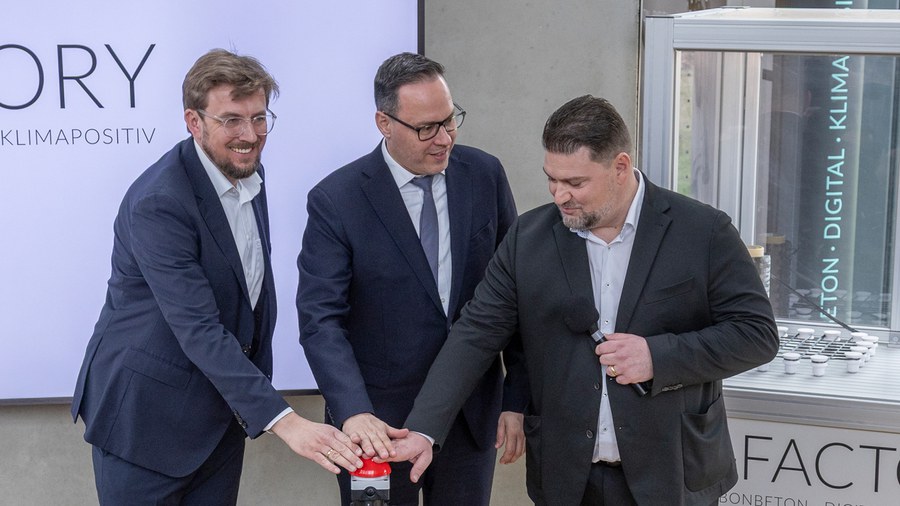
Dr.-Ing. Alexander Kahnt, Minister of State Dirk Panter and Dr.-Ing. Matthias Tietze launch the ambitious C-Factory project
The C-Factory, the world's first carbon concrete plant for CO₂-storing components, is to be built in Leipzig. The ambitious project is being funded by the Federal Ministry for Economic Affairs and Energy with around 15 million euros and is considered an important step towards more climate-friendly construction methods.
The Institute of Concrete Structures (IMB) at TUD Dresden University of Technology is playing a central role in the project. The Institute is playing a key role in the development of the C-Factory - a pilot plant for the largely automated production of carbon concrete components. With its expertise in structural engineering, which is unique in Europe, and extensive facilities for large-scale testing, the IMB is contributing crucial scientific and experimental expertise to the project.
The focus of the work is on the development and evaluation of components that can be manufactured under industrial conditions and at the same time achieve the highest possible CO₂ reduction or storage effect. In particular, the IMB is supporting the combination of various innovative individual technologies. These include low-CO₂ "eco" cements, CO₂-treated recycled aggregates, alternative mineral components such as olivine and oliment as well as ecological carbon fibers.
In addition, methods are being investigated in which CO₂ is introduced into the concrete in a targeted manner during the mixing process and during setting. The interaction of these approaches within an industrial production process is crucial here - not their isolated consideration.
Another focus is on investigating the load-bearing behavior of the carbon concrete components produced in this way under realistic loads. Here, the IMB can draw on its test infrastructure, which enables investigations from small-format test specimens to large-format components. At the same time, the researchers systematically analyze different material and process combinations in order to identify solutions that ensure the permanent and safe storage of CO₂ in the component.
In addition, the Institute is developing concepts for quality-assured production and for the future building authority approval of the new building material and component systems. The IMB is thus making an important contribution to transferring innovative research results into practical applications and establishing carbon concrete as a sustainable building material of the future.
The official project launch was accompanied by contributions from several representatives from science, politics and practice. Speakers included Dr. Matthias Tietze, Managing Director of Kahnt & Tietze GmbH and head of the project consortium, Dirk Panter, Minister of State at the Saxon State Ministry for Economic Affairs, Labour, Energy and Climate Protection, Dr. Hans-Jörg Temann, President of the Saxony Chamber of Engineers, Prof. Jean-Alexander Müller, Rector of Leipzig University of Applied Sciences, and Prof. Steffen Marx, Director of the Institute of Concrete Structures at TUD Dresden University of Technology.
Total amount / total funding amount: approx. 20 million euros / approx. 15 million euros
Project partners, in addition to the IMB of the TUD:
- Kahnt & Tietze GmbH
- Betonwerk Oschatz GmbH
- SCHWENK Zement GmbH & Co. KG
- Prilhofer Consulting GmbH & Co. KG
- ABS - GmbH Storkow
- Forschungs- und Transferzentrum Leipzig e.V. an der Hochschule für Technik, Wirtschaft und Kultur Leipzig (HTWK Leipzig)