
Creep behavior of old concrete
Table of contents
Project data
| Titel | Title Kriechverhalten alter, vorbelasteter Betone unter Druckbeanspruchung | Creep of old, preloaded concrete under compressive stress Förderer | Funding |
Short description
Existing structures that no longer meet current and future requirements often experience higher service and live loads as a result of conversion or strengthening measures. The additional compressive stresses lead to a renewed creep process in the existing concrete. These creep deformations must be taken into account in the planning stage using suitable prediction models in order to be able to quantitatively estimate losses in prestressing force, deflections, redistribution of internal forces, and other deformation-related changes in the structure. However, the currently valid normative creep models are based entirely on tests with comparatively young, previously unloaded concrete and are therefore not reliable for predicting creep deformations at high load ages.
The very few creep tests available on old concrete show that creep deformations are not negligible even at very high concrete ages and are underestimated by normative creep models. The aim of the research project is to quantify the creep behavior of (very) old, preloaded concrete and to derive suitable parameters for the development of new creep models or the adaptation of existing ones.
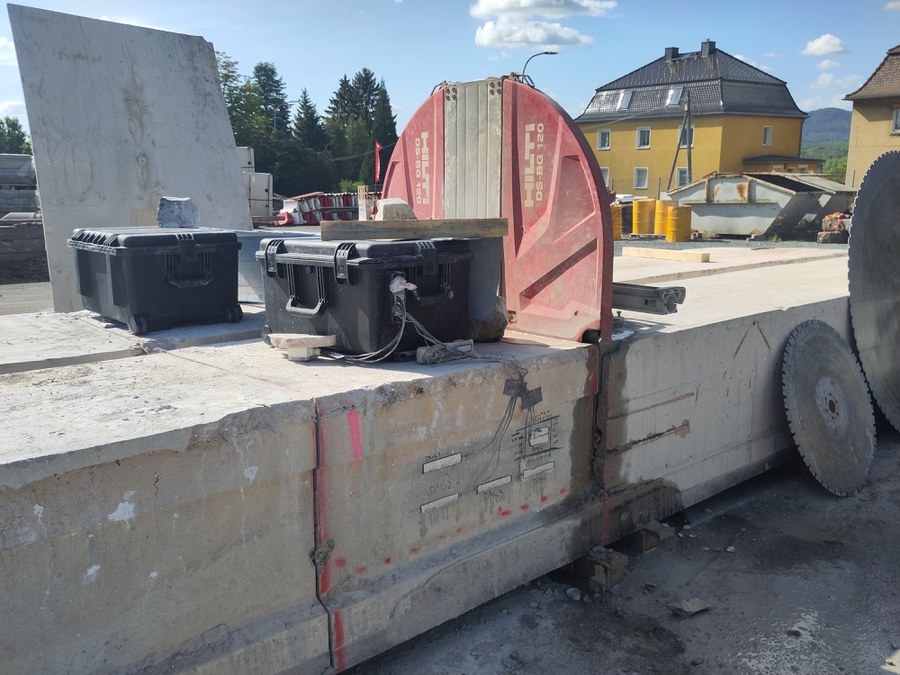
Prestressed precast bridge girder with applied strain gauges applied to measure strain recovery during concrete sawing operations
The test program includes two measurement concepts on four representative existing concrete structures (BW1–BW4) from the 1960s to the 1980s. In the scope of concept A, the basic and drying creep of drill core samples taken from three structures (BW1–BW3) and from three differently preloaded areas in each case is tested under laboratory conditions. The strain recovery of the concrete during and after extraction is measured in order to quantify the preload and the extent of delayed elastic deformation after a long period of loading. The in-situ moisture content of the concrete is also determined and ensured by storing the core samples in sealed conditions until the creep tests begin. Based on the test results from concept A, a prediction model for the creep behavior of preloaded concrete at a very high load age is derived.
In the scope of concept B, two existing prestressed concrete structures (BW3 and BW4) are prestressed externally and the resulting creep deformations are measured. In the case of BW3, the results from concept B are compared directly with the results from concept A. Taking into account the measured recovery strains, an assessment is made as to whether the creep behavior determined on the drill core can be transferred to the actual structures. In addition, the results of concept B are used to validate the creep model.