
DFZ-Bau
Table of contents
“We need a paradigm shift in construction. Not tomorrow, not the day after tomorrow – now.”
Manfred Curbach
Motivation
The construction sector is undergoing a fundamental transformation. As one of the largest consumers of raw materials and energy, it contributes significantly to climate change and resource depletion. At the same time, there is a growing demand for affordable housing and high-performing infrastructure. To address these challenges, construction materials, structural designs, and building processes must undergo a radical evolution. In addition to innovative and resource-efficient construction methods, the preservation, renovation, and transformation of existing structures are becoming increasingly important. The future of construction therefore requires not only technical innovations but also new ways of bridging the gap between research and construction practice.
Partners and funding
The German Research Center for Sustainable Construction (DFZ-Bau) is being established as a joint initiative of the German federal government, the states of Saxony, Thuringia and Baden-Württemberg, and leading research institutions.
Scientific Partners:
- TU Dresden
- University of Stuttgart
- Bauhaus-Universität Weimar
Funding of the initial research projects:
- Federal Ministry for Housing, Urban Development and Building (BMWSB)
- Free State of Saxony
- Free State of Thuringia
- State of Baden-Württemberg
Scientific Support:
- Federal Institute for Research on Building, Urban Affairs and Spatial Development (BBSR)
The research center
The German Research Center for Sustainable Construction (DFZ-Bau) serves as a nationwide research network designed to drive the transition toward a climate-neutral and resource-efficient construction sector. It employs a decentralized approach, pooling existing research expertise and fostering its further development across multiple locations. Bautzen is designated as the registered seat of the association.
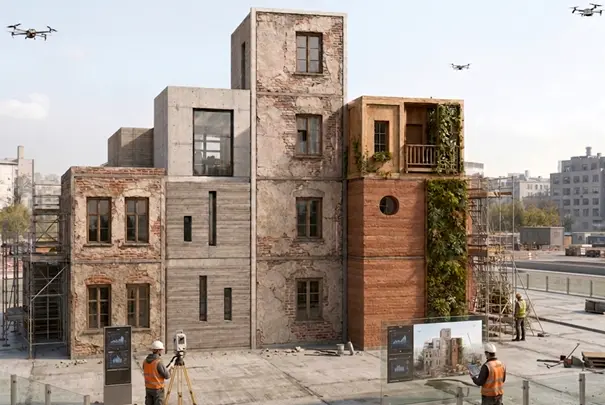
Concept visualization of a physical experimentation space for circular construction, based on the guiding principle of a ‘House of No Waste’
The focus is on practice-integrated and interdisciplinary construction research. Within physical experimental spaces, new materials, structures, technologies, and construction processes are to be tested and evaluated under realistic conditions, and further developed in collaboration with partners from the private sector and public authorities.
A key objective is to accelerate the transfer of scientific findings into construction practice, thereby paving the way for the widespread adoption of innovative, sustainable building methods.
From vision to implementation
The origins of DFZ-Bau date back to 2021, when a high-level team of initiators led by Prof. Manfred Curbach of TU Dresden developed the concept of a major construction research center under the name “Lausitz Art of Building”. The initiative was later pursued under the name LAB – Living Art of Building, forming an essential foundation for what is now the DFZ-Bau. With the conceptualization of a Federal Research Center for Climate-Neutral and Resource-Efficient Construction (BFZ), agreed upon in late 2025, the original idea evolved into a nationwide research network with decentralized research priorities.
At TU Dresden, key figures currently involved in the ongoing development of the research center include Prof. Viktor Mechtcherine – director of the Institute of Construction Materials and spokesperson for the Cluster of Excellence CARE – as well as Prof. Steffen Marx, director of the Institute of Concrete Structures. On September 25, 2026, the presentation of the first funding certificates marked the official launch of research activities within the consortium, now known as the German Research Center for Sustainable Construction (DFZ-Bau). The formal establishment of the research center is planned for 2026.
TU Dresden as a research partner
TU Dresden is one of the scientific partners of the DFZ-Bau, contributing its extensive expertise in the fields of sustainable construction materials, resource-efficient structures, digitalization, and the transformation of existing buildings. A key scientific foundation is provided by the Cluster of Excellence CARE – Climate-Neutral and Resource-Efficient Construction, which is jointly supported by TU Dresden and RWTH Aachen University. While CARE focuses on developing new scientific principles for climate-neutral construction materials, innovative structural concepts and advanced manufacturing technologies, DFZ-Bau aims to support the practical testing, further development and transfer into widespread application of these innovations. The two initiatives thus complement each other in their research approaches and objectives.
The initial research projects
Three initial projects have commenced their work at the Dresden, Stuttgart and Weimar locations. These projects serve as preparation for the future research clusters of the DFZ-Bau. The Dresden project focuses on the resource-efficient and minimally invasive transformation of existing buildings. This involves analyzing and evaluating municipal building stocks, preparing "living labs" (real-world laboratories), and developing innovative solutions for the renovation and continued use of structures under real-world conditions. In doing so, TU Dresden combines methodological foundations with application-oriented research, contributing to the sustainable development of the existing building stock.
Future prospects
In the long term, DFZ-Bau aims to establish itself as a central platform for application-oriented construction research in Germany. By connecting academia, industry and the public sector, the research center seeks to accelerate the transfer of innovative solutions into construction practice. At the same time, the research center offers new opportunities for the research landscape and the structural transformation of the Lusatia region. The planned research infrastructure in Bautzen is intended to create further opportunities for research, technology transfer, and regional value creation. The ultimate goal is a construction sector that uses resources responsibly, extends the lifespan of existing structures, and develops new construction methods that equally meet environmental, economic and societal requirements.