
Carbon-reinforced concrete (CRC) - research
Table of contents
- C - 37 Geometric Characterization of Profiled Carbon Reinforcing Bars
- C - 36 Material characterization of carbon reinforcement produced by direct yarn placement
- C - 35 Investigation of the bond behavior of connecting pins for Double Walls
- C - 34 Investigation of Alternative Non-Metallic Reinforcement
- C - 33 Numerical Investigation of Carbon Reinforced Concrete (CRC) Structures
- C - 32 Shear force transmission via crack flanks in carbon concrete
- C - 30 Four-point bending test on a carbon concrete T-beam
- C - 29 Flexural behavior of self-prestressed concrete slabs with carbon rod reinforcement
- C - 28 Alternating reinforcement guidance in expansion body tests
- C - 5 Installation parts for components made of carbon concrete
- C - 2 Prestressed reinforcements made of carbon, glass and basalt
C - 37 Geometric Characterization of Profiled Carbon Reinforcing Bars
Thermoplastic carbon reinforcement bars can be plastically formed by heating, thereby enabling the creation of defined profiles. The resulting bar geometry influences the effective cross-sectional area and the mechanical properties.
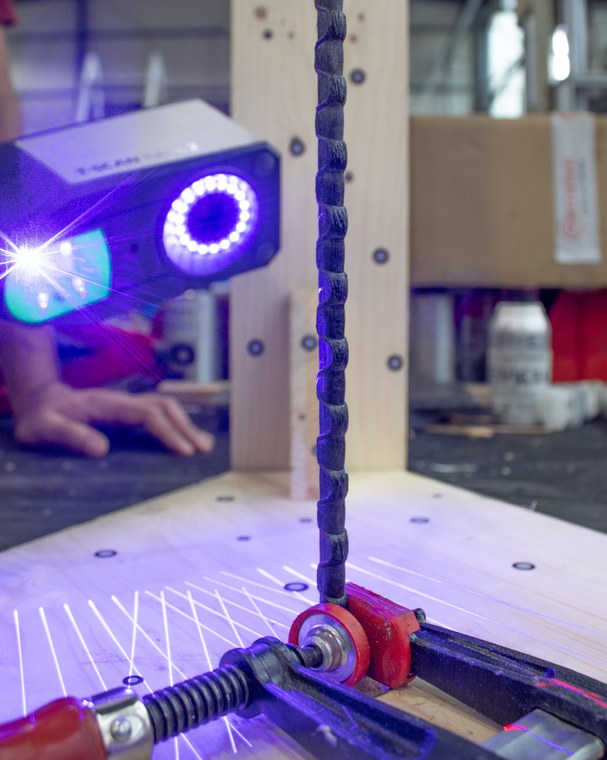
Digital capture of profiled carbon rods using 3D laser scanning
The objective of this thesis is to digitally capture profiled carbon reinforcement rods using 3D laser scanning and to analyze the resulting 3D models. The acquired geometric data will be used to verify existing rod tensile tests. Additionally, the method will be compared with conventional cross-sectional determination using the volume displacement method. Finally, the influence of the profiling on the mechanical properties of the reinforcing bars will be investigated.
This project can be undertaken as a course project or a master’s/diploma thesis.
The specific scope of the project will be defined in consultation with the student.
Contact person:
Dipl.-Ing. Johann Sinner
+49 351 463-31705
C - 36 Material characterization of carbon reinforcement produced by direct yarn placement
Carbon reinforcement can be used in concrete in the form of rebars and grids. The grid can be manufactured using the chain-knitting technique or direct yarn placement. In direct yarn placement, the impregnated roving is placed directly onto a tensioning frame by a robotic arm, enabling the production of load-optimized components.
As part of this thesis, a material characterization of the carbon grid produced by direct yarn placement will be conducted. This involves various tests, such as those to determine the tensile strength and flexural stiffness of the grid, which must be appropriately prepared, conducted, and evaluated.
This project can be undertaken as a project work or a master’s/diploma thesis.
The specific scope of the project will be defined in consultation with the student.
Contact person:
Dr.-Ing. Enrico Baumgärtel
+49 351 463-42631
C - 35 Investigation of the bond behavior of connecting pins for Double Walls
Double walls in precast construction are a well-established building method. In addition to conventional steel reinforcement, carbon fiber reinforcement can also be used to construct the load-bearing shells. As a result, the load-bearing shells can be designed with a thinner wall thickness. In double walls with steel reinforcement, steel pins are predominantly used as fasteners between the shells. While the use of steel connectors in combination with carbon fiber reinforcement is theoretically possible, bimetallic corrosion can lead to failure of the steel pins. Nonmetallic connecting pins offer an alternative and also exhibit higher corrosion resistance than steel.
This thesis investigates and documents the non-metallic connecting pins available on the market. The composite behavior of selected pins in concrete will be experimentally investigated and evaluated using pull-out tests. Based on the experimental results obtained, a numerical model for simulating the pull-out tests will be developed.
This project can be undertaken as a project work or a master’s/diploma thesis.
The specific scope of the project will be defined in consultation with the student.
Contact person:
Dr.-Ing. Enrico Baumgärtel
+49 351 463-42631
C - 34 Investigation of Alternative Non-Metallic Reinforcement
Carbon fiber reinforcements, particularly grids, are already being used on a large scale. In addition to their advantageous properties—such as improved corrosion protection compared to conventional steel reinforcement—the production of carbon fibers relies on crude oil, which poses a significant environmental drawback. More sustainable alternatives include the production of carbon fibers from bio-based materials (e.g., algae), the use of recycled carbon fibers, and the use of natural fibers.
This thesis aims to investigate and evaluate alternative reinforcements. For an initial assessment, the reinforcements will be analyzed in tensile tests with regard to their tensile behavior and crack formation. Finally, a comparative evaluation against conventional carbon fiber reinforcement will be conducted.
This project can be undertaken as a project work or a master’s/diploma thesis.
The specific scope of the project will be defined in consultation with the student.
Contact person:
Dr.-Ing. Enrico Baumgärtel
+49 351 463-42631
C - 33 Numerical Investigation of Carbon Reinforced Concrete (CRC) Structures
Detailed title: Numerical Investigation of Carbon Reinforced Concrete (CRC) Structures Using Finite Element Modeling
* only available in english *
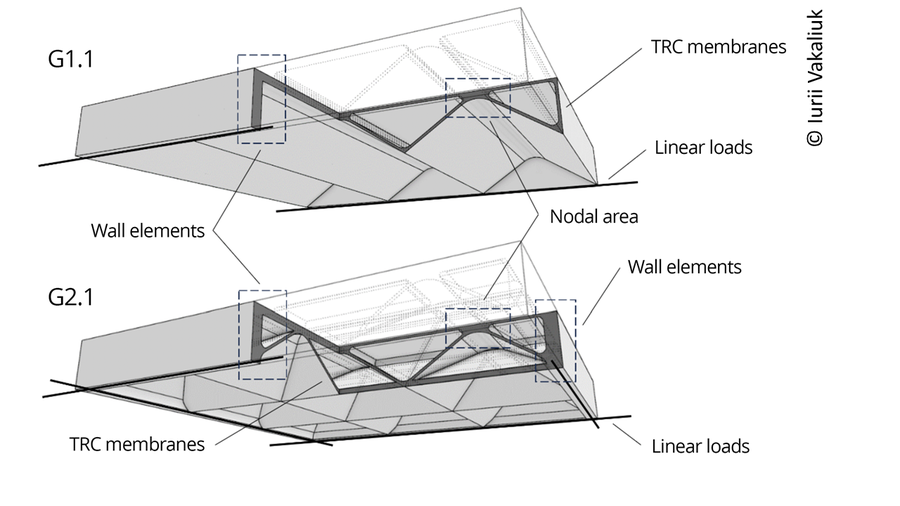
Geometrical Models
Carbon Reinforced Concrete (CRC) has emerged as an innovative and sustainable construction material due to its high durability, corrosion resistance, and ability to produce lightweight and thin-walled structural elements. In recent years, extensive research has focused on the structural behavior and numerical modeling of CRC shell structures using advanced finite element methods (FEM). Numerical simulations provide an efficient approach for understanding the complex behavior of CRC structures and for investigating the influence of various geometric and loading parameters.
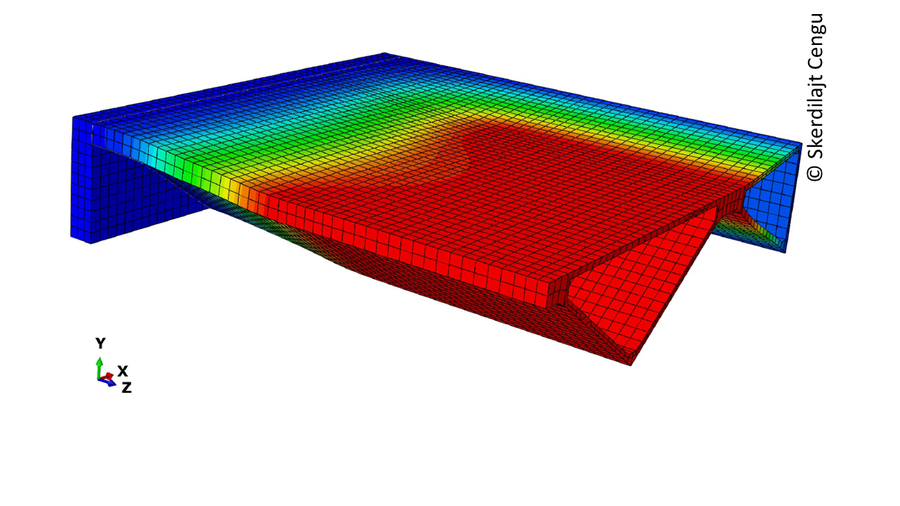
FEM silmulation of CRC shell structures
The objective of this master thesis is to develop reliable finite element models of CRC structures using ATENA and/or ABAQUS software, perform parametric studies, and compare the numerical results with available experimental data. The study aims to contribute to the understanding of the structural behavior of CRC shell structures and evaluate the influence of different parameters on their performance.
The task will be specified in consultation with the student.
Contact person:
Skerdilajt Cengu M. Sc.
+49 351 46339815
C - 32 Shear force transmission via crack flanks in carbon concrete
Carbon concrete enables the construction of jointless concrete roadways. Due to its corrosion resistance, the carbon reinforcement can be installed in the concrete roadway with less concrete cover. This makes it possible to achieve greater bending stiffness with more efficient use of materials. For the use of carbon reinforced concrete as a continuous concrete roadway, however, investigations into short and long-term loads are still necessary. If, for example, tensile stresses and cracks occur in this concrete roadway as a result of temperature deformations, shear forces from the traffic load must be transferred via the crack flanks.
In this work, cracked and non-cracked slabs made of carbon concrete are to be examined with regard to their shear force transmission via the crack flanks. For this purpose, findings on shear force transfer, crack toothing and dowel effect of carbon concrete are to be researched in the literature first. Subsequently, the shear force transmission at different crack widths will be investigated. The aim is to identify the crack width up to which shear force transfer is possible for the continuous concrete roadway.
The task will be specified in consultation with the student.
Contact person:
Dipl.-Ing. Jonathan Schmidt
+49-351-463-41118
C - 30 Four-point bending test on a carbon concrete T-beam
*Project work/diploma thesis - Test design and investigation of the load-bearing capacity of filigree carbon concrete beams
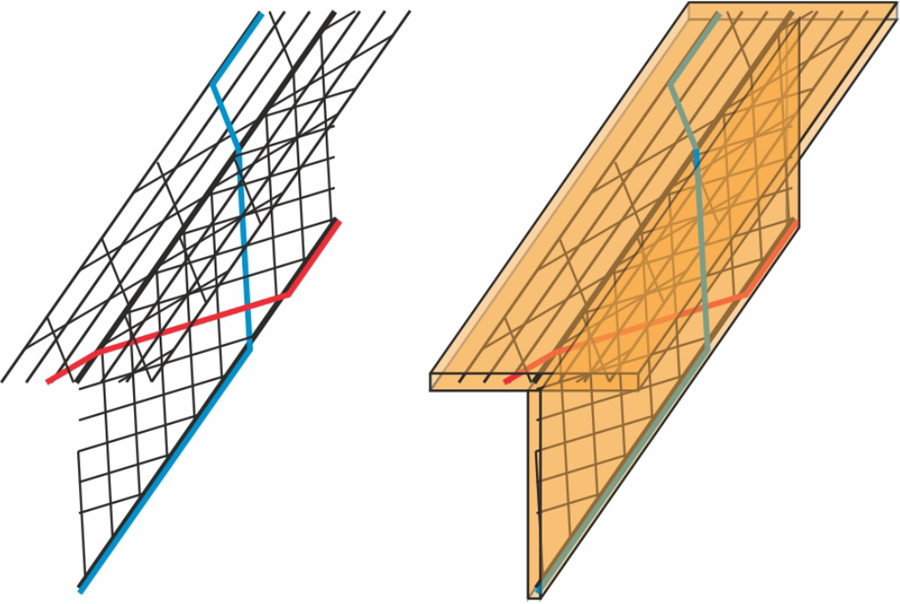
Bewehrungsführung der alternierenden Carbonbewehrung
Based on a current project work, in which the reinforcement design for a filigree carbon concrete beam was examined, the manufactured reinforcement is to be examined for its load-bearing capacity in a 4-point bending test. The special feature lies in the thin cross-section components. Since carbon reinforcement, unlike steel, cannot corrode, only a very small concrete cover is required. In a conventional reinforced concrete beam, the stirrups for absorbing the shear force enclose the longitudinal reinforcement for absorbing the tensile forces. With webs of only 3 cm, stirrup reinforcement is not feasible, which is why the reinforcement of the carbon yarns is alternating. The principle of alternating reinforcement has already been developed at the Institute in previous projects (for an example, see: Mesh lattice girders).
*Dependingon whether a project or diploma thesis is being prepared, the scope may only include the design of experiments or, for the latter, the focus of the load-bearing capacity analysis may be limited.
The task will be specified in consultation with the student.
Contact person:
Dipl.-Ing. Lore Zierul
0351 463 33609
C - 29 Flexural behavior of self-prestressed concrete slabs with carbon rod reinforcement
Processing only possible as part of a Master's thesis
Untersuchung der Verbundentwicklung zwischen Beton und Carbonbewehrungsstäben
Carbon reinforcing bars are increasingly being used as an alternative to conventional steel reinforcement, often in combination with high-strength concrete. However, this has an increased tendency to shrink, which can lead to cracking and other serviceability problems. Due to their low compressive strength, carbon reinforcement bars are only able to absorb negative shrinkage strains to a limited extent. As a result, the reinforcement can go into a passive state, which impairs its effectiveness and the structural behavior of the component.
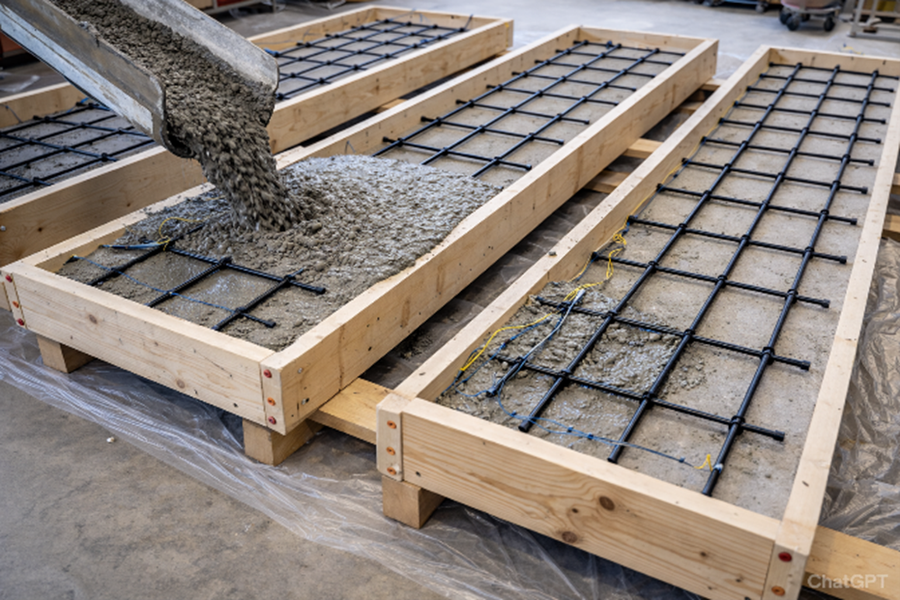
The aim of this work is therefore to investigate the influence of swelling concrete on the load-bearing behavior of concrete slabs reinforced with carbon reinforcement bars. The swelling concrete should partially or completely compensate for shrinkage deformations through a controlled increase in volume. If there is sufficient bonding between the concrete and the carbon reinforcement bars, this expansion can also induce tensile strains in the bars, causing tensile stresses and activating the carbon reinforcement. Overall, the use of swelling concrete is expected to improve the cracking behavior and significantly reduce the deflections of the slabs.
To implement this research project, several concrete slabs made of swelling concrete with dimensions of around 1500 mm × 500 mm × 80 mm will be produced. Prior to this, tests are carried out on small-scale test specimens to investigate the bond development between concrete and carbon reinforcement bars. Distributed fiber optic sensing (DFOS) technology is used to record the expansions and strains in the concrete and the reinforcing bars.
Contact person:
Mohammed Dhahir M.Sc.
+49 351 463-40411
Jasmin Dräger M.Eng.
+49 351 463-39878
C - 28 Alternating reinforcement guidance in expansion body tests
Project work: Conceptual design of tests
Herkömmlicher Dehnkörperversuch
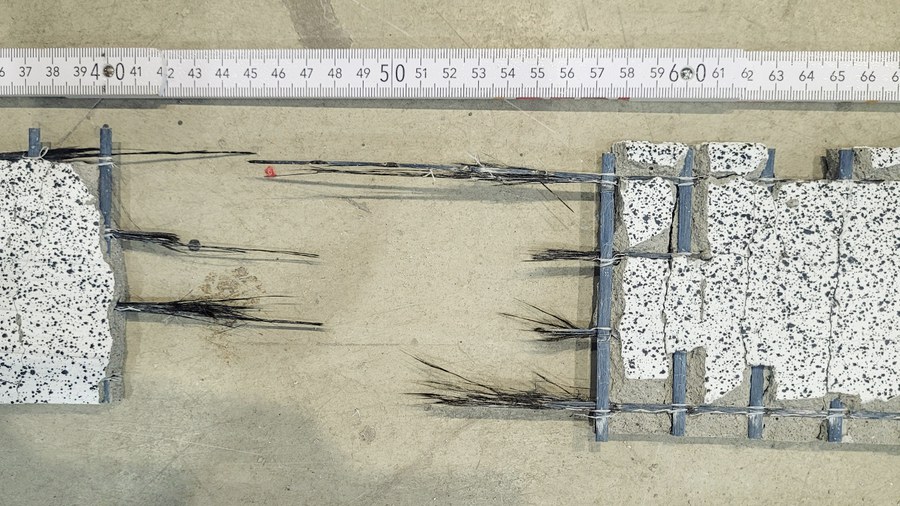
Components can be manufactured thinner if carbon reinforcement is used, as only a very small concrete cover is required. This is accompanied by construction using assembled slab elements instead of full cross-sections. However, the shear reinforcement cannot then be realized using stirrups, which leads to the concept of alternating reinforcement (for an example, see: Mesh lattice girders). Existing guidelines provide specifications for carrying out tests with a straight grid.
In the thesis, in cooperation with the Institute of Textile Machinery and High Performance Material Technology, test setups for the determination of composite properties are to be researched and a setup implemented.
The task will be specified in consultation with the student.
Contact person:
Dipl.-Ing. Lore Zierul
+49 351 463-33609
C - 5 Installation parts for components made of carbon concrete
* only in German language *
When using carbon reinforcement in precast construction, component thicknesses can be reduced to just a few centimetres. The classic connection technique relies on solid components that serve as an undisturbed anchor base. The low component thickness in carbon concrete construction and the associated increased probability of cracking place new demands on the fastening systems. Systems such as the Halfen Fassadenplatter Anchor FTA-3 adapt to the new challenges.
In this work, methods are to be collected and evaluated that can make a point load application in carbon concrete more favorable for the anchor base through a spatial distribution in order to counteract both the low component thickness and the expected crack formation. These methods are to be further developed into product concepts. The principle potentials of load transfer are to be estimated. FE programs can be used to analyze the load transfer. However, it is also possible to work without computer support, for example by using framework models. Details of the task are determined together with the student.
* Knowledge of fastening technology is required *
Contact person:
Dr.-Ing. Harald Michler
0351 463 32550
Harald.Michler@tu-dresden.de
C - 2 Prestressed reinforcements made of carbon, glass and basalt
Detailed title: Possibilities and boundary conditions for the production and use of prestressed textile reinforcements
* only in German language *
Up to now, non-metallic reinforcements have mainly been used as slack reinforcement. In the meantime, however, prestressing options such as prefabricated prestressed plates (CPC plates) are already on the market. The work is intended to collect and analyze current applications for prestressed non-metallic reinforcements - mostly in the context of research projects. A comparative analysis of the material properties of metallic and non-metallic prestressed reinforcements is intended to assess the potential of the individual materials, for example the effects of relaxation. The different methods of prestressing, such as prestressing with immediate, subsequent or without bond, are to be considered individually.
The work includes a literature study and preferably comparative hand calculations. Details of the task will be determined together with the student.
Contact person:
Dr.-Ing. Harald Michler
0351 463 32550