
Current and Past Project Grants from the TDL BU
Project Funding 2026
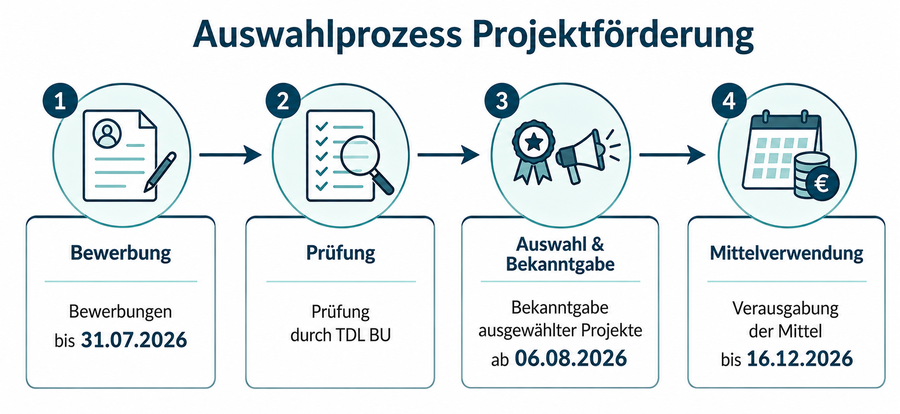
As part of the DLL Fund, the Digital Teaching in Construction and Environment team can independently select projects for funding. Take advantage of this opportunity now and apply by July 7, 2026. We will fund two projects, each receiving €5,000, from among the submissions.
It is essential that the funds benefit teaching and enhance its quality. The funds must always be spent with a focus on students and, ideally, be sustainable so they can be used by multiple cohorts of students. Both innovative and experimental formats, as well as established ones, are eligible for funding. Funding may be provided for personnel and material costs with an expenditure deadline of December 16, 2026.
The following outlines the basic principles for awarding grants, which were defined by the TDL BU and ZiLL in consultation:
- Only submissions received by the application deadline will be considered.
- There is no entitlement to funding.
- In accordance with the guidelines of the overarching DLL Fund, basic technical and spatial equipment, as well as parallel developments to existing central IT infrastructure systems and services offered by TUD, are not eligible for funding.
- Dual funding with the DLL Fund is not permitted.
- The TDL BU decides on project funding by majority vote based on agreed-upon award criteria.
- No faculty is given preferential treatment, and efforts are made to ensure a balanced distribution of funds among the faculties over the long term.
- Grant recipients collect and evaluate their experiences.
- Upon completion, the funded projects and initiatives will be published on the TDL BU website, and suitable materials will be made available for this purpose.
- Grant recipients must maintain a complete record of expenditures and proactively provide this to the TDL BU and the responsible staff member at ZiLL.
- The TDL BU communicates decisions regarding funding or rejection transparently to applicants.
- Rejected proposals may be resubmitted in the next funding period after incorporating feedback.
- Application details: brief project description (max. 1 page), responsible faculty member(s) and participating departments/Institutes, financial plan, duration of funding, sustainability, and, if applicable, current funding for a similar or identical project from another source.
- Please submit applications via email to the TDL BU.
The application period has ended. The funded projects will be announced shortly.
Project Funding 2025
As part of the DLL Fund, the Digital Teaching in Construction and Environment Team at TU Berlin can independently select projects for funding. We received numerous applications for the 2025 call for proposals, from which two projects were selected to receive €5,000 each.

We are pleased to present:
Project 1: Digital Self-Study Program / Inverted Classroom Components in Plant Use (€5,000)
The “LB 420 Planting Design” module will be supplemented with digital learning formats in the style of microlearning. Planned components include audio-guided exercise tutorials, guides for research and implementation planning, interactive case studies (best-practice examples), digital planning aids, tools for plant selection, and self-assessment tests. A discussion forum complements existing consultation services and fosters professional exchange. The resulting knowledge database supports students in their self-study and serves as a sustainable resource for future cohorts, which students can also access flexibly for later projects.
Contact person(s): Ole Franke and Jun.-Prof. Nora Huxmann
Project 2: Implementation of a Circularity Game for the Digital Delivery of Course Content (€5,000)
The project aims to promote awareness and knowledge of circular construction methods through the digitized board game “Trivial Circuit,” which was originally developed by LXSY Architects. In particular, the project seeks to provide Civil Engineering students with practical insight into the specifics of sustainable construction processes and the reuse of building materials. As part of the project, the game—which is based on a real-world construction project—will be digitized using the Unity development platform to improve flexibility and accessibility. Trivial Circuit will then be integrated into university curricula to link theoretical and practical content, thereby enhancing the interdisciplinary nature of teaching.
Contact person(s): Johanna Schober