
Aug 06, 2026
CIPSEM Alumni Seminar strengthens climate adaptation learning through the Navigating Uncertainty model
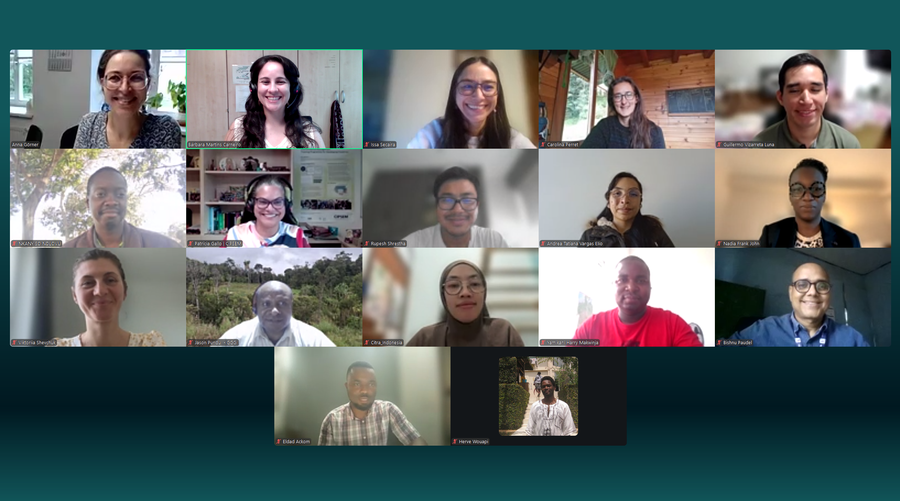
CIPSEM’s 2026 Alumni Seminar explored what it means to work through climate adaptation challenges collectively and across contexts. For the first time, the seminar used the Navigating Uncertainty dialogue model in a compact two-week online format and turned it into a shared learning space for systems thinking, peer exchange and collaborative problem exploration.
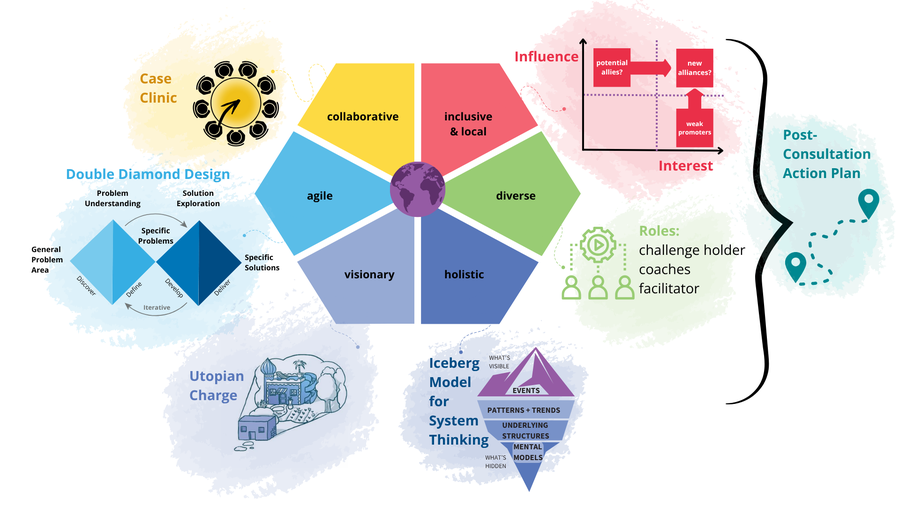
The “Navigating Uncertainty” dialogue model and selected tools used to move from system understanding to collaborative action.
Participants brought a wide range of regional and professional perspectives to the seminar. They came from countries including Bolivia, Cameroon, Ghana, Guatemala, Indonesia, Nepal, Papua New Guinea, Peru, Trinidad and Tobago, Ukraine and Zimbabwe, and worked in fields such as public administration, local government, research, civil society, consulting and international cooperation. This diversity shaped the seminar in a very practical way, as the cohort worked together on three participant cases and, in doing so, learned both about pressing adaptation challenges and about the dialogue model as a practical method.
The seminar was structured around three real-world cases introduced by participants from Ghana, Guatemala and Zimbabwe. These challenges became the common point of departure for the whole group, which used the model’s tools to move from first observations to deeper patterns, structural causes, stakeholder dynamics and possible pathways for action. In this way, the cases were not only topics for discussion, but also vehicles for collective learning.
One case focused on waste management in Kumasi, Ghana. Introduced by Eldad Kwaku Ackom, Sustainability Programmes Manager at JSO Group of Companies, it asked how a linear and inefficient system could be transformed into a climate-smart, circular and inclusive model that recognizes and integrates informal waste workers. As the cohort worked through the case, the discussion opened up broader questions of social justice, public health, flooding, circular economy and the relationships between municipalities, communities, recyclers and the informal sector.
A second case, brought by Issa Daniela Secaira Mancía, Climate Change and Sustainability Consultant at the Inter-American Development Bank, focused on the challenge of linking dispersed smallholder farmers in Guatemala to viable markets, business support and enabling institutions. The joint exploration of this case highlighted the complexity of climate-vulnerable food systems and the need to connect agroecological production with economic viability, trust-building and stronger linkages between producers, consumers and institutions.
The third case came from Nkanyiso Ndlovu, Head of the Solid Waste Management Section at the City of Bulawayo and a member of the city’s Climate Action Committee. His case addressed water stress, drought and local resilience in Bulawayo, Zimbabwe, and prompted wider discussion on groundwater recharge, blue-green infrastructure, institutional cooperation and ways of reducing overreliance on rainfall under increasingly uncertain climatic conditions.
The seminar was enriched by thematic input sessions that broadened the perspective beyond the three cases while remaining closely linked to their concerns. Adriana from the Wuppertal Institute presented the EcoZones framework for community-based and locally led climate adaptation, illustrating how neighbourhood-level assessment, collaborative mapping and co-design can support more inclusive urban climate action. Nadia Frank John from Trinidad and Tobago, Transportation Planner at the Division of Public Infrastructure and Transportation of the Tobago House of Assembly and Lead Researcher at the Caribbean Mobility and Resilience Initiative, used school zones in Tobago to show how questions of mobility, legacy infrastructure and climate resilience intersect in everyday planning practice.
A second input session drew attention to governance, institutions and infrastructure. Yamikani Harry Makwinya, originally from Malawi and currently based in Germany as a doctoral researcher at UNU-FLORES, spoke about institutional gelling, climate finance and the importance of connecting formal systems with community knowledge and lived realities in socio-ecological systems. Rupesh Shrestha from Nepal, Architect at Kathmandu Valley Heritage Trust, added insights on blue-green infrastructure and showed how adaptive and nature-based urban design can help address water-related risks while also requiring supportive planning cultures and political commitment.
Across the seminar, the Navigating Uncertainty dialogue model helped participants move beyond isolated technical fixes and look more closely at relationships, interests, structures and recurring patterns. In the final reflection, participants highlighted not only what they had learned from one another’s challenges and contexts, but also the confidence they had gained in applying the model in their own work. Just as importantly, the seminar strengthened connections across the alumni network and showed how a compact online format can still create trust, shared learning and a strong sense of community of practice.
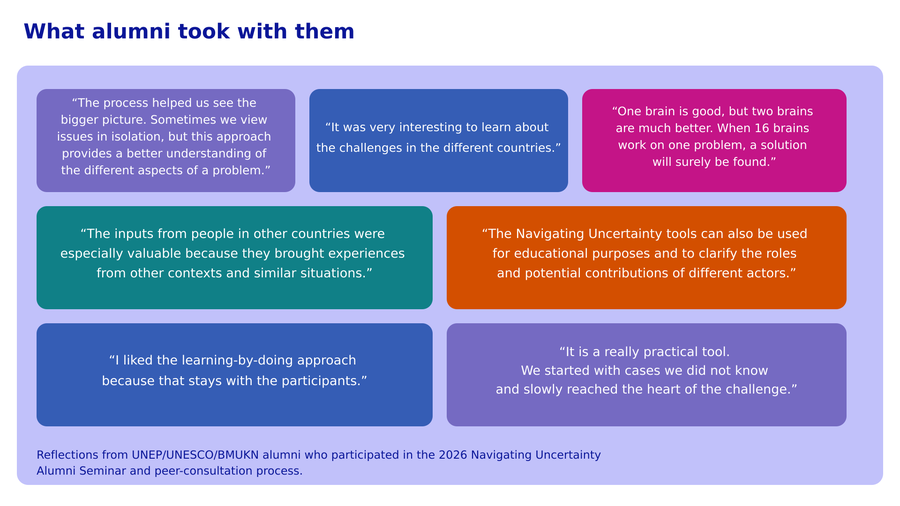
Reflections from UNEP/UNESCO/BMUKN alumni who participated in the Alumni Seminar 2026 Navigating Uncertainty online dialogue and peer consultation process.