
Applied Robotics and Control for Cooperative and Autonomous Mobility
| Module |
VW-VI-1715 |
|---|---|
| Participation |
Start: Every year in the summer semester |
| Amount of hours per week: |
6th Semester: 2 SWS lecture, 2 SWS exercise |
| Teachers: |
|
| Teaching language: | English |
| Requirements : |
Knowledge from: |
| Usability : |
VW-VI-1706 - Optimal Control Methods and Algorithms for Decision Making Processes |
| Exam : |
complex assignment |
| Credit Points & Module Grade: |
5 Credit Points |
Course Description
This course introduces the fundamental principles of autonomous and cooperative driving systems through a combination of theory and hands-on experimentation with mobile robots in a scaled laboratory environment. Students learn how autonomous vehicles perceive their surroundings, make decisions, collaborate with each other, and act safely within a shared traffic space. The course covers key aspects of autonomous and cooperative systems under the architecture of autonomous driving, including sensors, planning and control algorithms, and communication protocols and technologies, with practical examples such as platooning or autonomous intersection.
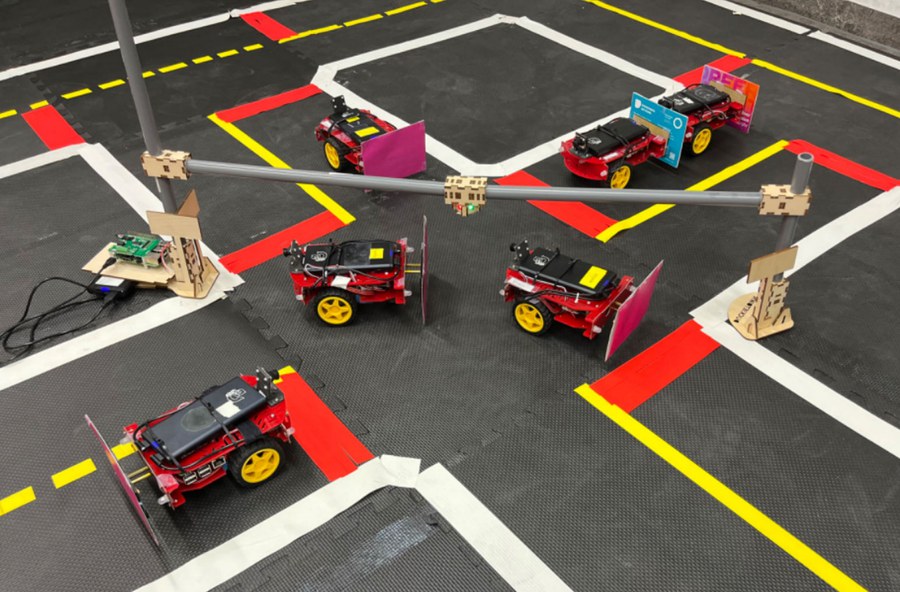
Students apply the concepts in the Miniature Connected, Cooperative and Automated Mobility (MiniCCAM) lab by programming and testing scaled mobile robots. The course also includes a four-week team or individual project in which students design, implement, and evaluate autonomous driving strategies.
Learning Objectives
Upon completion of this course, students will be able to:
- Explain the architecture of autonomous vehicles and use ROS as an integration framework for systems that perceive, decide, collaborate, and act.
- Design and implement PID controllers for precise motion control using DC motor models and encoder feedback.
- Apply computer vision and deep learning techniques (OpenCV, CNNs, YOLO) to detect traffic signs, lanes, and obstacles.
- Apply coordinate transformations and differential drive kinematics to implement odometry and basic SLAM for self-localization.
- Implement path planning algorithms (Dijkstra, A*, RRT) and apply cooperative planning principles for multi-vehicle scenarios.
- Develop, integrate, and evaluate autonomous driving strategies in an individual or team project.
Course Materials
Course materials are provided via the OPAL platform. Students are required to enroll in the course on OPAL to access all materials, including lecture slides and additional resources. Access is restricted to registered students, and login credentials will be communicated during the lecture.