
MiHUB (Medical Informatics Hub)
Hintergrund
Der Medical Informatics Hub (MiHUB) setzt die Arbeit des Vorgängerprojekts MiHUBx (Medical Informatics Hub in Saxony) fort. MiHUBx war einer von sechs regionalen Knotenpunkten digitaler Medizin-Infrastruktur in Deutschland (Digitale FortschrittsHubs Gesundheit) mit der Aufgabe, die wegbereitende Arbeit der Medizininformatik-Initiative (MII) aus den Universitätskliniken heraus in die Fläche des Gesundheitssystems zu tragen – also auch Hausarztpraxen, niedergelassene Facharztpraxen, regionale Krankenhäuser sowie Rehabilitations- und Pflegeeinrichtungen einzubeziehen. In einer zweiten Förderphase wird das Projekt fortgeführt: Der Hub wächst mit der Medizinischen Universität Lausitz – Carl Thiem über Sachsen hinaus und statt drei thematisch weit auseinanderliegender Anwendungsfälle konzentriert sich MiHUB auf ein medizinisches Feld – die Onkologie insbesondere den Lungenkrebs – und dort auf einen durchgängigen Versorgungspfad.
Zielstellung
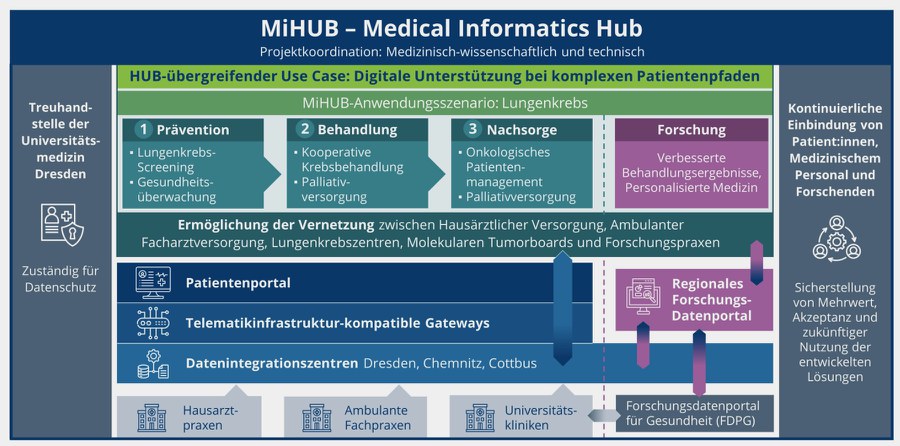
Das übergeordnete Ziel von MiHUB ist es, einen sektorenübergreifenden Datenraum und eine serviceorientierte Infrastruktur zu entwickeln, um die Zusammenarbeit der verschiedenen Akteure im Gesundheitssystem entlang eines vollständigen Behandlungsweges zu verbessern. Fachlicher Bezugspunkt ist die Lungenkrebsversorgung, in der Hausärzt:innen, niedergelassene Fachärzt:innen, regionale Kliniken und universitäre Krebszentren eng zusammenwirken müssen. Dabei stehen drei aufeinander aufbauende Anwendungsfälle im Fokus:
- Prävention und Lungenkrebs-Screening
- Kooperative Krebsversorgung einschließlich Palliativversorgung
- Nachsorge und Langzeitüberlebende
Damit soll ein digitaler Raum entstehen, der
- Patient:innen über den gesamten Behandlungsweg hinweg begleitet und ihr Engagement fördert,
- Daten und Wissen aus der nicht-universitären Versorgung für Forschung und Versorgung erschließt,
- Forschenden bei komplexen Krankheitsbildern schnellen Zugang zu notwendigen Daten für ihre Studien ermöglicht und
- Behandelnden über Sektoren- und Einrichtungsgrenzen hinweg ein durchgängiges Bild ihrer Patient:innen bietet.
Gemeinsam mit den anderen FortschrittsHubs arbeitet MiHUB darüber hinaus am Hub-übergreifenden Anwendungsfall „Digitale Unterstützung komplexer Patient Journeys" und trägt so dazu bei, die Digitalisierung in der Medizin und die Zukunfts- und Wettbewerbsfähigkeit der Region voranzutreiben.
Unsere Rolle im Projekt
Übergreifende Patientenpfade in der Lungenkrebsversorgung
Ein durchgängiger Versorgungsweg lässt sich digital nur unterstützen, wenn er zuvor präzise beschrieben ist. Wir entwickeln daher einen integrierten Patientenpfad, der Früherkennung, Behandlung, Nachsorge, Palliativversorgung und hausärztliche Primärversorgung zusammenführt. Grundlage sind klinische Leitlinien und Standardvorgehensweisen der beteiligten Einrichtungen; die Modellierung erfolgt in erweitertem BPMN und wird anschließend in ein maschinenlesbares Artefakt auf Basis von HL7 FHIR und etablierten Terminologien wie SNOMED CT, LOINC und ICD überführt. So entsteht ein computerinterpretierbarer Patientenpfad, der semantisch interoperabel und an nationale wie europäische Initiativen anschlussfähig ist. Ergänzend analysieren wir die bestehende Informationssystemlandschaft entlang des Pfades und identifizieren Lücken, Schwachstellen und nachnutzbare Komponenten. Der Patientenpfad bildet die fachliche Grundlage für alle weiteren Arbeiten im Hub.
Patientenportal und Patientenintegration entlang des Versorgungsweges
Das in MiHUBx von unserer Forschungsgruppe entwickelte Patientenportal wird in MiHUB entlang des gesamten Versorgungsweges ausgebaut – und den übrigen FortschrittsHubs zur Nachnutzung bereitgestellt, die im Gegenzug eigene Module beisteuern. Wir verantworten Anforderungsanalyse und Architektur, die Spezifikation der technischen Schnittstellen entlang nationaler und internationaler Standards (gematik ISiK, KBV MIO, MII-Kerndatensatz, EHDS), die Anbindung an den sektorenübergreifenden Datenraum sowie das Compliance-Management, insbesondere im Hinblick auf das Medizinprodukterecht.
Inhaltlich knüpfen wir dabei an die Vernetzungsplattform aus der ersten Förderphase an: Betroffene erhalten verständlich aufbereitete Informationen zu Befunden und anstehenden Terminen, können selbst Angaben zu Lebensqualität und Nebenwirkungen bereitstellen und werden in der Nachsorge weiter begleitet. Als gemeinsame Komponente des Hubs entwickeln wir außerdem einen Patientenpfad-Service, der den modellierten Pfad für Patient:innen und Behandelnde sichtbar macht und den aktuellen Stand der Behandlung darin verortet.
Projektbeteiligte
Technische Universität Dresden
- Zentrum für Medizinische Informatik (ZMI) – Medizinische Fakultät Carl Gustav Carus (Konsortialführung)
- Datenintegrationszentrum und Treuhandstelle – Medizinische Fakultät Carl Gustav Carus
- Bereich Allgemeinmedizin mit dem Forschungspraxennetz SaxoN – Medizinische Fakultät Carl Gustav Carus
- Nationales Centrum für Tumorerkrankungen (NCT/UCC) – Medizinische Fakultät Carl Gustav Carus
- Forschungsgruppe Usability & Technologieakzeptanz – Medizinische Fakultät Carl Gustav Carus
- Forschungsgruppe Digital Health – Fakultät Wirtschaftswissenschaften
Medizinische Universität Lausitz – Carl Thiem (Cottbus)
- Datenintegrationszentrum
- Klinik für Hämatologie, Onkologie, Nephrologie, Diabetologie und Pneumologie
Klinikum Chemnitz gGmbH
- Datenintegrationszentrum, Bereich Medizinische Informatik
- Klinik für Innere Medizin IV
- Institut für Radiologie und Neuroradiologie
Hochschule Mittweida
- Fakultät Angewandte Computer- und Biowissenschaften
Asprechpartner:in
© BMFTR