
Indonesian-German Graduate School @ TUD
Shaping the future of learning and work in a digitally transformed world. The Indonesian-German Graduate School at TU Dresden

Logo DIKTI
The Indonesian-German Graduate School at TU Dresden is based on a long-standing, multifaceted collaboration between researchers from various Indonesian universities and researchers from the faculties at TU Dresden. Closely linked to the Center of Open Digital Innovation and Participation (CODIP), it covers a carefully selected range of complementary disciplines and holds great promise for both technical and societal innovations. The doctoral students’ research topics are embedded in individual projects that revolve around interdisciplinary thematic clusters and are led by a group of distinguished professors. Each individual project is expected to take on the character of an entrepreneurial challenge and to focus on research relevant to the economic and societal development of Indonesia and Germany in a global context (e.g., comparative research and innovation approaches).
Given the complexity of technological progress and the societal challenges associated with the digital transformation, an interdisciplinary approach and a participatory design of research and technology development are becoming increasingly important. The transformation of our society is driven by transformative digital technologies and emerging principles of knowledge-based production. Shaping and steering the future of learning and work requires not only innovative solutions but also an inclusive approach that takes into account the diversity of cultural perspectives and individual needs. To develop effective and sustainable solutions, it is essential to incorporate the voices of all those affected. Does AI offer an effective answer to this?
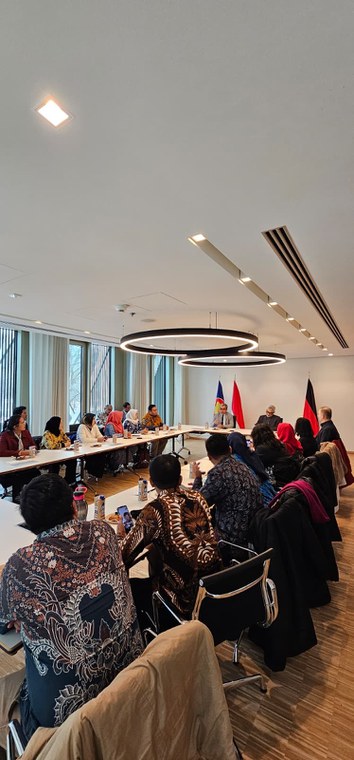
Panel discussion at the Indonesian Embassy in Berlin with the ambassador (Abdul Kadir Jailani) and the education attaché (Dr. Roniyus Marjunus)
In particular, the rapid digital transformation in education and the workplace calls for a rethinking of educational activities and occupational profiles. At the intersection of these fields, data-driven analytics and modeling offer unique opportunities to advance AI-supported learning and teaching processes. This master’s program explores approaches to integrating visual and learning analytics, dialogue agents, and virtual knowledge communities into educational and work environments. The interplay between technological advances and societal challenges calls for an interdisciplinary approach that prioritizes participatory research and inclusive design to address diverse needs and perspectives. Innovation and progress in all fields are driven and accelerated by digitalization, (big) data, and artificial intelligence (AI). The development and implementation of desirable visions for the future will benefit from carefully designed, data-driven, and AI-supported methods, as well as a well-trained workforce.
Research centers such as the Center for Open Digital Innovation and Participation (CODIP) and the Center for Interdisciplinary Digital Sciences (CIDS) at TU Dresden play a central role in promoting collaborative, data-driven innovation. By promoting participatory technology development, these centers not only enable excellent research for participants in the graduate program but also foster social engagement, behavioral change, and the co-creation of knowledge in digital innovation spaces. The concept of an open digital future underscores the need to balance complexity and accessibility and to embed learning and work within a broader societal framework. It is expected that doctoral projects—and not just these—will lead to the sustainable implementation of educational technologies through corporate responsibility.
As society navigates the conflict between traditional and emerging models, this program advocates for a transformative vision that links innovative educational practices with the evolving demands of the workplace. These developments underscore the critical importance of data-driven analysis for deriving actionable insights to ensure that digital transformation goes hand in hand with inclusive social progress. Such an interdisciplinary perspective offers a roadmap for a participatory and data-driven future in
education and work. Trending terms such as open innovation, future-ready skills, sustainable technologies, social enterprises, participatory innovation, equitable access to education, active digital citizenship, global collaboration, professional roles in educational technology, leadership for vulnerable target groups, etc., can serve as a starting point but must be grounded in sound and rigorous research with theoretical depth and empirical evidence.
Fellows and Topics
will be supervised by
Advisors
- Prof. Dr. Sandra Bohlinger - Chair of Adult Education
- Prof. Dr.-Ing. Dirk Brockmann - Chair of Biology of Complex Systems
- Prof. Dr. Ulf Ehlers - Chair of Educational Management and Lifelong Learning (Associated)
- Prof. Dr. Friedrich Funke – Chair of Quantitative Research Methods
- Young Investigator Dr. Sandra Hummel - Situating AI-Based Mentoring
- Prof. Dr. Steffen Kersten - Chair of Engineering Education
- Prof. Dr. Thomas Köhler – Chair of Educational Technology, Vocational Education (Coordinator)
- Prof. Dr. Jens Krzywinski - Chair of Industrial Design Engineering
- Prof. Dr. Oliver Michler - Chair of Transportation Telematics
- Prof. Dr. Wolfgang Nagel – Chair of Computer Architecture
- Prof. Dr. Jörg Rainer Nönnig – Chair of Knowledge Architecture (Associate)
- Prof. Dr. Birte Platow – Chair of Protestant Religious Education
- Dr. Nadine Schaarschmidt - Chair of Media Education
- Prof. Dr. Jaqueline Schmidt – Junior Chair in Digitalization in Education and Work Environments
- Prof. em. Dr. Eric Schoop - (Associate)
- Prof. em. Dr. Werner Wollersheim - (Associate)