
Nov 04, 2026
Nuclear Decommissioning Meets Virtual Reality: CODIP Research Featured on a Podcast
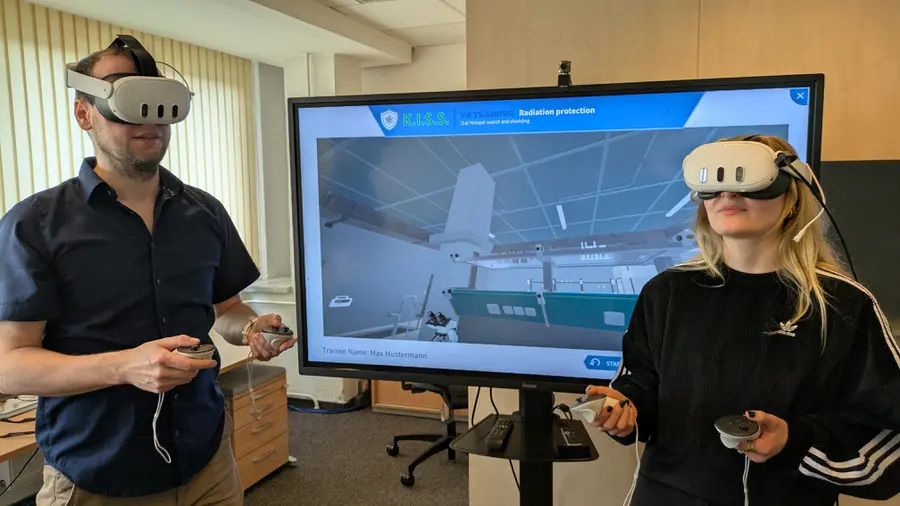
Jonathan Dyrna (CODIP, TU Dresden) is testing the virtual reality training program developed for the nuclear industry together with a student
How can virtual reality (VR) help prepare skilled workers for safety-critical tasks involved in the decommissioning of nuclear power plants? And how should virtual training environments be designed so that they not only impress with their user-friendliness but also offer educational value? Jonathan Dyrna from CODIP at TU Dresden discussed these questions with his project manager, Dr. John Kettler of actimondo eG, on the international podcast The Versatilist by the Immersive Learning Research Network (iLRN).
As guests on the podcast, they spoke with host Dr. Patrick O’Shea about the participatory development and educational use of a VR training program that was developed as part of the research project „Kompetenz. Innovation. Sicherheit. Strahlenschutz (K.I.S.S.)“ in collaboration with the company NUSEC XR. The interview was prompted by a research article published in Kerntechnik, which describes the development and evaluation of immersive VR training environments for radiation protection and nuclear security.
Participatory Development as a Key to Success for Practical VR Training
During the highly engaging discussion, the critical importance of involving future users early on in the process—to ensure that VR learning scenarios are tailored to their needs—became particularly clear. In the research project presented, both experienced professionals and novices were included in the development process. Their diverse perspectives provided important insights for the design of the virtual training environments and their integration into the learning process. This participatory approach is intended to ensure that the developed applications are not only factually accurate and technically functional, but also meet the actual needs of learners and professional practice.
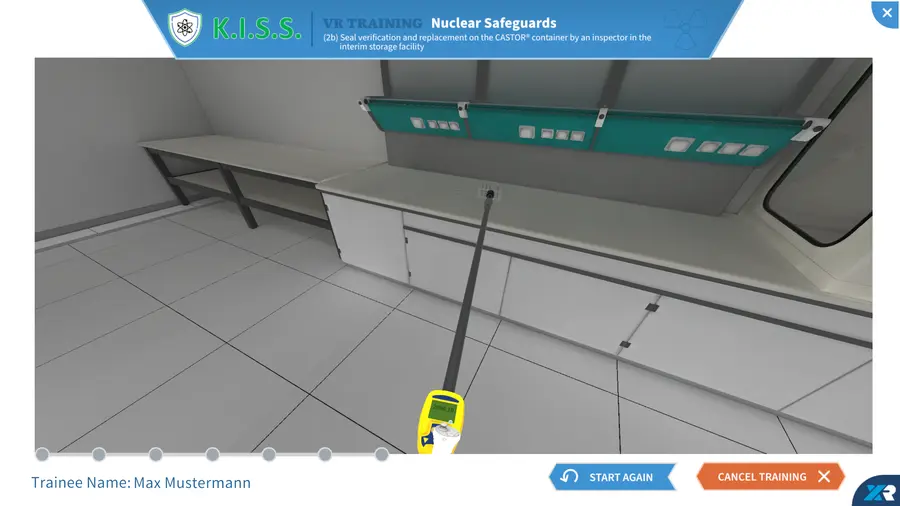
Insights into the VR training environment that was developed: Measuring the local dose rate with a dose rate probe in a laboratory setting
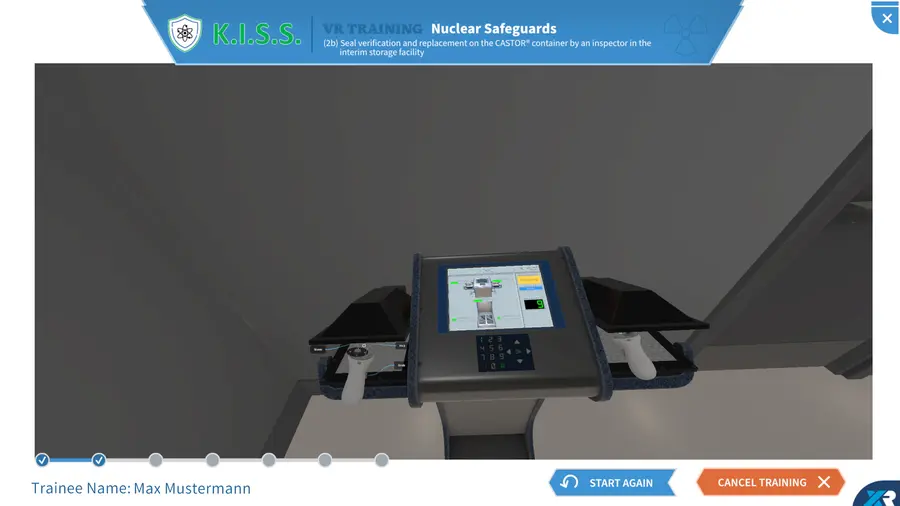
and contamination control using a hand-foot monitor in a holding area
From Technological Innovation to Educational Value
In addition, the participants discussed how VR training can be integrated into existing educational programs as easily and cost-effectively as possible. The user-friendly implementation developed in the project—based on commercially available hardware—helps reduce technical and organizational barriers to entry and makes immersive training programs accessible for a variety of educational contexts.
Special attention was also given to the pedagogical versatility of the training environment developed. It facilitates both individual work and collaborative learning in groups. In this setup, one person actively explores the virtual training environment and carries out the prescribed steps, while fellow learners follow the action on a screen, discuss possible approaches, and support the person performing the tasks as they complete the training exercises.
The insights gained from the studies conducted in the field of nuclear technology can also be applied to other areas of vocational and formal education. They illustrate how the combination of didactic research, participatory development, and user-friendly technology design can contribute to the development of practical digital learning offerings.
Listen and watch:
The Versatilist – Podcast-Folge auf podomatic | Amazon Music | Apple Podcasts | Spotify
Video of the VR training simulation developed
Further publications:
Kettler, J., Dyrna, J., Koslowski, D., Laumen, L., Malirsch, T. & Köhler, T. (2026). Participatory development and mixed-methods evaluation of immersive VR training for radiation protection and nuclear safeguards – KISS. Kerntechnik, 91(3), 292–308. https://doi.org/10.1515/kern-2025-0103
Kettler, J., Hoeborn, G., Güner, B., Kantharajah, A., v. Stamm, J., Stark, M., ... & Malirsch, T. (2025). Digitale und KI-gestützte Lösungen für einen sicheren und effizienten Rückbau kerntechnischer Anlagen: Das Forschungs-und Entwicklungsvorhaben „KISS “. atw – International Journal for Nuclear Power, 70(1), 41–48.