
Degree programme Classical Studies (Master)

News
The Study and Examination Regulations for the Master’s program in Ancient Cultures have been revised. The changes will take effect in the Winter-Spring semester 27/28. On October 6, 26, at 1:00 p.m. in office BZW A523, Zellescher Weg 17, the academic advisors will welcome the new cohort of students and introduce them to the new Master’s program structure.
General Information About the Degree Program
When and where was democracy actually invented? Why did the European world become Christian in a relatively short period of time, and to what extent did this contribute to a “unique European path”? Why did the dawn of ancient literature, beginning with Homer, immediately become one of the high points of world literature? Why was the circumference of the Earth calculated quite precisely as early as the 3rd century BCE, yet people later came to believe again that the Earth was flat? Why did ancient art serve as a model for so long? Why was the Roman Empire so enduring, and why did its subjects identify with it rather than rejecting it as foreign rule? The interdisciplinary master’s program “Classical Studies” addresses these and many other fascinating questions.
Graduates of the master’s program are, of course, distinguished by their in-depth and broad knowledge of Classical Studies; but above all, they have acquired the methodological and analytical tools to make sense of scattered and fragmentary information—which is generally characteristic of antiquity—to draw logically sound conclusions from it, and to develop plausible reconstructions and concepts. To this end, the program addresses philological, historical, and historical-religious issues throughout the course of study.
Course Content
The Master’s program in Classical Studies provides in-depth historical, philological, exegetical, and historical-religious knowledge for understanding the ancient cultures of the Mediterranean region. This research-oriented degree program is interdisciplinary in nature and is jointly administered by the participating departments of Ancient History, Biblical Theology, and Classical Philology.
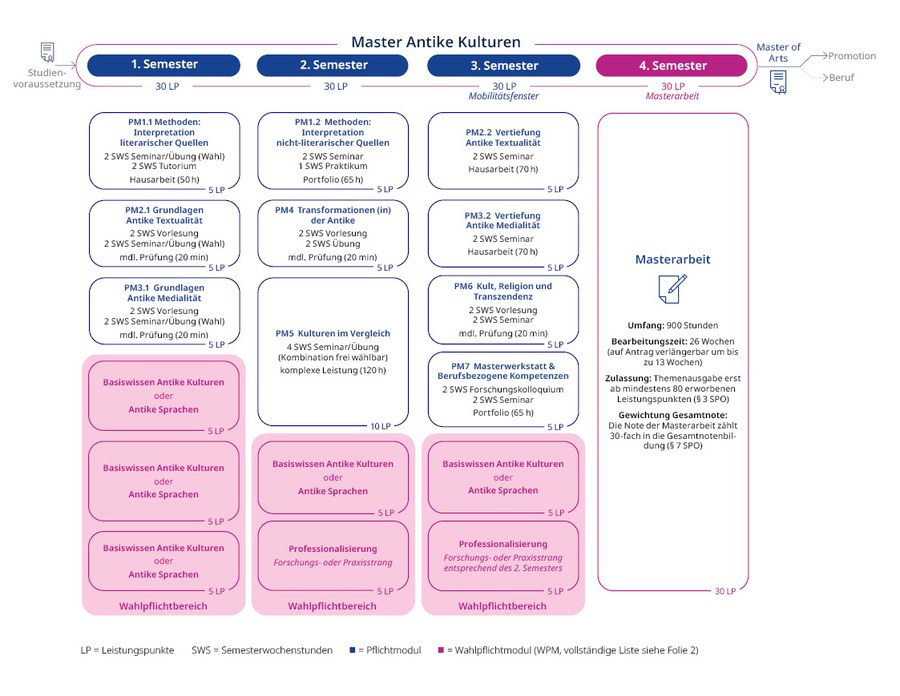
The program comprises 10 required modules that all students must complete: the modules “Methods for Interpreting Literary Sources and Source Types ” and “Methods for Interpreting Non-Literary Sources and Source Types” provide a methodological overview of the various literary and material sources of antiquity. The modules “Fundamentals and Advanced Study of Ancient Textuality ” and “Fundamentals and Advanced Study of Ancient Mediality,” which build upon one another, teach the analysis of ancient texts and material sources, respectively. The modules “Transformations (in) Antiquity,” “Comparative Cultures,” and “Cult, Religion, and Transcendence” address the central historical, cross-cultural, and historical-religious questions of the ancient Mediterranean world through interdisciplinary collaboration. The required component concludes with the module “Master’s Workshop and Career-Related Competencies,” which prepares students for their master’s thesis as well as for career-relevant interdisciplinary competencies.
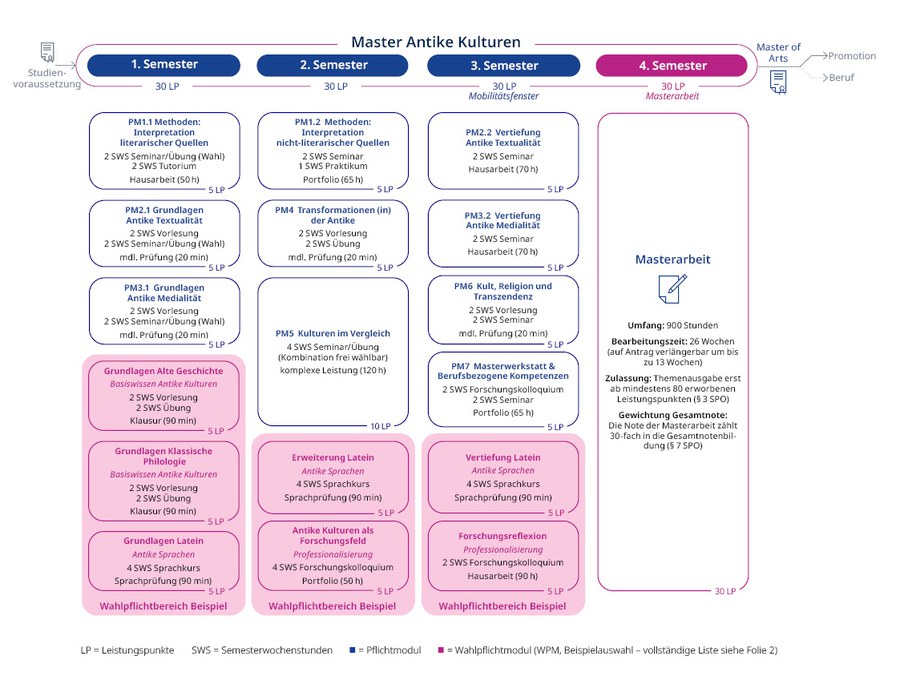
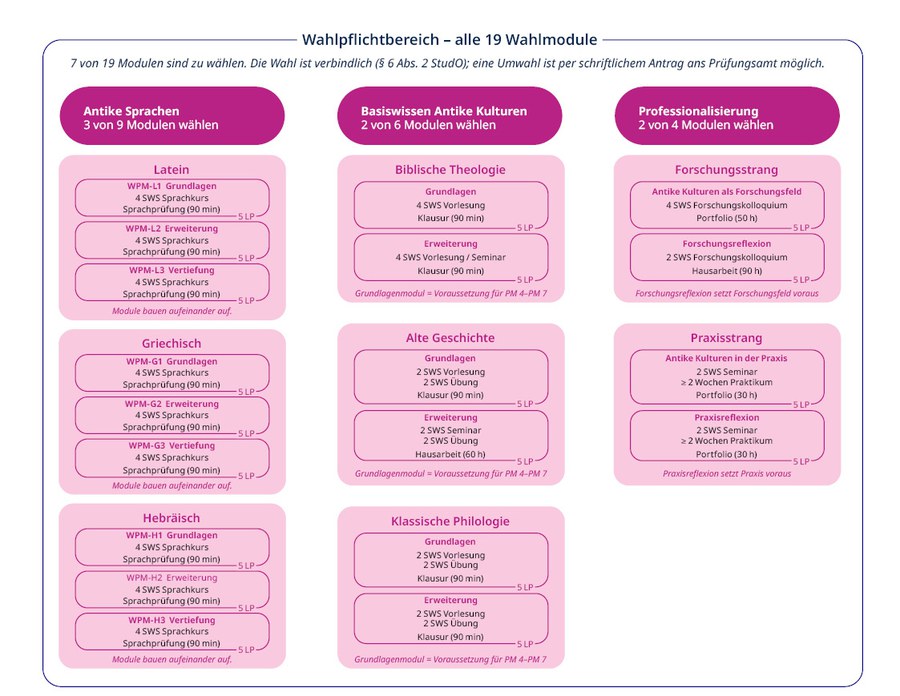
Since students enter the degree program with varying levels of prior knowledge from their bachelor’s studies, they additionally select 7 required-elective modules from three module groups: 3 modules from the “Ancient Languages” module group (Latin, Greek, or Hebrew, each at the Basic, Advanced, and Specialized levels), 2 modules from the “Basic Knowledge of Classical Studies ” module group (Biblical Theology, Ancient History, or Classical Philology, each at the Basic and Advanced levels), and 2 modules from the “Professional Development” module group. In the latter group, students choose between a research-oriented track (Classical Studies as a Field of Research and Research Reflection) and a practice-oriented track (Classical Studies in Practice and Practice Reflection).
Structure
A total of 120 credit points (LP) can be earned in the Master’s program in Classical Studies. Of these, 55 LP are accounted for by the 10 required modules, 35 LP by the 7 elective modules, and 30 LP by the Master’s thesis.
Structure of the degree programme
Sample study plan
Compulsory elective modules on the degree programme
Career Opportunities
The methodological and hermeneutic skills, as well as the interdisciplinary expertise, qualify students for careers in cultural management, in culturally oriented organizations and companies, and in institutions focused on cultural policy (such as museums, publishing houses, and providers of cultural travel), in journalism, and in university and non-university research in the field of classical studies.
Prerequisites
- A first professional degree recognized in Germany or a degree from a state-run or state-recognized vocational academy in history, Catholic theology, Protestant theology, Latin studies, or Greek studies—or in Latin or Greek—or in a degree program with a comparable academic focus
- English proficiency at the B2 level of the Common European Framework of Reference for Languages (CEFR), as evidenced, for example, by a high school diploma indicating the required language proficiency level or a language certificate (such as IELTS with an overall band score of at least 5.5 or TOEFL iBT with a score of at least 4)
- Proficiency in one of the following languages: Latin, Greek, or Hebrew at the A2 level of the CEFR, to be demonstrated, among other things, by a high school diploma (at least 2 years of study in the respective language with a grade of at least “sufficient” or 5 points) or an equivalent language certificate, such as the TUDIAS TU Dresden Institute of Advanced Studies GmbH
- Familiarity with the methods of classical studies (These skills are taught at TU Dresden in the bachelor’s degree programs in History, Catholic and Protestant Theology, Latin Studies, and Greek Studies.)
Start Date and Duration of the Program
The Classical Studies program can be started at TU Dresden at the beginning of each winter semester. It comprises 4 semesters (standard duration of study) and has a modular structure. The third semester is designed as a mobility window and is therefore particularly suitable for a temporary stay at another university; the fourth semester is reserved for writing the master’s thesis. In addition to full-time study, part-time study is also possible in accordance with the regulations governing part-time study.
ERASMUS Partnerships
Students in the Master’s program in Classical Studies can use the mobility window in the third semester for an ERASMUS stay at a partner university of the participating Chairs. Further information on partner universities, application deadlines, and contact persons can be found on the websites of the respective Institutes:
- ERASMUS at the Institute of Catholic Theology
- ERASMUS at the Institute of History
- ERASMUS at the Institute of Classical Philology
Credits
ECTS credits document the average course load as well as individual academic progress. One credit corresponds to a course load of 30 hours, with an average of 30 credits awarded per semester. A total of 120 credits must be earned in the modules of the Classical Studies degree program and through the master’s thesis, 30 of which are for the master’s thesis.
Study and Examination Regulations
Link to the Study and Examination Regulations
Academic Advising
The academic advisor is also the point of contact for questions regarding internships within the degree program.
Academic advisor
 © Jean Coert
Wissenschaftlicher Mitarbeiter
NameDr. Jean Coert
Send encrypted email via the SecureMail portal (for TUD external users only).
Professur für Alte Geschichte
Professur für Alte Geschichte
Visiting address:
Bürohaus Zellescher Weg (BZW) 17, A 523 Zellescher Weg 17
01062 Dresden
Office hours:
Im WiSe 26/27 werden in der Vorlesungszeit immer am Mo 12:00-13:00 Uhr Sprechstunden (ohne Voranmeldung) angeboten.
Deputy Academic Advisor
 © Sven Ellger
Wissenschaftlicher Mitarbeiter
NameMr Salvador Diebold
Send encrypted email via the SecureMail portal (for TUD external users only).