
30.06.2026
EW goes KI#2 - offene Diskussionsrunde über die Leitlinien zum Umgang mit generativer KI in der Lehre
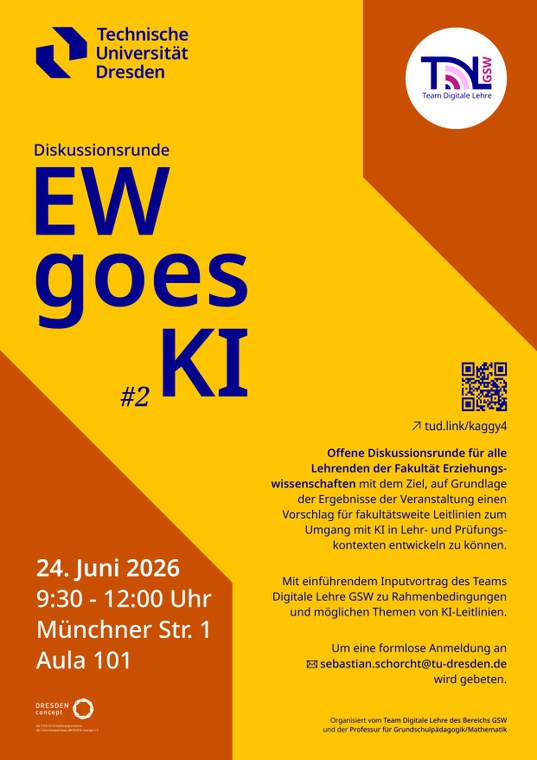
Wie sieht die Zukunft der Hochschullehre im Zeitalter von ChatGPT und Co. aus?
Am 24. Juni 2026 kam ein engagiertes Plenum aus Lehrenden und Angehörigen der Fakultät Erziehungswissenschaften der TU Dresden im Rahmen der Veranstaltungsreihe "EW goes KI" im Workshop "Leitlinien zum Umgang mit generativer KI in der Lehre" zusammen. Ziel des produktiven Austausches war es, auf Grundlage der Ergebnisse einen konkreten Vorschlag für fakultätsweite Leitlinien zum Umgang mit KI in Lehr- und Prüfungskontexten zu entwickeln.
Organisiert von der Professur für Grundschulpädagogik/Mathematik gemeinsam mit dem Team Digitale Lehre des Bereichs GSW, stand der Tag ganz im Zeichen von Orientierung, Didaktik und Prüfungsintegrität. Nach einem einführenden Inputvortrag zu den Rahmenbedingungen und möglichen Inhalten von KI-Leitlinien am Bereich GSW befassten sich die Teilnehmenden in Diskussion und anschließender Erarbeitungsphase zu Bestandteilen der Leitlinien intensiv mit den vielschichtigen Herausforderungen generativer KI in der Hochschullehre.
Diskutiert wurden unter anderem:
-
Transparenz: Dozierende sollen frühzeitig Vereinbarungen zur KI-Nutzung mit Studierenden treffen, während Studierende verpflichtet werden, den Einsatz generativer KI in Prüfungsleistungen transparent zu machen.
-
Selbstständigkeitserklärungen: Es wurde betont, dass zeitgemäße Selbstständigkeitserklärungen sinnvoll und notwendig sind, um den bewussten Umgang mit KI zu fördern.
-
Prüfungsformate: Der Ruf nach neuen, prozessorientierten Prüfungsformaten wurde laut. Produktorientierte Prüfungen müssten überdacht werden, um den Einsatz von KI sinnvoll zu integrieren.
-
KI-Literacy: Die Förderung von Kompetenzen im Umgang mit KI sowie die strukturierte Reflexion der eigenen KI-Nutzung wurden als zentrale Elemente identifiziert.
-
Datenschutz und rechtliche Aspekte: Inhalte, die Studierende und Lehrende in KI-Systeme eingeben, müssen klar geregelt werden. Datenschutz und akademische Integrität stehen dabei im Fokus.
Neben der Förderung von KI-Literacy und dem Wunsch nach Weiterentwicklung traditioneller Prüfungsformate stand die Identifikation von Best Practices sowie die rechtliche Relevanz von Leitlinien im Fokus. Abschließend wurde betont, wie wichtig eine Kultur des Vertrauens, gegenseitige Transparenz und eine ressourcenorientierte Perspektive auf das Thema KI sind.