
Insights and information
Interview with a School Assistant in Training
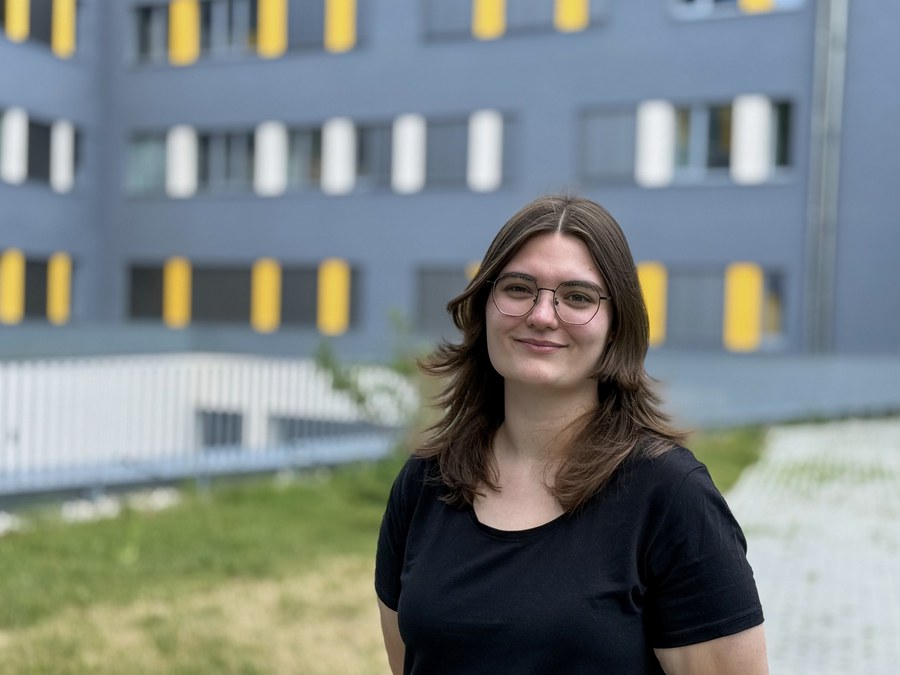
Laura is a master painter and varnisher and is currently in her fourth semester of the SchulAQ program, with a focus on the color technology department, interior design department, and surface technology department, as well as social studies, legal education, and economics. In the following interview, she answers a few questions about her daily life as a student.
The desire to become a teacher actually didn’t occur to me until I was in vocational school myself. Before that, I had never really thought about becoming a teacher. But it was only there that I realized school could be completely different from what I had experienced before. Suddenly, we were learning material that was directly relevant to our future careers and that we would actually need. That changed my perspective on school. At the same time, I’ve always been passionate about my trade. Eventually, I developed a desire to pass on my knowledge and experience to young apprentices and to guide them on their own career paths. I find it rewarding to help people develop the skills they’ll truly need later in their careers. Precisely because I myself went through an apprenticeship and master craftsman training, I can easily relate to the perspective of many apprentices. That helps me understand their challenges and meet them on equal footing.
The start of my college studies was a particularly challenging time for me. Although I was used to learning a lot of new things from my vocational training and master craftsman program, I still had a great deal of respect for college. Suddenly, I was confronted with many new topics, ways of working, and an enormous amount of knowledge. At first, it was overwhelming and definitely made me feel insecure. Over time, however, I realized that I was growing through these challenges. It’s precisely during stressful times that you see just how much you’re capable of. I’ve learned to trust myself more and to remember everything I’ve already accomplished in my life. I always told myself: If I’ve managed to do all that so far, then I’ll be able to master the next challenges as well.
For me, the best moments of my studies are when I realize how the course material relates to my future career as a teacher. It really motivates me when I understand why certain things are done a certain way in the classroom and what scientific reasoning lies behind them. This gives school a whole new meaning for me. I find it particularly exciting to connect the knowledge and practical experience I’ve already gained with new course material. You gain a deeper and deeper understanding of how lessons are planned and what teachers consider when doing so. Realizing that there’s a whole field of science behind schooling—and at the same time so many practical applications—never ceases to inspire me. And of course, the best moments are the ones I share with my friends in college. Especially during stressful exam periods, it’s motivating to realize that you’re not alone. We support each other, share ideas, and overcome challenges together.
I find the combination of my studies and my work as a teaching assistant particularly exciting because theory and practice constantly complement each other. Some of the material covered in lectures or seminars can be immediately recognized or even applied in the classroom. At the same time, you gain a better understanding of many theoretical concepts from your studies when you experience how schools actually function and what processes take place behind the scenes. Conversations with colleagues also give you a different perspective on things and make much of what you learn at the university more tangible. Conversely, you can also bring many experiences from everyday school life into your classes and connect them to the course material. I find this connection incredibly valuable. Furthermore, working as a teaching assistant is, for me, good preparation for life after college. You aren’t suddenly thrown in at the deep end; instead, you’re already familiar with many of the routines, structures, and challenges of everyday school life. As a result, things won’t feel completely new later on.
Juggling school and work is definitely challenging. You have to balance your studies, your job, and all the different tasks you have to handle. That requires good organization, perseverance, and sometimes the ability to set priorities. Especially during stressful periods, you shouldn’t underestimate the strain. At the same time, though, I see this as a great opportunity. You gain valuable experience, take in many new perspectives, and grow through the challenges you face. Of course, the pay also offers a certain degree of financial security while you’re in school. For me, though, the practical experience has become the main focus. The insights into everyday school life and the opportunity to be an active part of the school system while I’m still a student are particularly valuable to me.
I would definitely advise them to take advantage of this opportunity. This program allows you to gain practical experience early on and get to know the school environment from a perspective that you often don’t experience to this extent in a regular degree program. You quickly realize that things don’t always have to go perfectly and that challenges are what help you grow. The combination of theory and practice can be incredibly valuable and help you pursue your career path with greater confidence and self-assurance. Above all, you gain a very in-depth insight into everyday school life. The experiences you gain as a school assistant go far beyond what individual internships can offer. At the end of this program, you’ll not only take away subject-specific knowledge but also a wealth of school-related experience that will benefit you as you move forward in your career.
Interview with the Project Manager
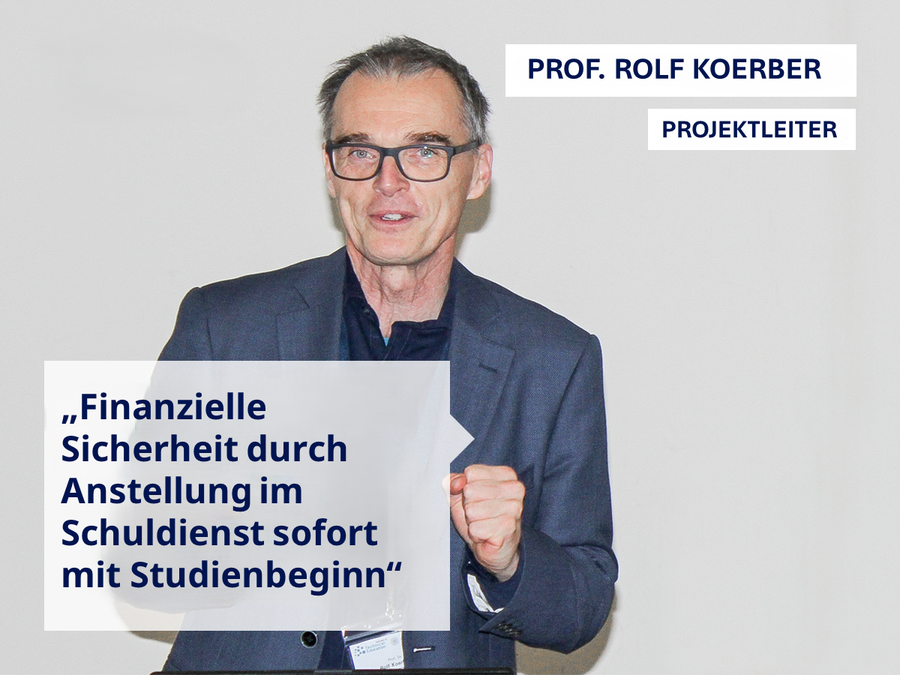
Prof. Dr. Rolf Koerber is the director of the SchulAQ program. In the following interview, he answers some questions about the program.
SchulAQ is a study option for technicians, master craftsmen and bachelors (BA, FH) in which the students are employed as school assistants in qualification at Saxon vocational school centers.
Professionally qualified people, particularly those with advanced training qualifications (technicians, master craftsmen), are ideally suited to work as teachers at vocational schools thanks to their professional experience. The dual study option SchulAQ offers these target groups the opportunity to complete an undergraduate degree while simultaneously working at a Saxon vocational school center. Schools can thus actively participate in their own promotion of young talent.
This is a study option for technicians, master craftsmen and people with a Bachelor of Engineering (HAW / BA) and professional experience who need to apply for a position as a school assistant at a Saxon vocational school center. The professional qualification also constitutes the university entrance qualification (HZB), a high school diploma is not required.
The students are employed as school assistants in qualification at Saxon vocational school centers with a corresponding salary. During the lecture period, they are given 3 days / week off for their studies at the university and work at the school for 2 days / week and during the lecture-free period.
- Financial security through employment in the teaching profession as soon as you start your studies
- In-depth support from TU Dresden, especially during the introductory phase of your studies
- Close proximity to school practice
- Studies possible without Abitur