
Narrative transformation
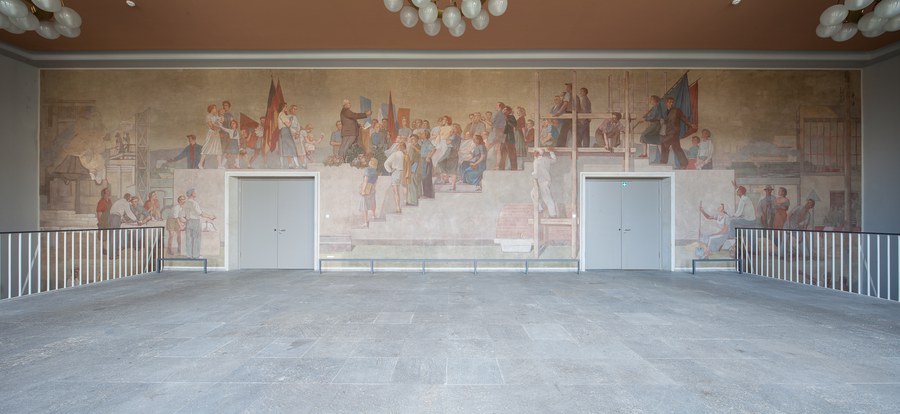
Alfred Hesse, Erich Gerlach: Education for Civic Awareness. Dresden 1954. Mural in the Gerhart Potthoff Building
What did the upheavals of the 1990s mean for East German universities? How were they experienced individually, shaped institutionally and reflected upon academically?
The East German higher education landscape has undergone profound changes since the 1990s, which were associated with new opportunities, but also with ruptures in individual biographies as well as social and institutional structures. The event series "Erzähl(t)e Transformation" focuses on these experiences and examines how they continue to shape everyday university life, personnel structures and the relationship between East and West to this day. The focus is on how transformations are inscribed in biographies, how they shape them and how they can be examined from various disciplines such as history, sociology, ethnology and cultural anthropology. Both methodological workshops and storytelling cafés will be held to explore this. The aim of the series is to sharpen the focus on the complex dynamics of institutional and individual transformation processes and to make their significance for the present of TU Dresden visible.
The series of events is aimed at (former) employees, students and interested parties who would like to engage with the diverse changes in the university system.
Insights into the topic are provided by an interview with Aron Schulze, a Research Associate at the Chair of Modern and Contemporary History, as well as blog posts on two of the workshops: “How Can Transformation Be Narrated?” and “How Can Narrated Knowledge Be Preserved?”
Narrating transformation! Storytelling Cafés on the Years Since 1989 at TU Dresden
In contrast to the workshops, the storytelling cafés explicitly tie in with personal experiences of social and institutional change and open up a space for exchange and understanding. Four dates are planned for fall 2026. People who experienced the 1990s at TU Dresden are explicitly invited to attend - whether as a student or as an employee of the university.
“Fall 1989 at TU Dresden—A New Beginning and Uncertainty”
Friday, September 11, 2026, 2:00–6:00 p.m.
Coffee, cake, and other beverages will be available free of charge throughout the afternoon.
Schedule?
- Welcome and introduction, including a presentation of the project team by Gwendolin Kremer (Office for Academic Heritage, Scientific and Art Collections)
- Short presentations on the history of TU Dresden and on portraits from the Office for Academic Heritage, Scientific and Art Collections
- Small-group discussions— with a particular focus on exchanges among the contemporary witnesses in attendance; researchers from the project team will provide discreet support during the roundtable discussions.
- Closing session with the entire group
"Institutional Transformation and Individual Career Paths"
Further information to follow
"To Study and Campus Life in a Time of Change"
More information to follow
"TU Dresden After Reunification – Long-Term Consequences of the Transformation"
More information to follow
Registration for storytelling cafés
If you would like to take part in one or more dates, please contact Constanze Wirsing by e-mail or by calling +49-351-463-36270. Feel free to share directly what connection you had to TU Dresden during the years of transformation and, if applicable, still have today.
If you have any questions in advance, please feel free to contact Constanze Wirsing. We have also set up online consultation hours to give interested individuals an idea of the event. Use Zoom to discuss any uncertainties with the organizing team and ensure your expectations are met. The following dates are available:
- July 13, 2026 (Monday), 6:00–7:00 p.m., via the following link: https://tu-dresden.zoom-x.de/j/69485466095?pwd=W66bya9mMG1d18iSjE7kcbxlaH73RR.1
- August 13, 2026 (Thursday), 6:00–7:00 p.m., via the following link: https://tu-dresden.zoom-x.de/j/69500858208?pwd=ke3Wea0F6FzKhnwqJPXc0TVctSCCbG.1
You may also find the answer you're looking for here:
All four sessions follow a similar format:
- Welcome
- Discussion between the moderator and individual eyewitnesses in the form of a short panel discussion or input on a subtopic of higher education transformation in Dresden
- Discussions among the eyewitnesses in small groups
- Closing
During the event, light refreshments (including coffee, tea, cake, and fruit) will be available.
We are looking for eyewitnesses for the storytelling cafés who experienced the transformation of Dresden’s higher education landscape in the 1990s and are willing to share their personal experiences with others. Since the goal is to capture as many perspectives as possible and reach people from various social and demographic groups:
- academic staff such as professors or Research Associates
- administrative staff
- students
- policy makers
- former members of the institutions that were integrated into TUD during those years (the “Carl Gustav Carus” Medical Academy, the University of Transport, and the “Karl Friedrich Wilhelm Wander” University of Education)
- People who came to Dresden from the western German states
We’re interested in your story!
Anonymous participation is generally possible.
To help us with planning, it would be helpful if you could provide your name and your connection to the Dresden higher education community when you register (e.g., Susanne Symbolfigur, professor at the University of Education from 1986 to 1992). It is up to you to decide to what extent you share this information with others at the storytelling cafés.
As part of the research project "Erzähl(t)e Transformation", we aim to collect additional research data, such as individual conversation notes taken during the cafés that do not identify specific individuals, or biographical interviews to be conducted following the cafés. Participation in the storytelling cafés does not obligate you to give an interview. Interviews will be arranged separately and discussed with the interviewee in accordance with data protection laws.
The events are not open to the public in order to provide a safe space for participants to interact with one another. For this reason, the event locations are not listed on the website. Participation is possible upon registration.
In addition to the eyewitnesses, the organizing team, researchers, and moderators will be present.
Since the events are not open to the public, there is no audience. Discussions will primarily take place in small groups at coffee tables, with participants sitting at eye level whenever possible. A member of the organizing team will facilitate these group discussions.
Panel discussions featuring the participating eyewitnesses are planned only as introductory remarks at the beginning of the events. Individual eyewitnesses will be asked in advance if they would like to participate in the panel; there is no obligation to do so. If you can imagine sharing your story in a larger group to potentially provide a starting point for the smaller table groups, please feel free to let us know when you register.
In addition to the eyewitnesses, the organizing team, researchers, and moderators will be present.
No, attendance is not mandatory—regardless of whether you have registered for one or more sessions. However, it would help us with our planning if you let us know if you can no longer attend due to unforeseen circumstances.
Even if you’re unsure whether you’ll actually be able to attend the sessions but are interested in participating, you can still register. Since these are private events, the venues will only be disclosed after you’ve registered.
The "Erzähl(t)e Transformation" project arose from the desire of several scholars in the humanities and social sciences to explore the topics of biographical university research and the years of transformation. Even more than 35 years after German reunification, the events leading up to it and the subsequent upheavals have not been sufficiently researched, particularly with regard to the professional experiences of current associate members of TU Dresden. The project offers an opportunity to examine various scholarly approaches in order to identify methodological parallels and foster interdisciplinary exchange.
Specifically, the project involves Anne-Kathrin Hoklas (Chair of Sociological Theories and Cultural Sociology, TUD), Aron Schulze (Chair of Modern and Contemporary History, TUD), Claudia Pawlowitsch (ISGV), Constanze Wirsing (Emerging Field “Societal Change,” TUD), Gwendolin Kremer (Office for Academic Heritage, Scientific and Art Collections, TUD), Judith Matzke (TUD University Archives), Lucas von Ramin (Emerging Field “Societal Change,” TUD), and Maren Hachmeister (HAIT). Aron Schulze, Maren Hachmeister, and Claudia Pawlowitsch, together with Judith Matzke, each organized a theoretical workshop for the project in the run-up to the storytelling cafés. The concept for the storytelling cafés builds on this methodological exchange and is developed collaboratively. As a cooperation partner, the Office for Academic Heritage, Scientific and Art Collections contributes its long-standing scholarly engagement with the history of TU Dresden to the project and will take the lead in organizing some of the sessions. Students are also involved in documenting and evaluating the storytelling cafés.
Narrated Transformation – Workshop Series on Biographical University Research
In three thematically consecutive workshops, experiences of upheaval at East German universities will be examined from different perspectives. They will address the history of university transformation as well as methods of biographical research and different archiving options. Expert impulses from research and practice encourage joint reflection and open up new perspectives on the development of modern universities.
You can find more information in our flyer.
Workshop Registration
If you would like to take part in one or more workshops, please register online using the registration form. If you have any questions, you are welcome to contact us directly by e-mail. Please note: The workshops have concluded, and the registration form has been removed.
Workshop I: Historiography and University Restructuring after 1989/90. Perspectives from University History on the Transformation of East Germany
Workshop under the direction of the Chair of Modern and Contemporary History, TU Dresden:
The restructuring of science after 1989/90 is still a prominent part of the memory of the post-reunification period. Until now, the field has been dominated by reports on the experiences of decision-makers and theoretical approaches from the social sciences. With the opening of the archives after 30 years, the topic has gradually migrated into contemporary history research since the 2020s. The workshop is therefore dedicated to the question of how a university history of the "Hochschulumbau Ost" can be methodically and substantively structured. We want to highlight previous cycles of research, discuss initial archive findings and outline perspectives on how a historically informed approach to the topic can contribute to an objectification of the debate. Based on this, possible thematic approaches for the conception and structuring of narrative cafés at TU Dresden will be developed together.
The workshop is aimed at students, lecturers, university staff and people with an interest in the contemporary history of universities in general and TU Dresden in particular.
| 9:00 | Introduction: University history as a 'marginal note' in contemporary historical research? Conjunctures, methodological approaches and sources | Aron Schulze (TU Dresden) |
| 10:00 | Coffee break | |
| 10:15 | Input: The four dimensions of East German academic restructuring | Prof. Dr. Peer Pasternack (Institute for Higher Education Research Halle-Wittenberg) |
| 11:00 |
Working phase: Deepening the dimensions using the example of TU Dresden a) personnel b) structure c) content d) culture |
Small groups |
| 11:30 | Final discussion: Perspectives for a structural organization and content-related conception of talks on the transformation period at TU Dresden |
24. April 2026 (Freitag), 9:00 bis 12:00 Uhr
Open Science Lab 1 (entrance via Zellescher Weg 25)
Workshop II: Biographical Interviews in Research and Teaching
Biographical interviews are one of the central methods of qualitative research, but they also present researchers and teachers with particular methodological, ethical and didactic challenges. The workshop "Biographical Interviews in Research and Teaching" invites researchers, teachers and students to exchange ideas on the practical use of narrative interviews and to learn from each other. The focus is on questions of interviewing, evaluation and sustainable archiving as well as the integration of biographical interview research into teaching formats in the sense of research-based learning. Using concrete practical examples and short keynote speeches, participants will discuss methodological approaches and possible uses of interview research data. A subsequent working phase offers space to develop ideas for cooperation and to explore perspectives for cross-institutional research and teaching in Dresden.
Leader: Maren Hachmeister (HAIT)
1. introduction (30min)
2. practical examples (90min)
3. working phase in small groups (45min): a) interview research in teaching, b) data management and reuse, c) networking and cooperation
4. conclusion and outlook (approx. 15 min)
May 08, 2026 (Friday), 9:00 a.m. to 12:00 p.m.
HAIT, room TIL 110 (Helmholtzstraße 6, 1st floor)
Workshop III: From Research to the Archive. Insights into Archiving Options for Analog and Digital Research Data
Research projects generate a wide range of subject-specific research data. In accordance with the standards of good scientific practice and the FAIR principles, this data can be found in "(research) archives" for a certain period of time after completion of a project and - if possible - made accessible. However, beyond this pure storage of research data (e.g. audio and video files or transcripts of interviews) for the periods specified by universities and funding bodies, there is also a lasting interest on the part of various stakeholders in the permanent preservation of this data.
The workshop "From research to archive" offers an insight into the archiving practices of different institutions and the associated framework conditions (responsibilities, use, costs). An exchange on the possibilities presented is also planned.
| 9:30 | Welcome | |
| 09:35 | Input 1: Life history archive | Claudia Pavlovich (ISGV) |
| 10:05 | Input 2: University Archives of the TU Dresden (cooperation partner of the Digital University Archives Saxony) | Judith Matzke (TU Dresden) |
| 10:35 | 10 minutes break | |
| 10:45 | Input 3: Contact point for research data at TU Dresden | N.N. (TU Dresden together with SLUB) |
| 11:15 | Input 4: Oral-History.Digital | Herdis Kley (Oral-History.Digital) |
| 11:45 | Final discussion |
May 26, 2026 (Friday), 9:30 a.m. to 12:30 p.m.
Open Science Lab 1 (entrance via Zellescher Weg 25)




The Office for Academic Heritage, Scientific and Art Collections at TU Dresden includes not only the teaching and research collections, particularly in the natural sciences and engineering, but also an extraordinary art collection, with numerous works from the GDR era.
After the historic university site in the center of Dresden was almost completely destroyed in February 1945, an immense building boom began. Under an Artistic Advisory Board founded in 1954, the furnishing of the newly built institute buildings with works of art was professionally supported and strategically promoted for the first time. The collection is public in the sense that all construction-related works in and on the buildings as well as the sculptures and sculptures on the university campus are freely accessible. It also includes paintings, works on paper and small sculptures, which are available for loan to the entire university staff.